
As managed IT services mature, many enterprises begin to question a familiar pattern: costs increase, ticket volumes fluctuate, and vendors meet contractual obligations—yet business outcomes remain unchanged. Availability improves on paper, but delivery speed, reliability, and efficiency do not materially move.
This tension has driven growing interest in outcome-based managed IT contracts. Rather than paying for hours, headcount, or activity, organizations seek to pay for results. The promise is compelling, but the execution is complex.
This article examines outcome-based managed IT contracts from a business and operational perspective. It explains when these contracts create real value, the conditions required for them to work, and why many organizations struggle to adopt them successfully.

Table of Contents
Key Takeaways
- Paying for effort obscures value → vendors optimize activity, not outcomes → outcome-based contracts realign incentives around results.
- Shared risk and reward changes vendor behavior → operational decisions shift toward prevention and optimization → maturity and trust become prerequisites.
- Outcomes must be precise and measurable → vague KPIs create disputes and gaming → contract clarity is non-negotiable.
- Outcome-based models demand stronger governance and data → weak visibility increases risk for both parties → readiness matters more than ambition.
- Hybrid models reduce transition risk → partial outcome alignment builds confidence → full adoption becomes a deliberate evolution.
Further Reading
Why Traditional Managed IT Contracts Often Fail to Deliver Business Value
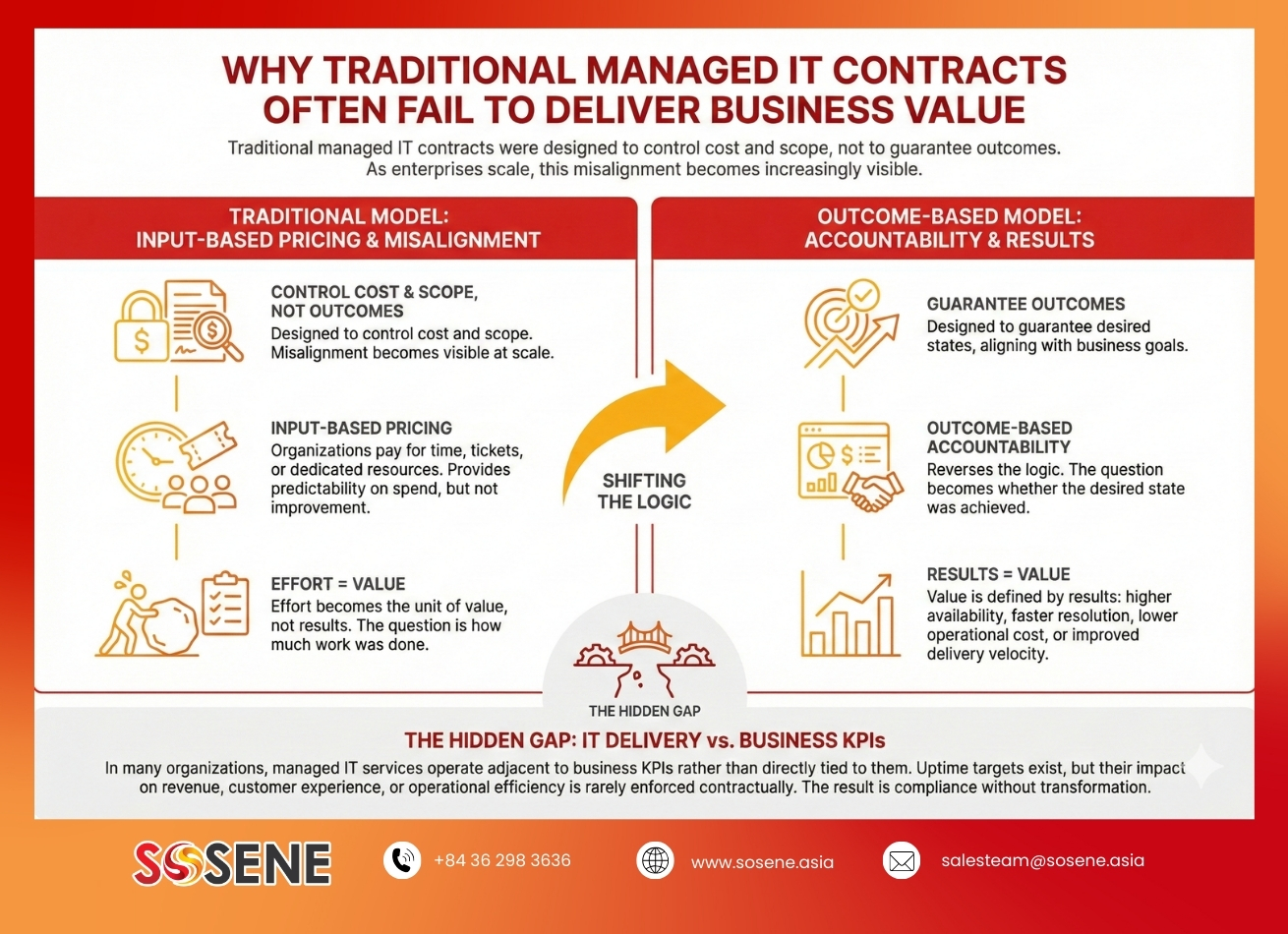
Traditional managed IT contracts were designed to control cost and scope, not to guarantee outcomes. As enterprises scale, this misalignment becomes increasingly visible.
Input-based pricing vs. outcome-based accountability
Most managed IT contracts are input-based. Organizations pay for time, tickets, or dedicated resources. While this provides predictability on spend, it does not ensure improvement. Effort becomes the unit of value, not results.
Outcome-based accountability reverses this logic. Instead of asking how much work was done, the question becomes whether the desired state was achieved—higher availability, faster resolution, lower operational cost, or improved delivery velocity.
The hidden gap between IT delivery and business KPIs
In many organizations, managed IT services operate adjacent to business KPIs rather than directly tied to them. Uptime targets exist, but their impact on revenue, customer experience, or operational efficiency is rarely enforced contractually. The result is compliance without transformation.
What Is an Outcome-Based Managed IT Contract?
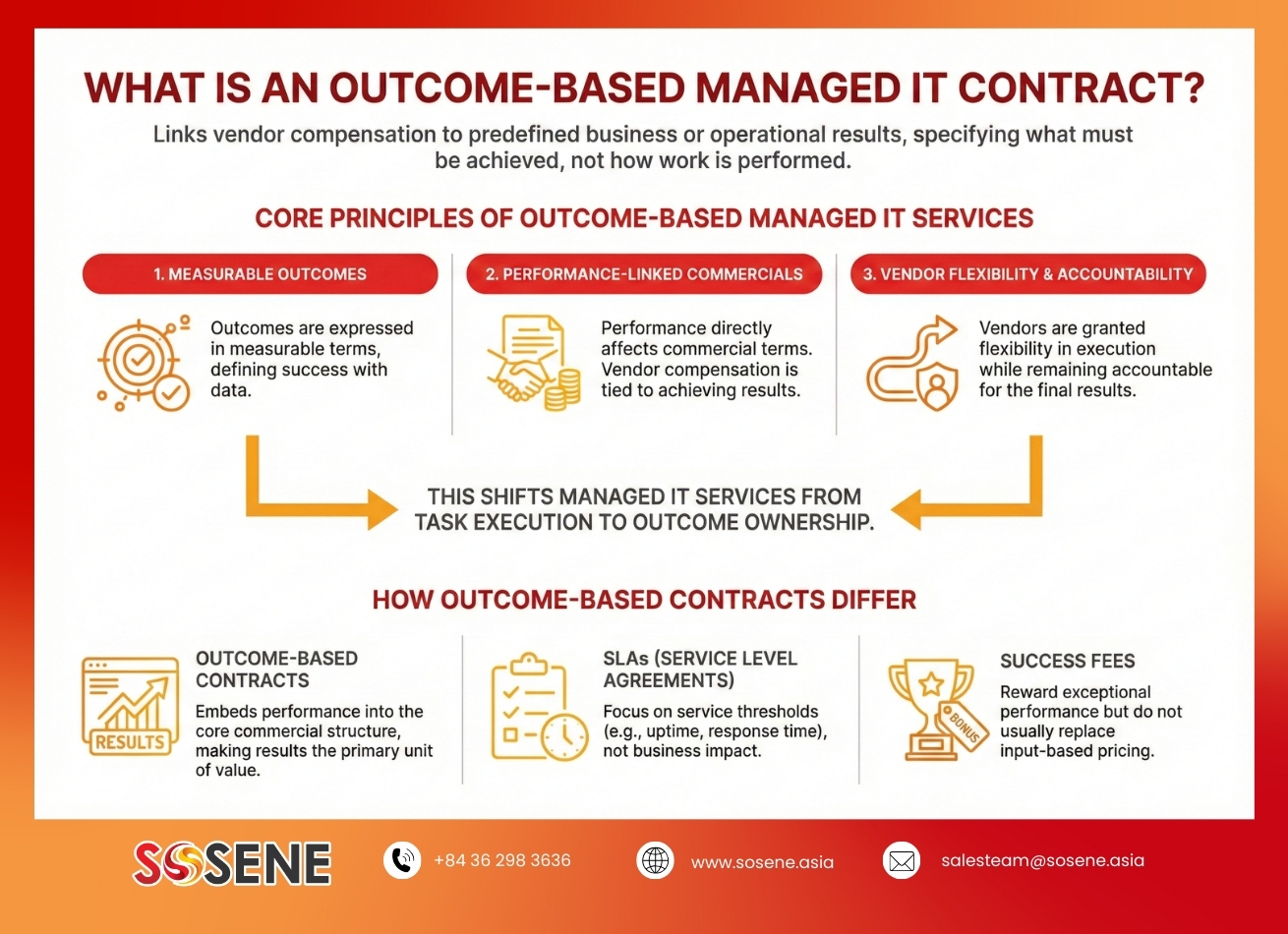
An outcome-based managed IT contract links vendor compensation to predefined business or operational results rather than predefined activities. The contract specifies what must be achieved, not how work must be performed.
Core principles of outcome-based managed IT services
Three principles define this model. First, outcomes are expressed in measurable terms. Second, performance directly affects commercial terms. Third, vendors are granted flexibility in execution while remaining accountable for results.
This shifts managed IT services from task execution to outcome ownership.
How outcome-based contracts differ from SLAs and success fees
SLAs focus on service thresholds, not business impact. Success fees reward exceptional performance but do not usually replace input-based pricing. Outcome-based contracts embed performance into the core commercial structure, making results the primary unit of value.
Key Elements of Outcome-Based Managed IT Contracts That Work
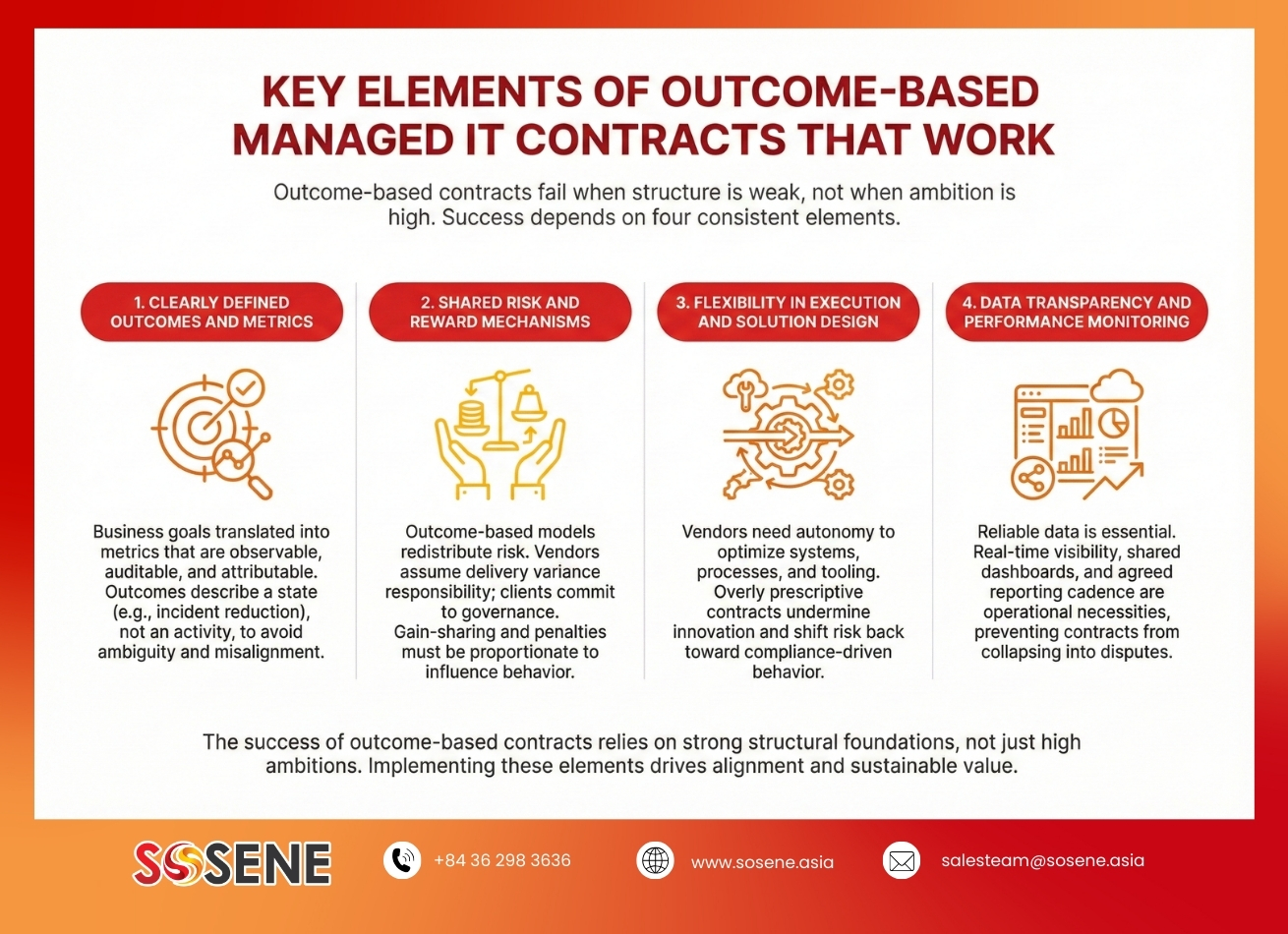
Outcome-based contracts fail when structure is weak, not when ambition is high. Several elements consistently determine success.
Clearly defined outcomes and metrics
Business goals must be translated into metrics that are observable, auditable, and attributable. Ambiguity creates misalignment. Outcomes should describe a state, not an activity—for example, incident reduction over time rather than ticket response speed alone.
Shared risk and reward mechanisms
Outcome-based models redistribute risk. Vendors assume responsibility for delivery variance, while clients commit to governance discipline and data transparency. Gain-sharing and penalties must be proportionate to influence behavior without distorting priorities.
Flexibility in execution and solution design
Vendors need autonomy to optimize systems, processes, and tooling. Overly prescriptive contracts undermine innovation and shift risk back toward compliance-driven behavior.
Data transparency and performance monitoring
Without reliable data, outcome-based contracts collapse into disputes. Real-time visibility, shared dashboards, and agreed reporting cadence are operational necessities, not optional features.
Benefits of Outcome-Based Managed IT Services

When structured correctly, outcome-based managed IT services create advantages beyond cost optimization.
Stronger alignment between IT operations and business goals
By tying compensation to outcomes, IT priorities naturally converge with business objectives. Preventive maintenance, automation, and root-cause resolution become economically rational for vendors.
Improved ROI and cost predictability over time
While initial pricing may appear higher, outcome-based models often reduce long-term volatility. Fewer incidents, stabilized environments, and improved delivery consistency compound into predictable operational cost.
Incentivizing continuous improvement and innovation
Because vendors benefit from efficiency gains, outcome-based contracts encourage automation, AI-driven monitoring, and proactive optimization rather than reactive staffing increases.
Risks and Constraints of Outcome-Based Managed IT Contracts

Despite their appeal, outcome-based contracts introduce new forms of risk that must be managed explicitly.
Complexity in defining and interpreting outcomes
Metrics can drive unintended behavior. Poorly designed KPIs may optimize one dimension at the expense of another, such as availability over user experience. Governance mechanisms must anticipate interpretation risk.
Vendor risk exposure and pricing implications
Vendors absorb delivery uncertainty, which may result in higher baseline pricing or narrower scope. Outcome-based contracts do not eliminate cost; they redistribute risk.
Organizational readiness and data maturity requirements
Organizations lacking reliable data, stable processes, or decision clarity often struggle. Outcome-based managed IT services amplify existing weaknesses rather than compensating for them.
When Outcome-Based Managed IT Contracts Are a Good Fit
Outcome-based models are not universally applicable. Fit depends on context.
Suitable business scenarios and transformation goals
They work best in environments where availability, scalability, or efficiency directly affect business performance—such as uptime-critical platforms, high-growth operations, or cost-sensitive shared services.
Trust, partnership history, and governance readiness
Outcome-based contracts rarely succeed with untested vendors. Trust, shared understanding, and proven collaboration are foundational prerequisites, not byproducts.
Transitioning from Traditional to Outcome-Based Managed IT Services

Most organizations adopt outcome-based models incrementally.
Hybrid contract models as a starting point
Hybrid models blend input-based pricing with outcome-linked components. This reduces risk while building data discipline and governance maturity.
Evolving procurement, finance, and IT collaboration
Outcome-based contracts require cross-functional alignment. Procurement, finance, and IT must agree on how outcomes are defined, measured, and valued. Without this alignment, contracts stall at negotiation.
How Sosene Approaches Outcome-Based Managed IT Engagements

Sosene approaches outcome-based managed IT contracts as an operational evolution rather than a commercial shortcut. Engagements begin by aligning outcomes with business priorities before discussing technology or scope.
From there, Sosene works with organizations to design measurable KPIs, governance structures, and accountability models grounded in operational reality. This reduces ambiguity and limits downstream disputes.
Rather than forcing full adoption, Sosene typically supports hybrid models first—allowing trust, data maturity, and operational discipline to develop before expanding outcome-based components. This phased approach balances flexibility, risk, and long-term value creation.
Teams exploring whether outcome-based managed IT contracts are viable in their context often benefit from an external, neutral assessment. You can start that conversation at https://sosenesoftware.com/.
Conclusion
Outcome-based managed IT contracts represent a strategic shift in how enterprises think about outsourcing value. They move managed IT services from transactional delivery toward shared accountability for results.
However, outcomes do not emerge from contract language alone. They require clarity, data maturity, governance discipline, and trusted partnerships. When these conditions exist, outcome-based models can stabilize operations, improve ROI, and align IT more closely with business priorities.
For organizations evaluating this approach, the critical question is not whether outcome-based managed IT contracts are superior in theory, but whether the organization is ready to support them in practice. With the right structure and phased execution, they can become a powerful lever for sustainable operational performance.
FAQs
What are outcome-based managed IT contracts?
They are managed IT agreements where vendor compensation is linked directly to measurable business or operational outcomes rather than effort or activity.
How do outcome-based contracts differ from traditional managed IT services agreements?
Traditional contracts pay for inputs such as hours or resources, while outcome-based contracts pay for achieved results and performance states.
What metrics are typically used in outcome-based managed IT contracts?
Common metrics include availability, incident reduction, resolution time trends, cost efficiency, and delivery reliability tied to business impact.
What are the main benefits of managed IT services under an outcome-based model?
They improve incentive alignment, encourage proactive optimization, and often deliver better long-term ROI and operational stability.
What risks should companies consider before adopting outcome-based managed IT services?
Key risks include poorly defined outcomes, insufficient data visibility, governance gaps, and vendor pricing adjustments for assumed risk.
When should a company avoid outcome-based managed IT contracts?
They should be avoided when operational data is unreliable, governance is weak, or vendor relationships lack trust.
Can outcome-based contracts be combined with traditional managed IT services models?
Yes. Hybrid models are common and often serve as a practical transition toward deeper outcome-based engagement.