Introduction
Manufacturing in Southeast Asia (SEA) is entering a decisive decade. Rising labor costs, geopolitical uncertainty, supply chain volatility, and accelerating digital transformation are reshaping how factories operate and compete. For project managers, HR leaders, and C-level executives, resilience is no longer a theoretical concept—it is a daily operational requirement.
Yet many manufacturing organizations across Vietnam, Thailand, Indonesia, and Malaysia still rely on fragmented IT systems, overstretched internal teams, and reactive problem-solving. When downtime, cyber incidents, or talent shortages occur, the impact is immediate: production delays, revenue loss, and reputational damage.
This is where managed IT services emerge as a strategic lever—not just to “keep systems running,” but to build long-term manufacturing resilience. By combining operational stability, cost control, and scalable technology, managed IT allows manufacturers to focus on what truly matters: production efficiency, workforce capability, and sustainable growth.
This article explores how managed IT services enable resilience in SEA manufacturing, supported by regional use cases, global insights, and a pragmatic leadership lens.
Table of Contents
Key Takeaways
- Manufacturing resilience today depends as much on IT reliability as on physical operations.
- Managed IT services reduce operational risk while improving cost predictability and scalability.
- SEA manufacturers use managed IT to overcome talent shortages and accelerate digital adoption.
- The benefits of managed IT services extend beyond uptime to workforce, compliance, and growth readiness.
- Strategic partners like Sosene help manufacturers balance innovation with operational continuity.
Further Reading
What are the Managed IT services for manufacturing?
Managed IT services for manufacturing refer to outsourcing the operation, monitoring, security, and optimization of critical IT systems—such as ERP, MES, cloud infrastructure, and cybersecurity—to a specialized partner in order to ensure business continuity, reduce operational risk, and enable scalable growth.
Why Manufacturing Resilience Is Now an IT Leadership Issue
Manufacturing resilience used to mean redundancy in machinery or supplier diversification. Today, it also means digital resilience.
According to Gartner, over 60% of manufacturing disruptions now have a digital component—ranging from ERP outages and cybersecurity incidents to integration failures between production and planning systems.
In SEA, this challenge is amplified by:
- Rapid industrial expansion with uneven IT maturity.
- Difficulty hiring and retaining experienced IT engineers.
- Increasing regulatory and data security requirements from global customers.
As a result, IT has shifted from a support function to a core pillar of operational resilience.
How Managed IT Services Strengthen Manufacturing Operations
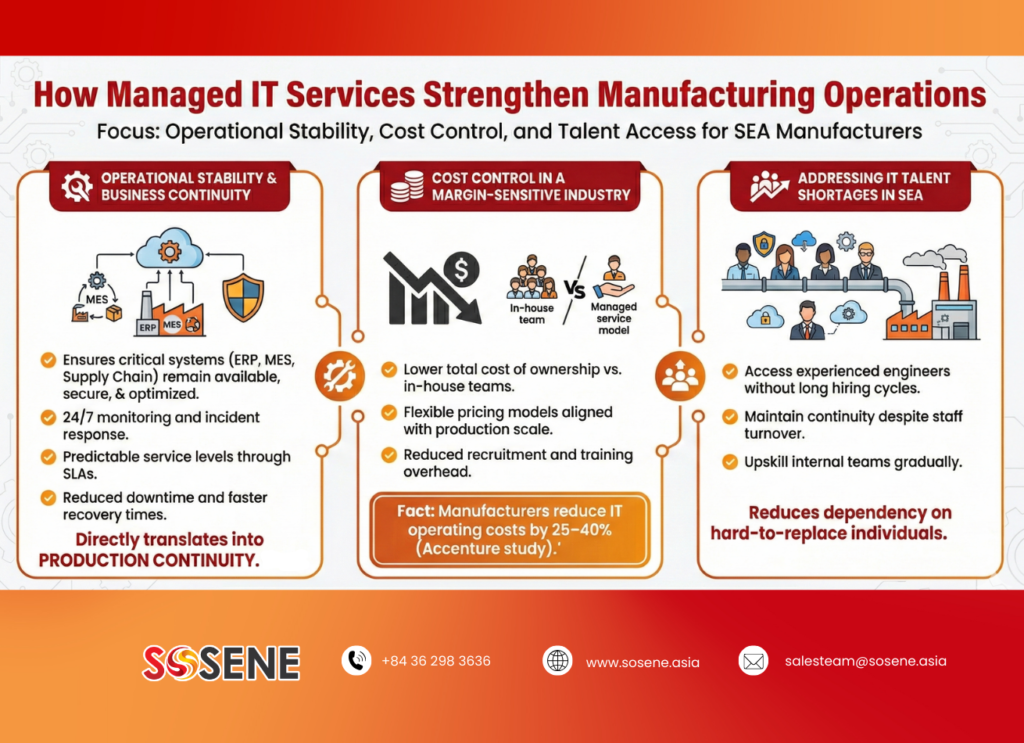
Operational Stability and Business Continuity
At its core, managed IT services ensure that critical systems—ERP, MES, supply chain platforms, HR systems—remain available, secure, and optimized.
The benefits of managed IT services include:
- 24/7 monitoring and incident response.
- Predictable service levels through SLAs.
- Reduced downtime and faster recovery times.
For manufacturers operating multiple plants or shifts, even small improvements in system availability translate directly into production continuity.
Cost Control in a Margin-Sensitive Industry
Manufacturing leaders in SEA operate under constant cost pressure. Hiring and retaining a full in-house IT team capable of handling infrastructure, security, and modernization is increasingly expensive.
Managed IT services benefits include:
- Lower total cost of ownership compared to in-house teams.
- Flexible pricing models aligned with production scale.
- Reduced recruitment and training overhead.
A regional study cited by Accenture highlights that manufacturers using managed services reduce IT operating costs by 25–40% while improving service reliability.
Addressing IT Talent Shortages in SEA
SEA faces a structural shortage of senior IT talent, particularly in cybersecurity, cloud operations, and enterprise system integration.
Managed IT services allow manufacturers to:
- Access experienced engineers without long hiring cycles.
- Maintain continuity despite staff turnover.
- Upskill internal teams gradually rather than all at once.
For HR leaders, this model reduces dependency on hard-to-replace individuals while maintaining operational confidence.
Use Cases from Southeast Asia Manufacturing
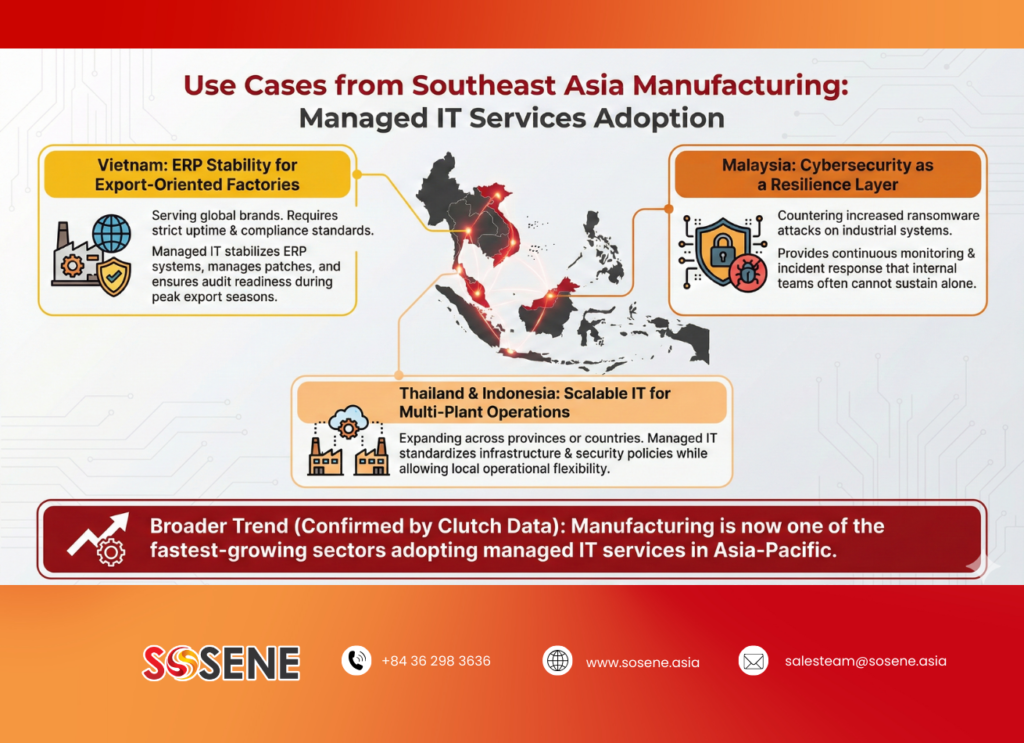
Vietnam: ERP Stability for Export-Oriented Factories
Vietnamese manufacturers serving global brands must meet strict uptime and compliance standards. Many rely on managed IT services to stabilize ERP systems, manage patches, and ensure audit readiness during peak export seasons.
Thailand & Indonesia: Scalable IT for Multi-Plant Operations
Manufacturers expanding across provinces or countries use managed IT to standardize infrastructure and security policies while allowing local operational flexibility.
Malaysia: Cybersecurity as a Resilience Layer
With increased ransomware attacks targeting industrial systems, managed IT services provide continuous monitoring and incident response that internal teams often cannot sustain alone.
These examples reflect a broader trend confirmed by Clutch: manufacturing is now one of the fastest-growing sectors adopting managed IT services in Asia-Pacific.
Beyond Uptime: Strategic Benefits of Managed IT Services
The benefits of managed IT services extend beyond technical reliability.
From a leadership perspective, they enable:
- Faster adoption of automation, analytics, and AI.
- Better data visibility for planning and workforce decisions.
- Alignment between IT strategy and business growth plans.
Big technology providers like Microsoft and SAP consistently emphasize managed services as a foundation for scalable digital manufacturing.
Conclusion
Manufacturing resilience in Southeast Asia is no longer defined solely by machinery, suppliers, or labor availability. It is increasingly shaped by the strength, flexibility, and reliability of IT systems that underpin every operational decision.
Managed IT services offer manufacturers a pragmatic path forward—balancing cost-effectiveness, innovation, industry expertise, and scalability. They reduce risk without slowing progress and enable leaders to shift from firefighting to long-term strategy.
For project managers, HR leaders, and C-level executives, the question is no longer whether to use managed IT services, but how strategically they are deployed to support resilient growth.
Sosene is a trusted partner in Vietnam, helping manufacturing enterprises ensure business continuity with innovative IT solutions and reliable software outsourcing services.
With strengths in cost-effectiveness, innovative technology, industry expertise, and scalability, Sosene supports manufacturers across SEA in building resilient, future-ready IT foundations.
FAQs
What are managed IT services in manufacturing?
Managed IT services involve outsourcing IT operations such as infrastructure management, security, monitoring, and support to a specialized provider.
What are the main managed IT services benefits for manufacturers?
Key benefits include reduced downtime, cost predictability, access to skilled talent, and improved business continuity.
How do managed IT services improve manufacturing resilience?
They ensure system reliability, faster incident response, and scalable IT capacity during disruptions or growth phases.
Are managed IT services suitable for mid-sized SEA manufacturers?
Yes. Many mid-sized manufacturers adopt managed IT to gain enterprise-level capabilities without enterprise-level costs.
How do I choose the right managed IT partner in SEA?
Look for industry experience, clear SLAs, regional understanding, and the ability to scale with your operations.