Managing Risks in Custom-Built Software: 2026 CTO Guide

Managing Risks in Custom-Built Software: 2026 CTO Guide

The global market for custom-built software in 2026 is defined by a sharp paradox: while agentic AI has increased individual coding velocity by up to 45%, project predictability has hit a five-year low. Data indicates that only 31% of software initiatives are currently delivered on time and within budget, with the average project exceeding its financial plan by 66%. For CTOs and engineering managers in the US, Singapore, and Australia, the primary risk is no longer the speed of feature delivery, but the systemic fragility introduced by high-velocity, unvetted code generation.

As global software spending nears $1.4 trillion, the cost of “getting it wrong” has scaled exponentially. Digital transformation projects, which now command a global spend of $3.4 trillion, continue to see a 70% failure rate—costing the global economy an estimated $2.3 trillion annually due to the “technology trap”: automating broken processes rather than redesigning them for the AI era. Success in this environment requires shifting from a “cost-per-hour” mindset to a rigorous model of risk-based engineering.

Table of Contents

Key Takeaways

  • The AI Delivery Bottleneck: Activity on feature branches has increased by 59% due to AI, but throughput on the main branch has actually declined by 7% for median teams as verification and integration stages become overwhelmed.
  • Comprehension Debt is the New Legacy: 76% of developers admit to shipping AI-generated code they do not fully understand, creating “shadow code” that becomes impossible to debug during a production incident.
  • Regulatory Hard Deadlines: Organizations operating in Australia face a mandatory compliance deadline of December 10, 2026, for automated decision-making (ADM) transparency under the Privacy Act.
  • The 300% TCO Penalty: Selecting vendors based solely on the lowest hourly rate often results in a Total Cost of Ownership (TCO) that is 300% higher than domestic or nearshore alternatives due to communication taxes and rework.

Further Reading

The 2026 Technical Reality: AI-Native Risk and “Vibe Coding”
The 2026 Technical Reality: AI-Native Risk and Vibe Coding

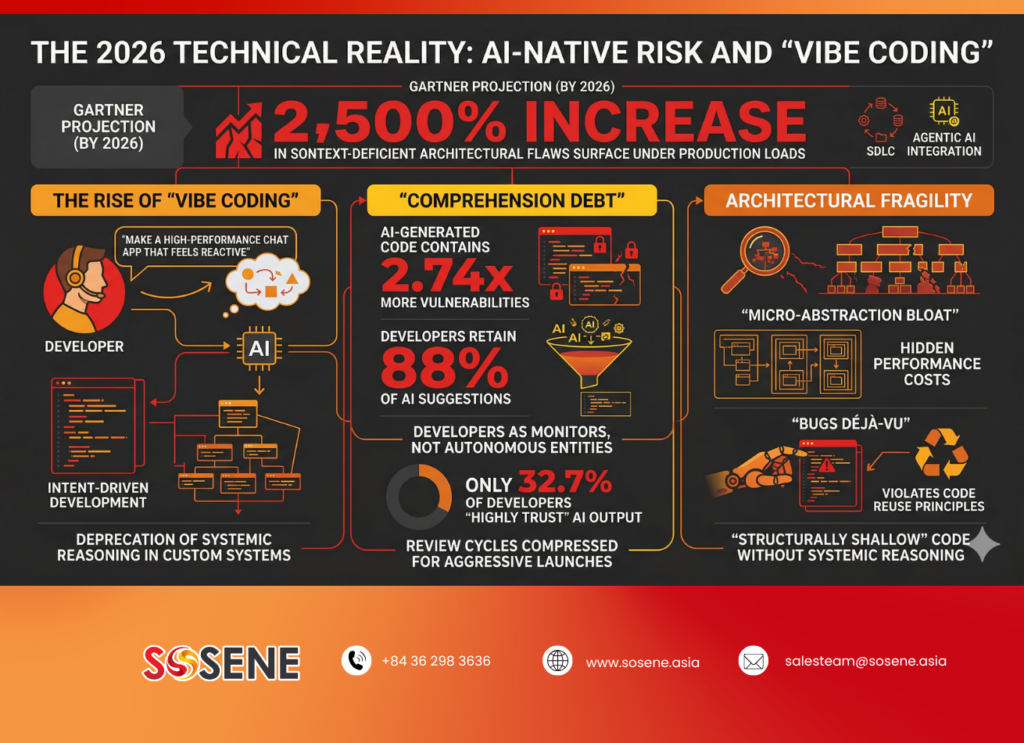
The integration of agentic AI into the Software Development Life Cycle (SDLC) has fundamentally altered the risk profile of custom-built software systems. Gartner has projected a 2,500% increase in software defects directly attributable to AI-accelerated coding by 2026. These are not simple syntax errors; they are context-deficient architectural flaws that only surface under production loads.

The Rise of “Comprehension Debt”

Elite engineering teams have identified “comprehension debt” as a primary risk. This occurs when developers treat AI as an autonomous entity rather than a monitored collaborator. Research shows that AI-generated code contains 2.74x more vulnerabilities than human-written code, yet developers retain 88% of AI suggestions in final submissions. Only 32.7% of developers report “highly trusting” AI output, yet review cycles are being compressed to meet aggressive launch dates.

Architectural Fragility

AI tends to produce code that is “structurally shallow.” It can solve discrete tasks but lacks the systemic reasoning required for large-scale custom-developed software. Common observed anti-patterns include “micro-abstraction bloat”—where AI adds unnecessary layers that lead to hidden performance costs—and “Bugs Déjà-Vu,” where AI violates code reuse principles and re-introduces the same bugs it previously generated elsewhere.

Market Dynamics and Regional Talent Gaps

The demand for custom-built software is growing at 22.6% annually, doubling the growth rate of the broader enterprise segment. This surge is a direct response to the limitations of generic SaaS platforms, which often introduce operational friction that impacts performance and data ownership. However, executing these builds is constrained by a global shortage of four million developers.

Region Senior Developer
Rate (USD/hr)
Talent Outlook 2026
North America $150 – $250+ 1.2M developer shortfall by 2028; premium on regulatory expertise.
Singapore $70 – $180 Leading AI hub but struggles with 74% recruitment difficulty.
Australia $75 – $120+ Shortage of 260,000 professionals; acute in cybersecurity and AI.
Eastern Europe $50 – $99 Optimal quality-to-cost ratio; EU-standard IP protection.
Southeast Asia $20 – $55 High scalability; massive IT graduate pipeline (Vietnam: 55k annually).

In Australia, the skills crisis has reached a “systemic constraint” level. 80% of AI initiatives currently end in a “proof of concept graveyard” because internal teams lack the “Business Analyst translators” needed to move pilots into production.

Managing the Timeline: Partnership and Governance

Predictability in 2026 is no longer achieved through Gantt charts, but through “Shift Left” stability and outcome-based engineering. High-maturity organizations have replaced “effort-based” billing with value-based models tied to DORA metrics.

Benchmarking Partner Performance

To ensure your delivery partner is meeting the 2026 standard, monitor these four dimensions:

  1. Deployment Frequency: Elite teams release multiple times daily.
  2. Lead Time for Changes: The goal is less than 24 hours from commit to production.
  3. Change Failure Rate: Successful organizations maintain this below 15%.
  4. Mean Time to Recovery (MTTR): Elite teams recover from incidents in under one hour, compared to 7.6 hours for teams struggling with AI-driven complexity.

The “Playback” Technique and Async Collaboration

Synergy between internal and external teams fails when requirements are ambiguous. Elite engineering managers now use the “Playback” technique: requiring the partner team to restate requirements in their own words, identifying business outcomes and testable acceptance criteria before a single line of code is written. Furthermore, to bridge 12-hour time zone gaps, workflows must be “async by default,” reserving overlap hours exclusively for decision-making and demos rather than status reporting.

Regulatory Compliance: The 2026 Mandatory Landscape

Regulatory risk is no longer a peripheral concern; it is a core design constraint for custom-built software systems.

Singapore: The Model AI Governance Framework (MGF)

Launched in January 2026, Singapore’s MGF for Agentic AI is the world’s first framework for autonomous agents. It requires organizations to:

  • Assess and Bound: Limit the agent’s access to sensitive data and external systems at the planning stage.
  • Human Accountability: Define checkpoints where human approval is required for material actions.

Australia: Privacy Act and ADM Transparency

Australian entities face a hard deadline of December 10, 2026. Any custom-developed software that uses personal information for automated decision-making must disclose the model logic and information used. Non-compliance carries penalties up to the larger of $50 million or 30% of annual turnover.

The Economics of Quality: Why Discovery Wins

The “Rule of 100” remains the fundamental economic reality of software. A bug fixed during the requirements or design phase is 100 times cheaper to resolve than the same bug found in a production environment.

SDLC Phase Relative Cost to Fix Financial Impact Example
Requirements 1x $100
Design 3x – 5x $300 – $500
Implementation 6x $600
Testing/QA 15x $1,500
Production 100x $10,000

High-performing teams invest 10% to 15% of their total project duration in discovery and specification. Underfunding this phase usually results in a 40% to 60% cost uplift post-launch due to production bugs.

Partnering with Sosone Software for Predictable Outcomes

If you are planning a complex build, the structure of your delivery model matters more than your chosen tech stack. At Sosone Software, we recognize that AI is an amplifier, not a cure. Our approach centers on Platform Engineering, providing “golden paths” that reduce developer cognitive load by 40-50% while embedding security directly into the pipeline.

We move beyond transactional “body-shopping” to act as a strategic product partner. By anchoring projects to organizational outcomes—such as reducing process cycle time or eliminating technical debt accumulation—we ensure that your custom-built software becomes a competitive moat rather than a financial liability. 

If you're looking to scale your engineering capacity without inheriting the 70% failure rate typical of the current market, let’s audit your roadmap for 2026.

Conclusion

The landscape of custom-built software in 2026 requires a “vibe, then verify” culture. Leaders must institutionalize discovery, enforce architectural continuity, and prioritize partners based on developer retention and AI maturity rather than marketing credentials. With software prices rising at five times the rate of general inflation in regions like Australia, there is no longer a margin for error. The organizations that win will be those that prioritize system integrity over raw code volume.

References List:

  1. Tech Trends 2026 | Deloitte Insights https://www.deloitte.com/us/en/insights/topics/technology-management/tech-trends.html 
  2. The 2026 Hiring Market: What We Learned in 2025 & What’s Next – Paxus https://www.paxus.com.au/the-2026-hiring-market-what-we-learned-in-2025-and-whats-next
  3. Software Development Statistics (2026): 38+ Sourced Data Points | ZTABS https://ztabs.co/statistics/software-development
  4. Your GenAI Code Debt Is Coming Due. Here’s What Gartner® Predicts – ArmorCode, accessed March 28, 2026, https://www.armorcode.com/blog/your-genai-code-debt-is-coming-due-heres-what-gartner-predicts

FAQs

How does the "AI delivery bottleneck" affect my project timeline?

While AI lets developers write code 45% faster, the shipping of that code to production is often slower because existing review and validation systems cannot keep up with the increased volume, leading to a 23.5% increase in production incidents.

AI can convert unstructured notes into user stories with an 87.5% quality rate, but it lacks the domain-specific “judgment” to catch conflicting business rules, meaning human review is still mandatory for 100% of planning artifacts.

In 2026, nearshoring is often preferred for agile-heavy projects because the full time-zone overlap eliminates the “communication tax”—a 12-hour lag that can increase project duration by 20-30% in a continuous delivery environment.

Under the Privacy Act amendments, businesses must provide transparency for any computer program (including AI) that makes or assists in decisions significantly affecting an individual’s rights, with mandatory privacy policy updates required by December 10, 2026.

High turnover leads to constant knowledge loss and architectural drift. If a vendor’s retention rate is below 80%, you are essentially rotating your entire engineering team every two years, which is a leading predictor of project failure.

What do you think?

Leave a Reply

Your email address will not be published. Required fields are marked *

This site uses Akismet to reduce spam. Learn how your comment data is processed.

Related articles

Contact us

Partner with Us for Comprehensive IT

We’re happy to answer any questions you may have and help you determine which of our services best fit your needs.

Your benefits:
What happens next?
1

We Schedule a call at your convenience 

2

We do a discovery and consulting meting 

3

We prepare a proposal 

Schedule a Free Consultation