The 2026 Guide to Software Development Timelines: From AI Velocity to Delivery Reality

The 2026 Guide to Software Development Timelines: From AI Velocity to Delivery Reality

The software delivery landscape in 2026 is defined by a study in friction: while agentic AI has increased individual task velocity by up to 45%, project success remains elusive. Data indicates that only 31% of software projects are currently delivered on time and within budget. For CTOs and engineering managers in the US, Singapore, and Australia, the primary challenge of a software development timeline is no longer the speed of coding, but the stability of the architecture. With global software spending projected to exceed $1.4 trillion in 2026, the cost of “getting it wrong” has scaled alongside the technology. This analysis provides the decision-grade benchmarks required to navigate high-velocity delivery without compromising long-term technical health.

Table of Contents

Key Takeaways

  • AI is a Throughput Multiplier, Not a Management Cure: AI tools reduce routine coding time by 30–50% but increase instability and security vulnerabilities if foundational DevOps practices are weak.
  • Discovery is the Timeline’s Critical Path: High-performing teams spend 10–15% of the total project duration on upfront specifications to prevent scope creep, which typically accounts for 15–25% of total costs.
  • The 300% TCO Rule: Choosing offshore partners based solely on a $25/hour rate often results in a Total Cost of Ownership (TCO) that is 300% higher than domestic or nearshore alternatives due to communication taxes and technical debt.

Further Reading

Defining the 2026 Software Development Timeline

A software development timeline is the structured roadmap of a project, encompassing six core phases: Discovery, Design/Architecture, Development, Quality Assurance (QA), Deployment, and Maintenance. In 2026, this timeline is no longer a static estimate but a dynamic variable influenced by agentic AI—autonomous software agents that can reason and execute workflows—and the shift toward “senior-heavy” squads.

When a timeline is mismanaged, the implications are severe: the average software project exceeds its budget by 66%. In regions like Australia, where a structural shortage of 260,000 tech workers persists, failing to secure a predictable timeline often means missing a market window entirely. To avoid the “Proof of Concept (PoC) graveyard”—where 80% of AI initiatives currently stall—executives must prioritize architectural discipline over raw speed.

Real-World Timeline Framework and Benchmarks

The complexity of your build determines the reality of your delivery. While “Greenfield” projects (building from scratch) offer architectural freedom, “Brownfield” projects (integrating with legacy systems) are often 30–35% less expensive upfront but introduce significant integration friction that can extend timelines by 20–30%.

Project Complexity Duration
(Months)
2026 Cost Range
(USD)
Primary Risk Factor
Simple MVP 3 – 4 $25,000 – $60,000 Requirement Ambiguity
Medium Complexity 5 – 9 $60,000 – $200,000 Integration Friction
Enterprise System 9 – 18+ $200,000 – $1M+ Architectural Debt
SaaS Platform 6 – 12 $75,000 – $150,000 Scalability Bottlenecks

Most teams fail because they treat the development phase (typically 12–24 weeks) as the only variable. However, in high-maturity organizations, the “Shift Left” philosophy—integrating QA and security from day one—is what ensures predictability. Automated testing now accounts for 15–25% of a healthy budget; skipping it to save 15% upfront typically leads to a 40–60% cost uplift post-launch due to production bugs.

What Most Vendors Won’t Tell You

Beneath the “AI-powered” marketing polish of 2026 lie three critical factors that derail projects:

  1. The Communication Tax: In a continuous delivery environment, a 12-hour time lag is a project killer. US firms offshoring to Asia often face a 20–30% increase in project duration compared to nearshoring in Latin America, where real-time collaboration is the norm.

  2. The Seniority Gap: Many vendors use AI to allow junior developers to handle boilerplate code. However, unvetted AI-generated code is responsible for 14–60% of new enterprise vulnerabilities. High-quality vendors now offer “Senior-Heavy” squads where experts supervise AI agents to maintain system integrity.

  3. The Retention Trap: Vendor turnover is a direct predictor of project stability. If a vendor’s developer retention rate is below 80%, expect constant knowledge loss and architectural drift. A vendor with 57% turnover will replace your entire team every two years.

Typical Software Development Timeline: Decision-Stage Answer
Typical Software Development Timeline: Decision-Stage Answer

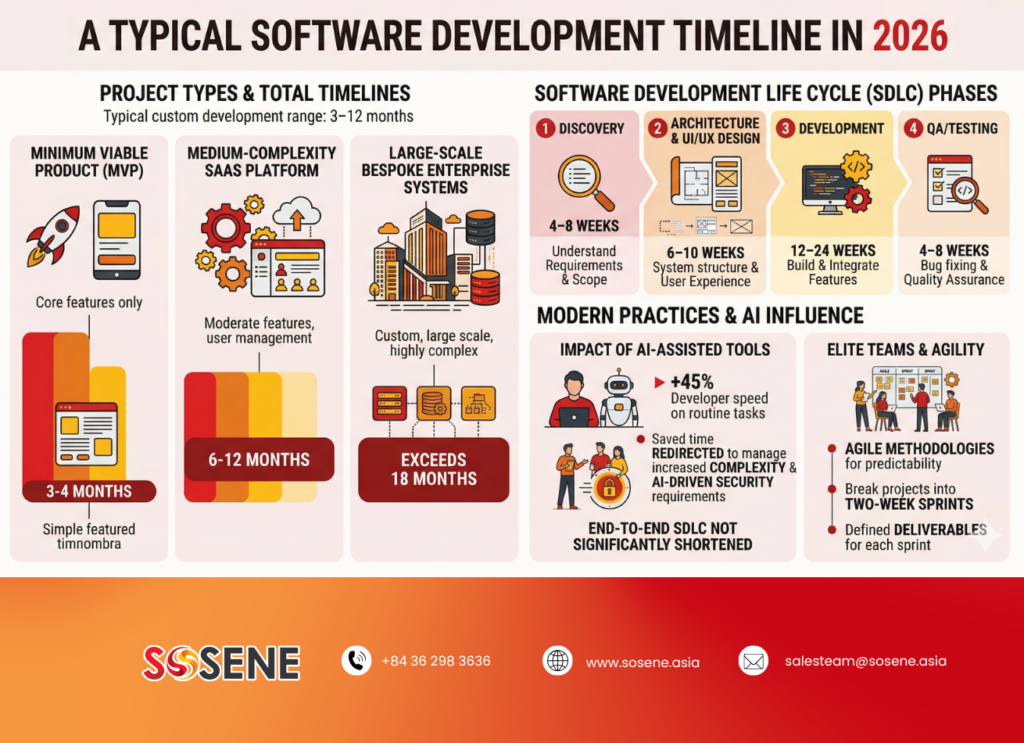
A typical software development timeline in 2026 ranges from 3 to 12 months, depending on the scope of the custom software development. A Minimum Viable Product (MVP) with core features generally takes 3–4 months, while medium-complexity SaaS platforms require 6–12 months. Large-scale bespoke software development for enterprise systems often exceeds 18 months.

These timelines are segmented into Discovery (4–8 weeks), Architecture and UI/UX Design (6–10 weeks), Development (12–24 weeks), and QA/Testing (4–8 weeks). While AI-assisted tools have improved developer speed on routine tasks by up to 45%, they have not significantly shortened the end-to-end SDLC (Software Development Life Cycle). Instead, the time saved in coding is often redirected toward managing the increased complexity of modern tech stacks and AI-driven security requirements. Elite teams maintain predictability by using Agile methodologies, breaking projects into two-week sprints with defined deliverables.

How to Evaluate the Timeline for Your Project

To ensure your partner can deliver on the promised schedule, use the following checklist during the selection phase:

  • Audit AI Maturity: Ask for the specific AI toolchain used for testing and code review. Vendors using AI for value—not just marketing—achieve 35–45% productivity gains while maintaining code quality.

  • Check Retention Benchmarks: Request 2025 retention data. Reject vendors with rates below 80%.

  • Verify Platform Engineering: Ensure the vendor uses Internal Developer Platforms (IDPs). This reduces “DevOps chaos” and prevents the configuration drift that delays 2026 projects.

  • Pilot Project Requirement: Before committing to a $200k+ build, run a 2–4 week pilot ($5,000–$15,000) to validate communication workflows and code quality.
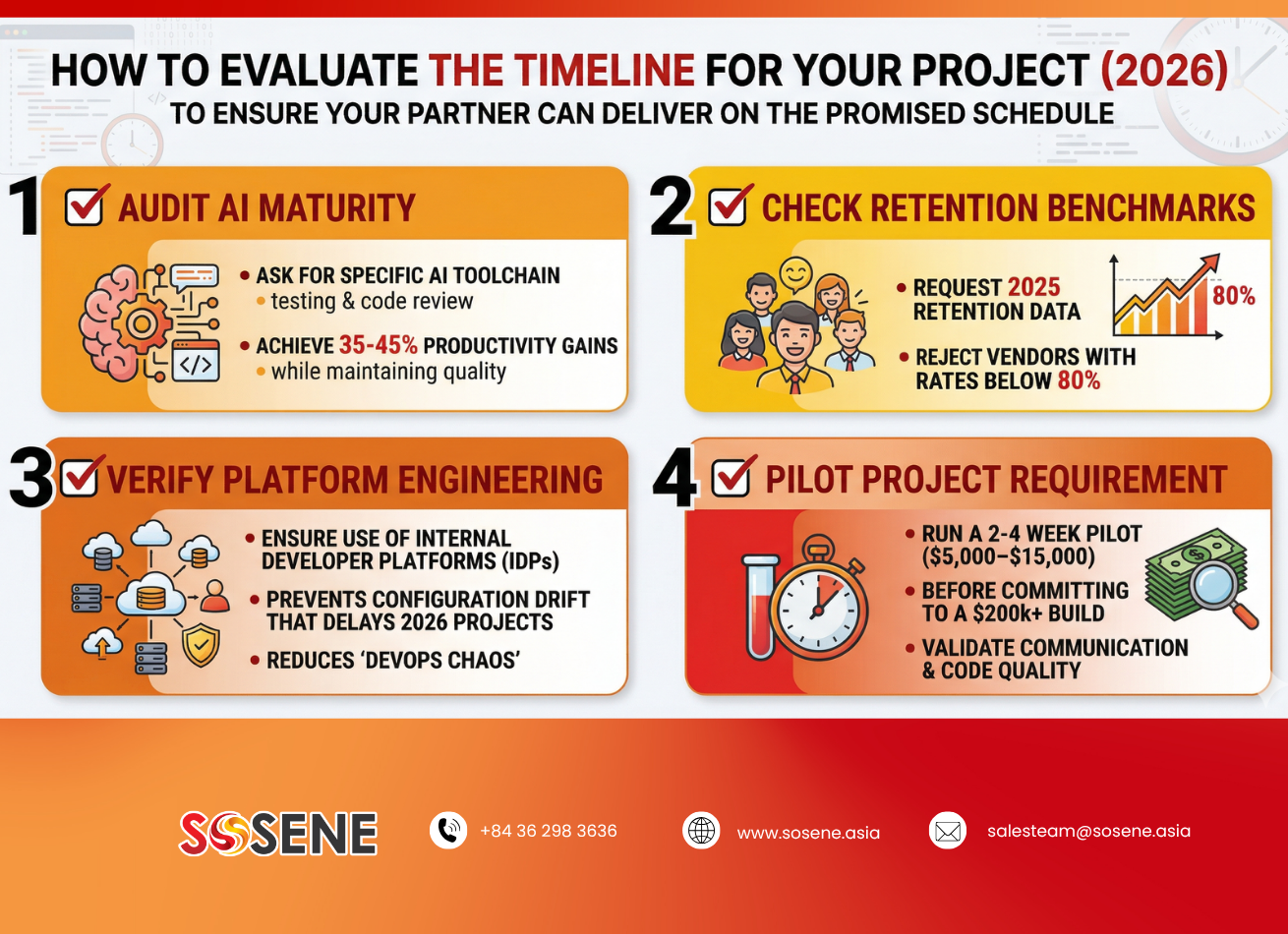

How to Evaluate the Timeline for Your Project

Partnering for Predictable Delivery

If you are planning a project with high technical complexity, the structure of your delivery model matters more than the tech stack. Modern software development requires a hybrid approach where internal leadership sets the direction and external “managed PODs” accelerate delivery. In the 2026 market, the most successful leaders are those who move away from “cost-per-hour” thinking toward value-based outcome models that tie fees to DORA benchmarks—standardized metrics for deployment frequency and lead time for changes.

At Sosene, we focus on removing the architectural friction that derails timelines, ensuring your software is a strategic lever for growth rather than a source of technical debt.

Conclusion

The software development timeline of 2026 is a balance of AI-augmented speed and human-centric governance. With software prices rising at five times the pace of general inflation in regions like Australia, the margin for error has disappeared. To win, you must invest in discovery, prioritize near-shore or high-overlap collaboration, and treat your vendor as a strategic partner who challenges your requirements. The next step is to conduct an architectural audit of your current roadmap to identify the hidden bottlenecks that could derail your 2026 launch.

References List:

  1. Software Market Size, Share and Trends 2026 to 2035 – Precedence Research, accessed March 27, 2026, https://www.precedenceresearch.com/software-market
  2. Software Development Statistics (2026): 38+ Sourced Data Points | ZTABS, accessed March 27, 2026, https://ztabs.co/statistics/software-development
  3. Gartner Forecasts Worldwide IT Spending to Grow 10.8% in 2026, Totaling $6.15 Trillion, accessed March 27, 2026, https://www.gartner.com/en/newsroom/press-releases/2026-02-03-gartner-forecasts-worldwide-it-spending-to-grow-10-point-8-percent-in-2026-totaling-6-point-15-trillion-dollars
  4. Gartner Forecasts Worldwide IT Spending to Grow 9.8% in 2026, Exceeding $6 Trillion For the First Time, accessed March 27, 2026, https://www.gartner.com/en/newsroom/press-releases/2025-10-22-gartner-forecasts-worldwide-it-spending-to-grow-9-point-8-percent-in-2026-exceeding-6-trillion-dollars-for-the-first-time
  5. Software Development Statistics for 2026: Key Facts & Trends – Itransition, accessed March 27, 2026, https://www.itransition.com/software-development/statistics

FAQs

How much does AI actually shorten a software development timeline?

While AI improves individual task speed by 45%, the overall project duration usually only drops by 20–30% because the time saved is often offset by increased testing and security verification requirements.

Rates vary by region: the US and Canada range from $125 to $250+, Singapore averages $70 to $180, and high-quality Southeast Asian hubs like Vietnam range from $35 to $55.

Most failures stem from “The AI Paradox,” where teams ship code faster but lack the architectural oversight to manage the resulting complexity, leading to system instability and security debt.

Only if the scope is perfectly defined. For complex builds, the “Communication Tax” and rework costs often make the total cost of ownership 300% higher than higher-rate nearshore or domestic teams.

The Discovery phase (4–8 weeks) is the most critical. Investing 10–15% of your timeline here to define measurable success criteria prevents the scope creep that accounts for up to 25% of budget overruns.

What do you think?

Leave a Reply

Your email address will not be published. Required fields are marked *

This site uses Akismet to reduce spam. Learn how your comment data is processed.

Related articles

Contact us

Partner with Us for Comprehensive IT

We’re happy to answer any questions you may have and help you determine which of our services best fit your needs.

Your benefits:
What happens next?
1

We Schedule a call at your convenience 

2

We do a discovery and consulting meting 

3

We prepare a proposal 

Schedule a Free Consultation