
Many organizations begin with software outsourcing to accelerate delivery, reduce cost, or access specialized skills. The model works well when scope is clear and timelines are defined. But as products mature and roadmaps extend beyond a single release cycle, project-based outsourcing often reveals structural limits.
Velocity fluctuates. Knowledge resets between engagements. Innovation slows as each project reestablishes context. What was once an efficient execution strategy becomes a coordination burden.
This is where the evolution toward long-term delivery teams begins. The shift is not merely contractual. It changes governance, accountability, and strategic alignment. By the end of this article, you will understand when this transition makes sense, what operational shifts are required, and how it impacts scalability, control, and long-term product performance.
Table of Contents
Key Takeaways
- Project-based software outsourcing optimizes for scope completion → limited continuity → insufficient for evolving products.
- Long-term delivery teams shift from transactional execution to shared product accountability → improved velocity consistency and innovation contribution.
- Dedicated or extended team models provide greater scalability and flexibility than fixed-scope contracts → resource elasticity supports changing priorities.
- Governance maturity and outcome-based metrics are essential → without them, long-term engagement can drift.
- The true benefits of software outsourcing compound over time when teams remain embedded in roadmap stewardship rather than rotating per project.
Further Reading
The Limits of Traditional Software Outsourcing
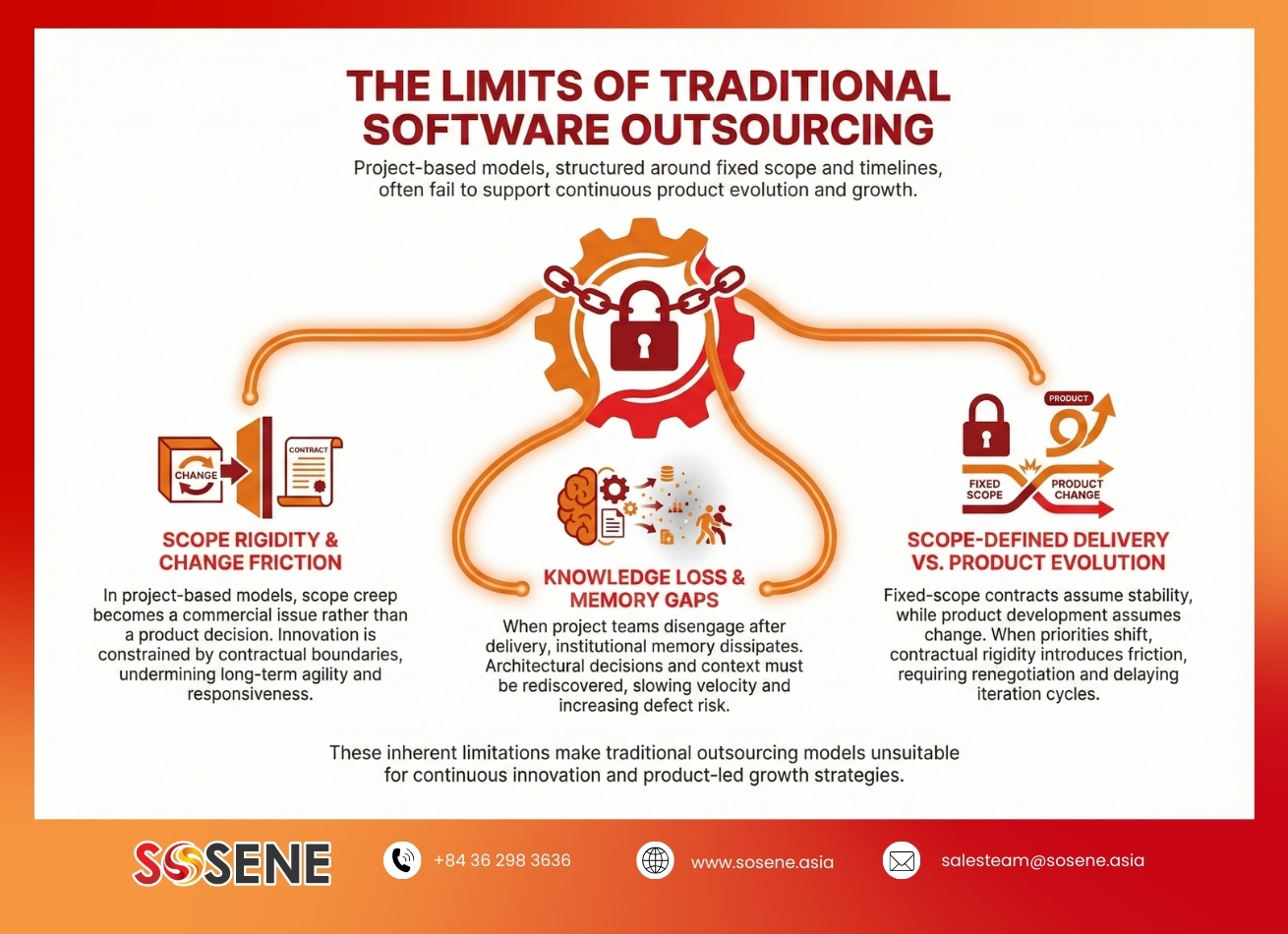
Project-based outsourcing is structured around defined scope, fixed timelines, and milestone-based delivery. While efficient for discrete initiatives, it often fails to support continuous product growth.
Scope-defined delivery vs. product evolution
Fixed-scope contracts assume stability. Product development assumes change. When priorities shift or user feedback alters direction, contractual rigidity introduces friction. Each adjustment requires renegotiation, delaying iteration cycles and reducing responsiveness.
Knowledge loss and institutional memory gaps
When project teams disengage after delivery, institutional memory dissipates. Architectural decisions, trade-offs, and contextual knowledge must be rediscovered by subsequent teams. This repetitive onboarding slows velocity and increases defect risk.
Scope rigidity and change friction
In project-based models, scope creep becomes a commercial issue rather than a product decision. Innovation is constrained not by feasibility, but by contractual boundaries. Over time, this tension undermines agility.
What Defines a Long-Term Delivery Team Model
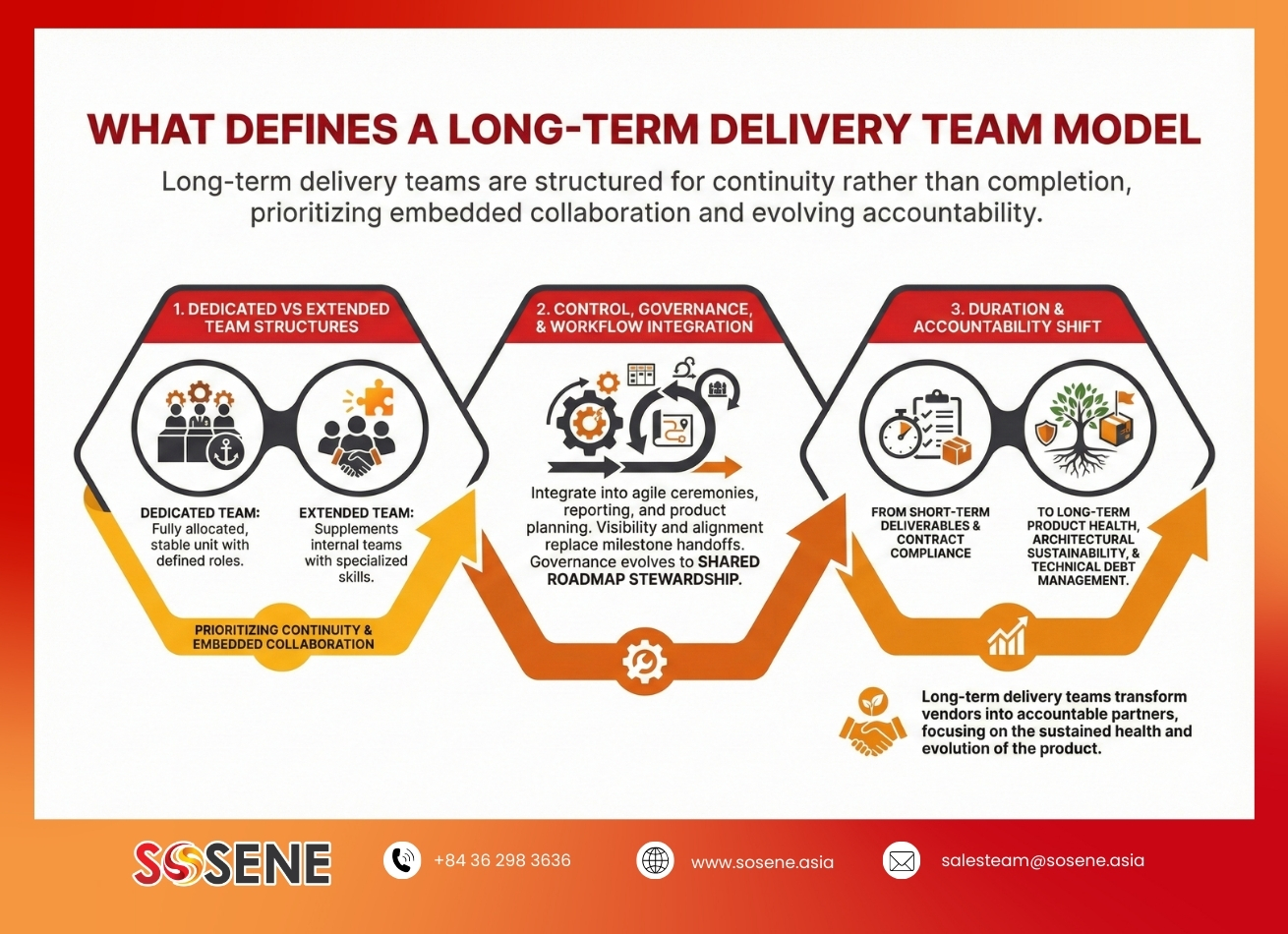
Long-term delivery teams are structured for continuity rather than completion.
Dedicated team vs extended team structures
A dedicated team is fully allocated to a product or portfolio, operating as a stable unit with defined roles. An extended team model supplements internal teams with specialized skills while remaining integrated into core workflows.
Both models differ from traditional outsourcing by prioritizing continuity and embedded collaboration.
Control, governance, and workflow integration
Long-term delivery teams integrate into internal agile ceremonies, reporting structures, and product planning cycles. Visibility and alignment replace milestone handoffs. Governance evolves from contract compliance to shared roadmap stewardship.
Duration and accountability shift
As engagement duration increases, incentives change. Vendors become partners accountable for long-term product health rather than short-term deliverables. Accountability expands beyond features to include architectural sustainability and technical debt management.
Comparing Engagement Models: Project Outsourcing vs Long-Term Teams
| Dimension | Project-Based Software Outsourcing | Long-Term Delivery Teams |
|---|---|---|
| Strategic Objective | Milestone completion | Continuous product evolution |
| Flexibility | Limited after scope agreement | High adaptability to roadmap changes |
| Cost Structure | Fixed per project | Stable multi-period operational cost |
| Knowledge Retention | Resets between projects | Accumulates over time |
| Innovation Contribution | Execution-focused | Strategic input on roadmap and architecture |
The comparison highlights a fundamental shift: from delivery optimization to product ownership support.
Benefits of Software Outsourcing in a Long-Term Model
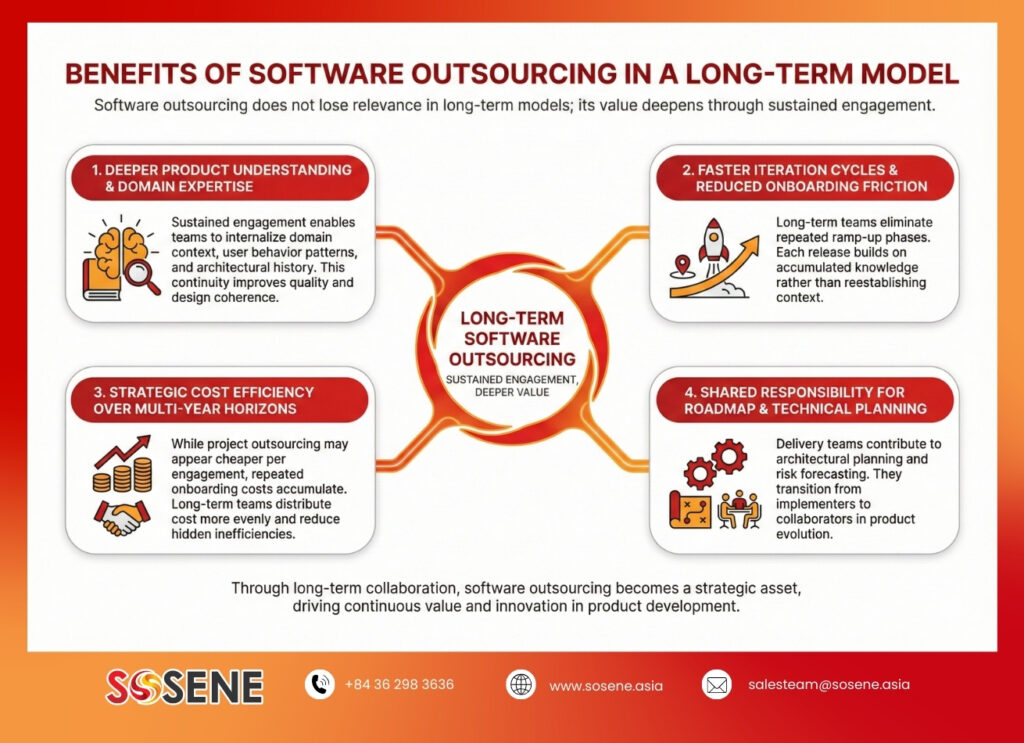
Software outsourcing does not lose relevance in long-term models; its value deepens.
Deeper product understanding and domain expertise
Sustained engagement enables teams to internalize domain context, user behavior patterns, and architectural history. This continuity improves quality and design coherence.
Faster iteration cycles and reduced onboarding friction
Long-term teams eliminate repeated ramp-up phases. Each release builds on accumulated knowledge rather than reestablishing context.
Strategic cost efficiency over multi-year horizons
While project outsourcing may appear cheaper per engagement, repeated onboarding and transition costs accumulate. Long-term delivery teams distribute cost more evenly and reduce hidden inefficiencies.
Shared responsibility for roadmap and technical planning
Delivery teams contribute to architectural planning and risk forecasting. They transition from implementers to collaborators in product evolution.
When to Transition from Project Outsourcing to Delivery Teams
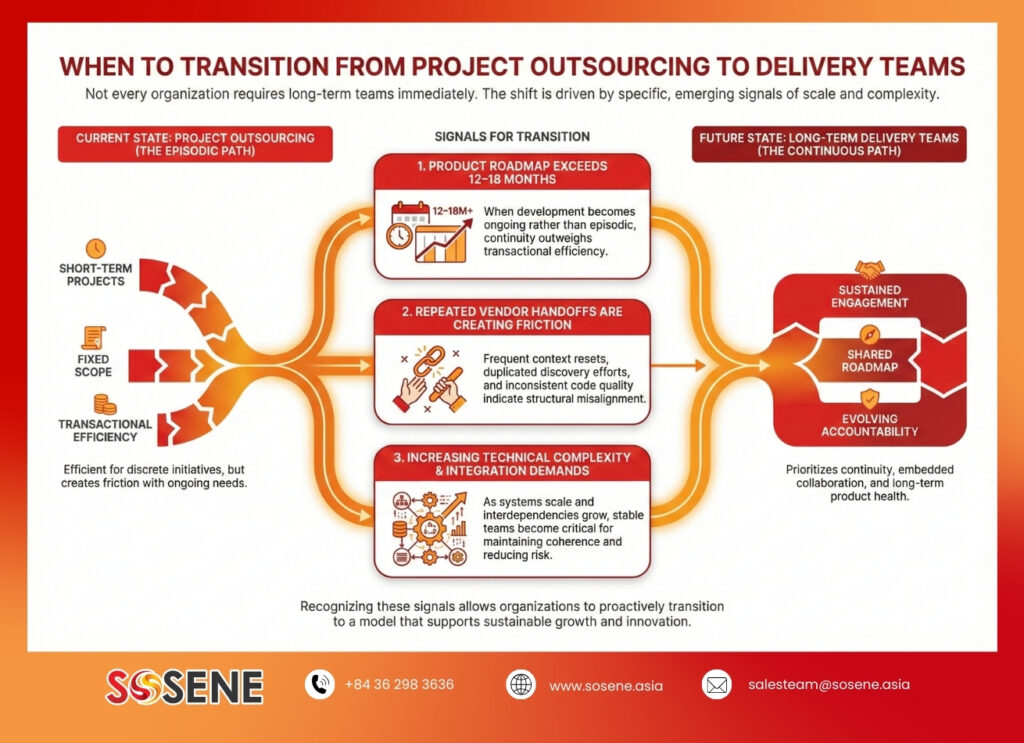
Not every organization requires long-term delivery teams immediately. Signals typically emerge gradually.
Product roadmap exceeds 12–18 months
When development becomes ongoing rather than episodic, continuity outweighs transactional efficiency.
Repeated vendor handoffs are creating friction
Frequent context resets, duplicated discovery efforts, and inconsistent code quality indicate structural misalignment.
Increasing technical complexity and integration demands
As systems scale and interdependencies grow, stable teams become critical for maintaining coherence and reducing risk.
Governance and Management Shifts Required
Transitioning engagement models requires internal evolution as well.
Moving from task metrics to outcome metrics
Feature counts and velocity points must give way to business KPIs such as user growth, uptime stability, and delivery predictability.
Embedding agile governance frameworks
Long-term delivery teams function best within structured agile governance—clear backlog ownership, sprint cadence, and retrospective feedback loops. Transparency reduces misalignment.
Cultural integration and communication rhythm
Trust-building, onboarding depth, and shared accountability frameworks must evolve intentionally. Cultural integration is not incidental; it is operational infrastructure.
Risks and Trade-Offs in Long-Term Engagement
Long-term delivery teams are not universally superior.
Management maturity requirements
Client-side product ownership and leadership remain essential. Without clear direction, long-term engagement can drift into inefficiency.
Security and compliance governance
Shared access across longer periods increases the need for robust data protection and compliance oversight. Governance cannot be informal.
Cost misalignment without clear roadmap ownership
If roadmap priorities are unstable or unclear, long-term cost structures may inflate without proportional value creation. Stability of vision remains critical.
A Phased Approach to Transitioning Engagement Models
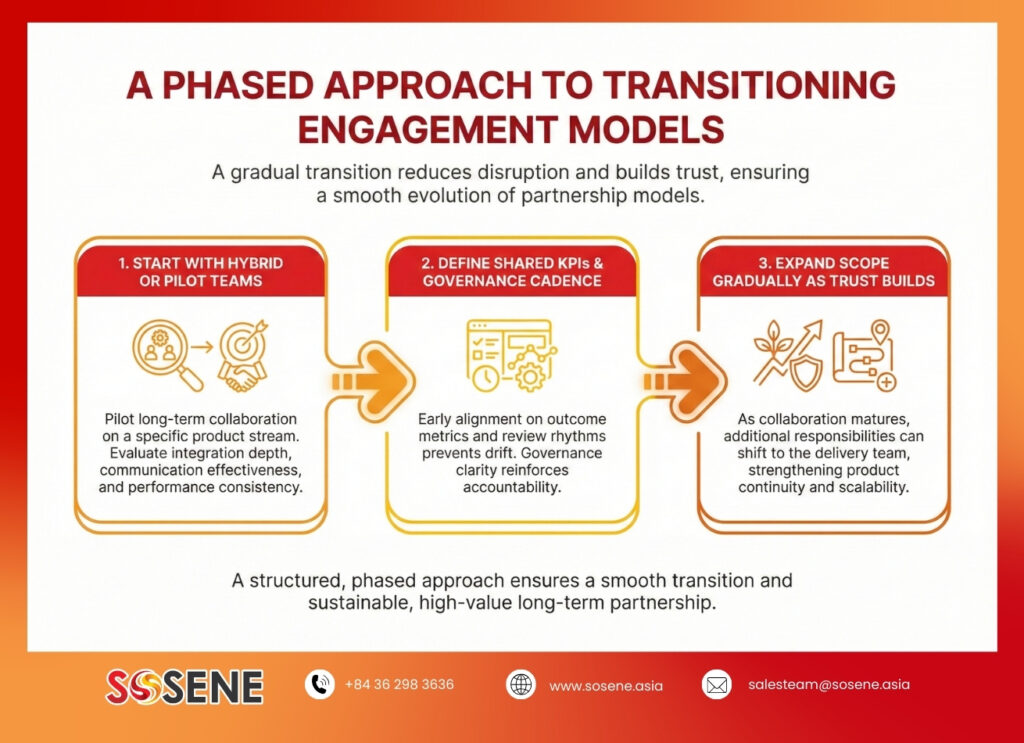
A gradual transition reduces disruption and builds trust.
Start with hybrid or pilot teams
Pilot long-term collaboration on a specific product stream. Evaluate integration depth, communication effectiveness, and performance consistency.
Define shared KPIs and governance cadence
Early alignment on outcome metrics and review rhythms prevents drift. Governance clarity reinforces accountability.
Expand scope gradually as trust builds
As collaboration matures, additional responsibilities can shift to the delivery team, strengthening product continuity and scalability.
How Sosene Builds Long-Term Delivery Partnerships
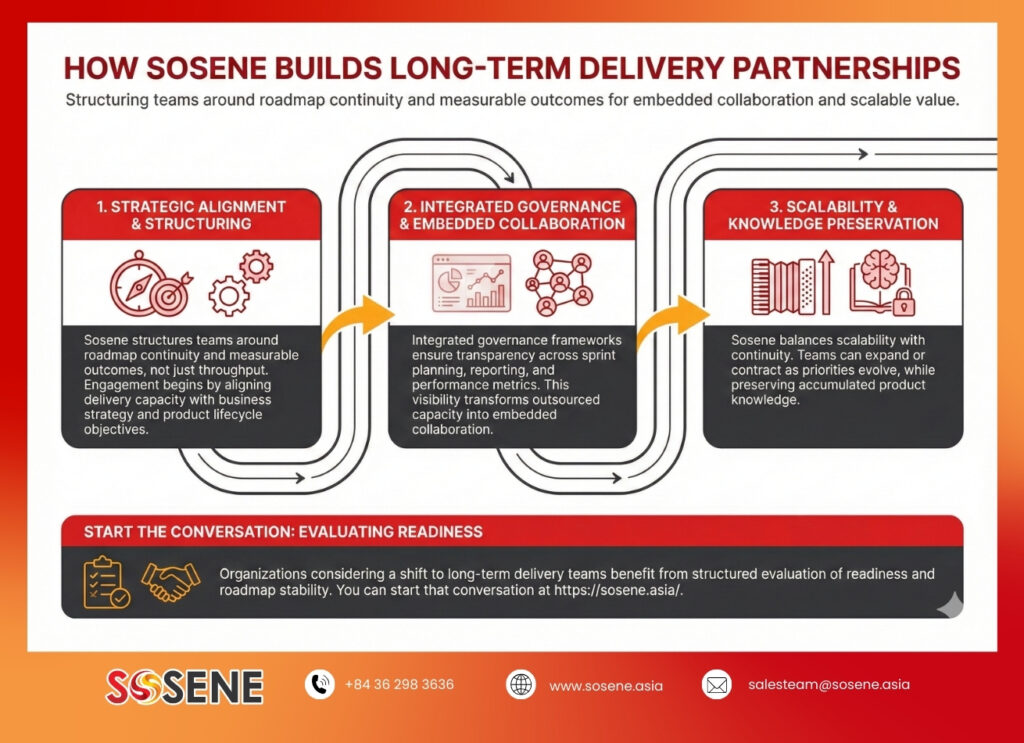
Sosene structures long-term delivery teams around roadmap continuity and measurable outcomes rather than feature throughput alone. Engagement begins by aligning delivery capacity with business strategy and product lifecycle objectives.
Integrated governance frameworks ensure transparency across sprint planning, reporting, and performance metrics. This visibility transforms outsourced capacity into embedded collaboration.
Sosene also balances scalability with continuity. Teams can expand or contract as priorities evolve, while preserving accumulated product knowledge.
Organizations considering a shift from project-based software outsourcing to long-term delivery teams often benefit from structured evaluation of readiness and roadmap stability. You can start that conversation at https://sosenesoftware.com/.
Conclusion
Software outsourcing remains a powerful strategy for accessing talent and accelerating development. However, as products evolve and roadmaps extend, project-based models often constrain long-term growth.
Transitioning to long-term delivery teams represents a strategic evolution from transactional execution to collaborative product stewardship. This shift enhances knowledge retention, velocity stability, and innovation contribution—provided governance and leadership maturity support it.
The decision should align with product complexity, roadmap stability, and organizational readiness. When structured thoughtfully, the benefits of software outsourcing compound over time, transforming external teams from temporary executors into sustained partners in product success.
FAQs
What is the difference between software outsourcing and a long-term delivery team?
Software outsourcing typically focuses on defined projects and scope completion, while a long-term delivery team supports continuous product development and roadmap evolution.
When should a company move from project outsourcing to a dedicated team model?
When product development becomes ongoing, complexity increases, or repeated vendor transitions create friction, a dedicated model often provides greater continuity.
What are the benefits of software outsourcing in a long-term engagement?
Benefits include deeper product knowledge, consistent velocity, reduced onboarding cost, and improved architectural coherence over time.
How do dedicated teams differ from extended teams?
Dedicated teams are fully allocated to a product, while extended teams augment internal resources with specific skills while remaining integrated into existing workflows.
Is a long-term delivery team more expensive than project-based outsourcing?
Not necessarily. While costs may appear higher initially, long-term efficiency gains and reduced transition overhead often offset repeated project expenses.
What governance structure is required for successful delivery teams?
Clear product ownership, agile frameworks, outcome-based metrics, and transparent reporting are essential for alignment and accountability.
How can companies transition existing outsourced projects into long-term partnerships?
Begin with pilot teams, define shared KPIs, embed governance mechanisms, and gradually expand scope as trust and operational maturity increase.