
Introduction
Across Southeast Asia, education institutions are facing a quiet but systemic challenge: manual operations are no longer sustainable. From student enrollment and attendance tracking to payroll, reporting, and parent communication, many schools still rely on spreadsheets, disconnected tools, and paper-based workflows.
For project managers, HR leaders, and C-level executives in education, the issue is no longer about digitization for its own sake. It is about operational resilience, scalability, and governance. As student populations grow, compliance requirements tighten, and digital learning becomes permanent, manual processes increasingly act as friction—slowing decisions, increasing errors, and exhausting staff.
This is where school management software—particularly all-in-one school management software platforms—is reshaping how education organizations operate. By automating manual operations, institutions can shift administrative energy away from repetitive tasks and toward strategic priorities such as academic quality, staff development, and learner experience.
Table of Contents
Key Takeaways
- Manual administrative operations limit scalability and resilience in education.
- School management software automates core workflows across academics, HR, and finance.
- The school management software benefits extend beyond efficiency to governance and data quality.
- All-in-one school management software platforms reduce system fragmentation.
- SEA institutions increasingly adopt school management system apps to modernize operations sustainably.
Further Reading
What Is School Management Software?
School management software is a digital platform designed to centralize and automate administrative, academic, and operational processes within education institutions.
An all-in-one school management software typically includes modules for student information, attendance, grading, scheduling, HR, payroll, finance, reporting, and parent communication—often delivered through a web platform and a school management system app.
According to Gartner, education organizations that consolidate administrative systems reduce operational complexity and experience 20–30% efficiency gains compared to institutions using fragmented tools.
Why Manual Operations Are Holding Schools Back
Manual workflows persist in education for historical and cultural reasons. However, their impact has become more visible as institutions scale.
Common challenges include:
- Duplicate data entry across departments.
- High error rates in attendance, payroll, and reporting.
- Slow decision-making due to delayed or inconsistent data.
- Heavy administrative workload contributing to staff burnout.
Research from Accenture highlights that organizations with manual back-office processes spend up to 40% more time on administrative tasks compared to digitally automated peers.
For education leaders, this inefficiency directly affects cost control, staff morale, and service quality.
How School Management Software Automates Manual Operations
Student Lifecycle Automation
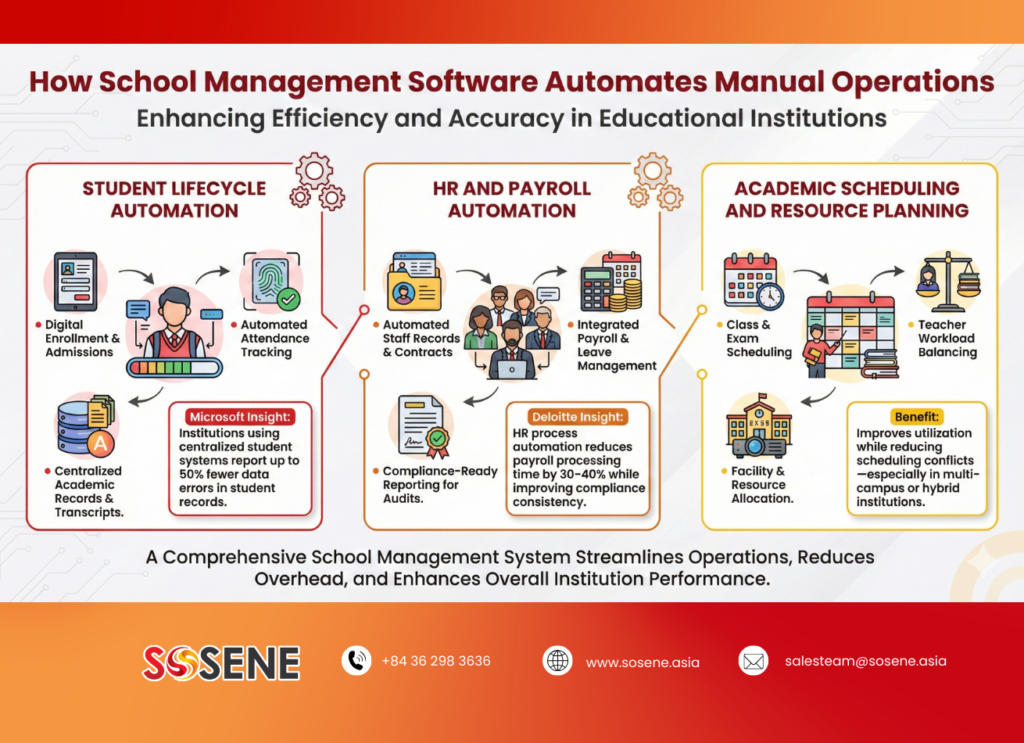
Modern school management software automates the entire student lifecycle:
- Digital enrollment and admissions.
- Automated attendance tracking.
- Centralized academic records and transcripts.
This reduces administrative overhead while improving data accuracy. According to Microsoft, institutions using centralized student systems report up to 50% fewer data errors in student records.
HR and Payroll Automation
HR teams in education often manage large, diverse workforces with limited systems support.
A comprehensive school management system app enables:
- Automated staff records and contracts.
- Integrated payroll and leave management.
- Compliance-ready reporting for audits.
Insights from Deloitte show that HR process automation reduces payroll processing time by 30–40% while improving compliance consistency.
Academic Scheduling and Resource Planning
Manual scheduling is one of the most error-prone areas in education operations.
All-in-one school management software automates:
- Class and exam scheduling.
- Teacher workload balancing.
- Facility and resource allocation.
This improves utilization while reducing scheduling conflicts—especially in multi-campus or hybrid institutions.
School Management Software Benefits Beyond Efficiency
Data-Driven Leadership
Automated systems generate real-time operational and academic insights. Leadership teams gain:
- Accurate dashboards for enrollment, performance, and staffing.
- Faster reporting for regulators and partners.
- Evidence-based planning for growth.
According to PwC, organizations using integrated management platforms are 2.5× more likely to make timely, data-driven decisions.
Improved Staff Experience
Automation reduces repetitive administrative work, allowing educators and staff to focus on teaching and student support.
This directly impacts retention. World Economic Forum reports that digital process simplification is a key factor in reducing workforce burnout in knowledge-intensive sectors like education.
Use Cases Across Southeast Asia
Vietnam: Scaling Private and International Schools
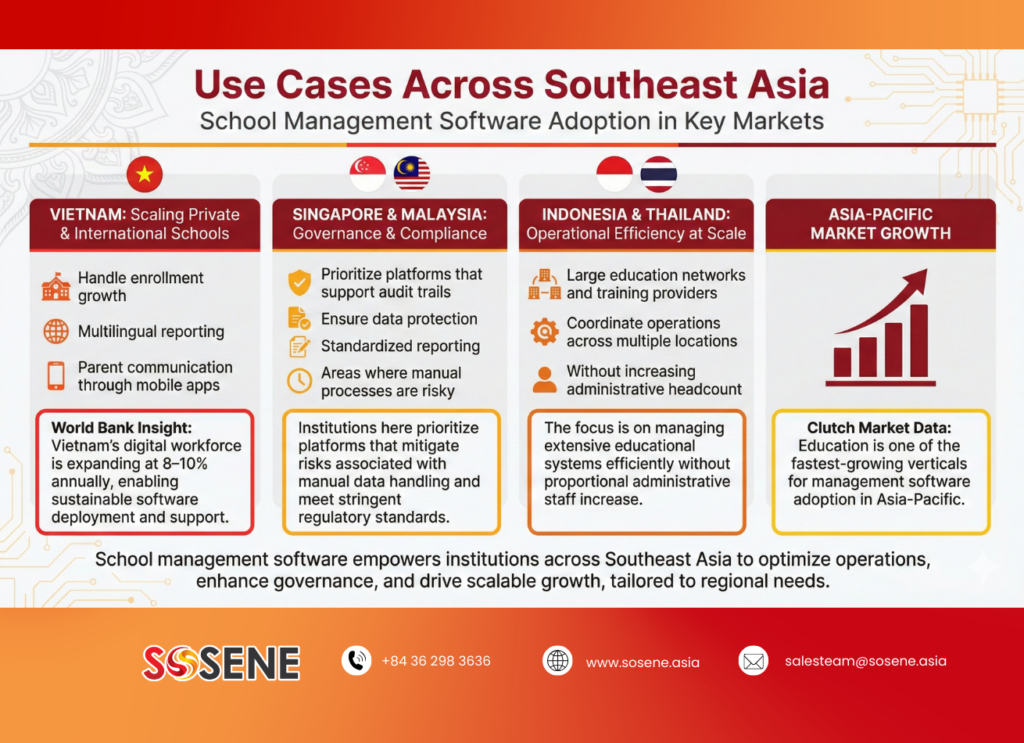
Private and international schools in Vietnam increasingly deploy all-in-one school management software to handle enrollment growth, multilingual reporting, and parent communication through mobile apps.
Vietnam’s education technology adoption is supported by a fast-growing IT ecosystem. According to World Bank, Vietnam’s digital workforce is expanding at 8–10% annually, enabling sustainable software deployment and support.
Singapore and Malaysia: Governance and Compliance
Institutions in Singapore and Malaysia prioritize software platforms that support audit trails, data protection, and standardized reporting—areas where manual processes are particularly risky.
Indonesia and Thailand: Operational Efficiency at Scale
Large education networks and training providers adopt school management system apps to coordinate operations across multiple locations without increasing administrative headcount.
Market data from Clutch shows education as one of the fastest-growing verticals for management software adoption in Asia-Pacific.
Why All-in-One School Management Software Matters
Fragmented systems create hidden costs:
- Integration failures.
- Inconsistent data.
- Higher support overhead.
An all-in-one school management software platform consolidates operations into a single source of truth. According to Gartner, organizations that consolidate systems reduce IT support costs by up to 25% while improving user adoption.
For education leaders, consolidation simplifies governance and lowers long-term risk.
Implementation Considerations for Education Leaders
When selecting school management software, leadership teams should assess:
- Scalability – Can the platform grow with enrollment and programs.
- Localization – Support for regional regulations and languages.
- Security – Protection of student and staff data.
- Integration Capability – Compatibility with LMS and finance systems.
- Vendor Partnership Model – Long-term support, not just deployment.
These principles align with digital governance frameworks recommended by PwC.
Conclusion

Manual operations are no longer a tolerable inefficiency in modern education. They introduce risk, limit scalability, and drain institutional capacity. School management software provides a structural solution—automating workflows, improving data quality, and enabling leadership teams to operate with clarity and confidence.
For institutions across Southeast Asia, the shift toward all-in-one school management software and school management system apps represents not just a technology upgrade, but an operational transformation. The real value lies not in digitization itself, but in the freedom it creates for educators and leaders to focus on learning outcomes.
Sosene is a trusted partner in Vietnam, helping education organizations ensure business continuity with innovative IT solutions and reliable software outsourcing services.
With strengths in cost-effectiveness, innovative technology, industry expertise, and scalability, Sosene supports schools and education providers in designing, building, and scaling robust school management software platforms.
FAQs
What is school management software?
It is a digital platform that automates administrative, academic, and operational processes in education institutions.
What are the main school management software benefits?
Improved efficiency, reduced errors, better data visibility, and scalable operations.
What is an all-in-one school management software?
A single platform that integrates student, academic, HR, finance, and communication modules.
Why use a school management system app?
Mobile access improves communication, real-time updates, and user adoption.
How does school management software support growth?
By automating manual tasks, enabling data-driven decisions, and reducing operational bottlenecks.