Introduction
Malaysia’s education sector is at a structural inflection point. Universities, private colleges, international schools, and education groups are no longer experimenting with digital tools—they are operating core academic and administrative functions on software platforms.
For project managers, HR leaders, and C-level executives in education, the challenge has shifted. The question is no longer whether to adopt technology, but how to design education software that is compliant, scalable, and aligned with Malaysia’s regulatory and institutional realities.
Off-the-shelf platforms often struggle with local requirements such as data governance, multi-campus operations, multilingual delivery, and integration with legacy systems. As a result, education software development, delivered by experienced education software development companies, is becoming a strategic priority for Malaysian institutions seeking long-term operational resilience.
Table of Contents
Key Takeaways
- Education software development is critical to Malaysia’s education digital maturity.
- Generic platforms often fail to meet Malaysian regulatory and operational needs.
- Custom education software improves governance, scalability, and cost control.
- Malaysia-based institutions increasingly rely on regional delivery partners for flexibility.
- The right education software development services enable resilience, not just digitization.
Further Reading
Malaysia’s Education Digital Landscape
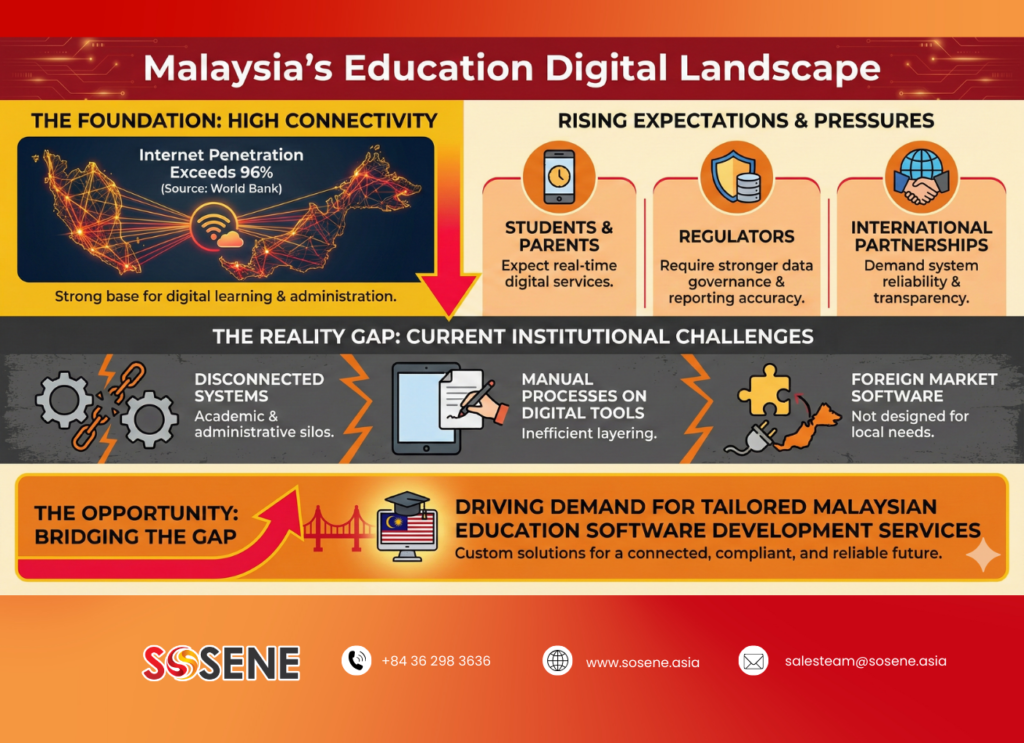
Malaysia has one of the most digitally connected education environments in Southeast Asia. According to World Bank data, 98% of people in Malaysia used the internet in 2024, creating strong foundations for digital learning and administration.
At the same time, expectations have increased:
- Students and parents expect real-time digital services.
- Regulators require stronger data governance and reporting accuracy.
- International partnerships demand system reliability and transparency.
Yet many institutions still operate with:
- Disconnected academic and administrative systems.
- Manual processes layered on top of digital tools.
- Software platforms designed for other markets, not Malaysia.
This gap is driving demand for education software development services tailored specifically to the Malaysian market.
What Education Software Development Means for Malaysia
Education software development refers to designing, building, customizing, and maintaining digital platforms that support academic delivery, administration, and governance within education institutions.
In the Malaysian context, this often includes:
- Learning Management Systems (LMS) customized for local curricula.
- Student Information Systems (SIS) aligned with regulatory reporting.
- Campus and school management platforms supporting multi-location operations.
- Analytics and reporting tools for accreditation and audits.
Platforms built around a school’s own processes avoid the workarounds that generic software forces on staff.
Why Custom Education Software Matters in Malaysia
Regulatory and Data Governance Requirements
Malaysia’s education institutions operate under strict data protection and governance expectations. Custom education software allows governance rules, audit trails, and reporting structures to be embedded directly into system architecture.
Building compliance into digital systems reduces regulatory risk and manual audit effort.
Multi-Campus and Group Education Models
Many Malaysian education providers operate:
- Multiple campuses.
- Franchise or partner institutions.
- International programs with shared systems.
Custom education software development services enable centralized governance while allowing operational flexibility across locations—something generic platforms often struggle to support.
Integration with Existing Enterprise Systems
Education software in Malaysia must integrate with finance, HR, identity management, and cloud platforms. Custom development enables integration without forcing institutions to redesign internal workflows.
Integration with existing systems often decides whether a digital project succeeds.
Education Software Development Services in Practice (Malaysia Use Cases)
Private Universities and Colleges
Private universities in Malaysia increasingly commission custom platforms to:
- Manage student lifecycle from enrollment to graduation.
- Support hybrid and blended learning models.
- Improve reporting accuracy for regulators and partners.
Automating academic and administrative workflows reduces manual effort in higher-education environments.
International Schools
International schools face complex requirements:
- Multilingual systems.
- International curriculum management.
- Parent communication across time zones.
Custom education software allows these institutions to unify operations without compromising flexibility or user experience.
Education Groups and Training Providers
Large education groups and professional training providers in Malaysia rely on custom software to:
- Standardize operations across branches.
- Track learner progress and outcomes.
- Scale programs without increasing administrative headcount.
Data-Driven Leadership Through Education Software
Modern education software centralizes data across academic, operational, and financial functions. This enables leadership teams to:
- Monitor enrollment and retention trends.
- Optimize staffing and resource allocation.
- Improve forecasting and strategic planning.
Integrated data platforms help leaders make timely, evidence-based decisions.
Selecting the Right Education Software Development Company
For Malaysian institutions, choosing an education software development company is a strategic decision.
Key evaluation criteria include:
- Education Domain Expertise – Understanding academic workflows and compliance needs.
- Security and Data Protection Capability – Proven handling of sensitive education data.
- Scalability – Ability to support enrollment growth and program expansion.
- Cost Transparency – Sustainable pricing aligned with long-term use.
- Long-Term Partnership Model – Ongoing support, not one-off delivery.
Why Malaysian Institutions Work with Regional Software Partners
While local vendors offer proximity, many Malaysian education providers increasingly collaborate with regional partners—particularly Vietnam-based teams—to balance quality and cost.
Vietnam has emerged as a strong delivery hub due to:
- Cost-effectiveness compared to Western providers.
- A rapidly maturing engineering talent pool.
- Strong experience in education and enterprise software.
- Cultural alignment with long-term partnerships.
Conclusion

Education software development for the Malaysia market is no longer about digitizing isolated processes. It is about building resilient, scalable, and compliant digital foundations that support long-term educational outcomes.
Custom education software gives Malaysian institutions control over operations, data, and growth—while reducing dependence on fragmented tools and manual workarounds. For project managers, HR leaders, and C-level executives, the right software strategy directly shapes institutional performance and credibility.
Sosene is a software development company in Vietnam. We design, build and support custom education software, such as school management systems, learning platforms and parent portals, and work remotely with institutions outside Vietnam.
For a real example, see how Sosene digitised operations for Little Angel Language Center with a custom school management platform.
FAQs
What is education software development?
It involves designing and building digital platforms tailored to education institutions’ academic and operational needs.
Why is custom education software important in Malaysia?
It aligns systems with local regulations, scalability requirements, and institutional workflows.
What services does an education software development company provide?
System design, development, integration, maintenance, and long-term support.
Why work with regional education software development services?
They offer cost efficiency, technical depth, and scalable delivery models.
How does education software support institutional growth?
By automating operations, improving data visibility, and enabling consistent digital experiences.