
Software project failure is rarely a technical limitation; it is a structural failure of clarity. In 2026, the global software development landscape has reached a point where AI agents can write 60–80% of code, yet only 16.2% of projects finish on time and within budget. The “scoping paradox” of the current market is that while we can build faster, we are losing time to misaligned expectations. For a CTO or COO in Singapore, the US, or Australia, the primary challenge is to scope software development such that internal squads and offshore partners remain synchronized across a 24-hour development cycle.
Bottom Line Up Front (BLUF): Strategic scoping in 2026 requires moving from static feature lists to dynamic “Objective-Validation Protocols.” By investing in a 2-4 week discovery phase, firms reduce rework costs by 3–5x and can leverage a “Follow-the-Sun” model to reduce delivery timelines by 30%.
Table of Contents
Key Takeaways
- The Clarity Premium: Upfront scoping clarity reduces development cycles by 40–60% by eliminating decision-making bottlenecks.
- The “Real Cost” Multiplier: Nominal offshore rates (e.g., $27/hr in Vietnam) must be adjusted for a “communication tax” (+15%) and “quality tax” (+15%), often yielding a real cost of $36/hr.
- Guardrails over Gates: Traditional manual approval gates cannot scale with AI-augmented velocity; 2026 leaders must implement automated policy-driven pipelines.
- Outcome-Based Pricing: Move away from Time & Materials toward milestone contracts where the partner absorbs the cost of architectural rework.
Further Reading
Understanding the 2026 Scope: Beyond Feature Lists
To define what is a scope in software development today, one must look past the “User Story.” In the current era, a development scope is a dynamic framework of business objectives and system boundaries.
When scoping is done incorrectly, organizations experience “Vibe Coding”—where AI-generated code snippets are merged without architectural judgment, leading to a 2,500% increase in software defects. High-performing teams avoid this by defining “non-negotiable guardrails” for security, data sovereignty (GDPR/SOC2), and integration density before the first sprint begins. Without these, every integration point beyond the first three adds 20–40% to the project duration.
The Framework: From Discovery to Asynchronous Handoffs
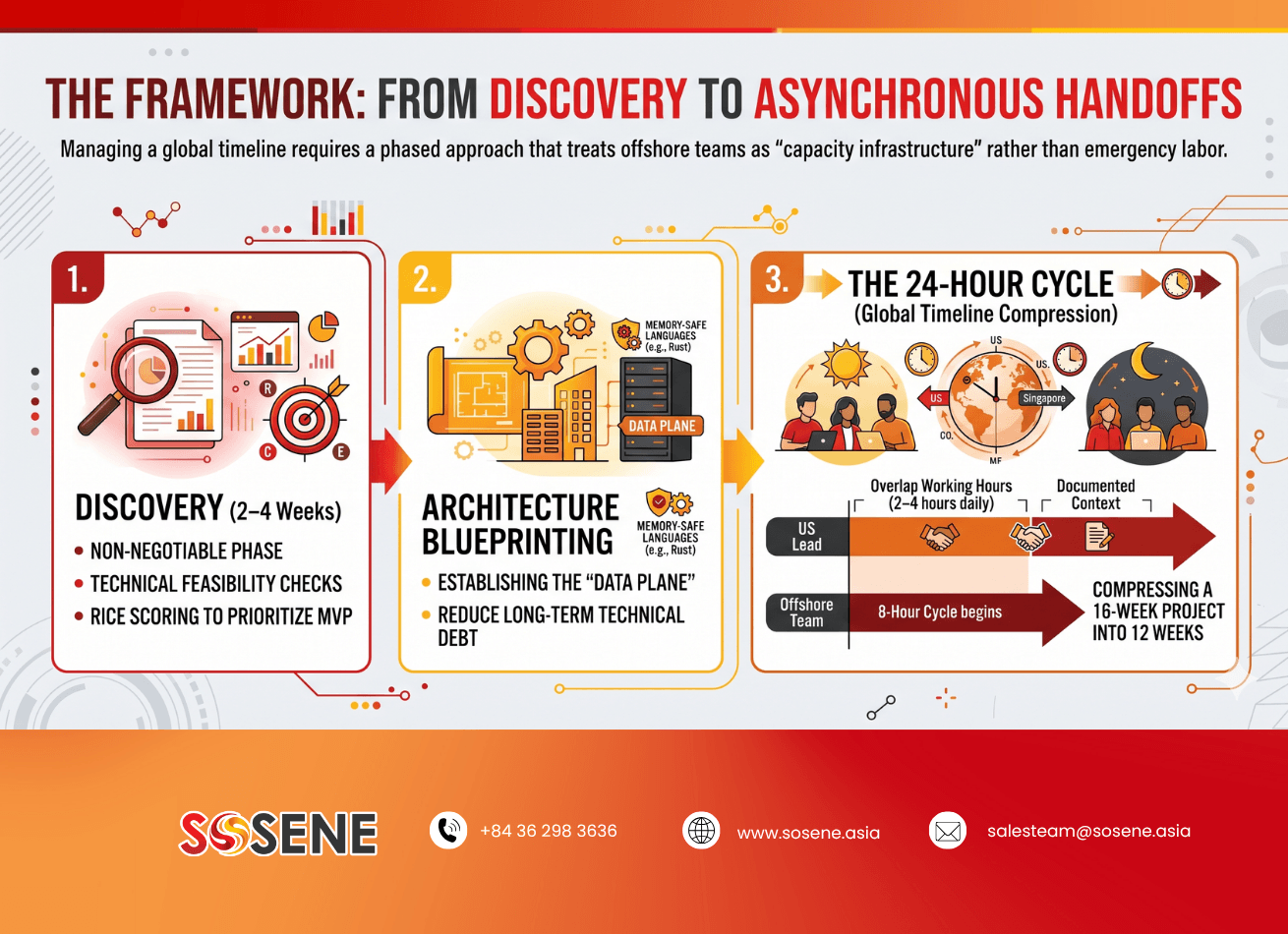
Managing a global timeline requires a phased approach that treats offshore teams as “capacity infrastructure” rather than emergency labor.
- Discovery (2–4 Weeks): This phase is non-negotiable. It includes technical feasibility checks and RICE (Reach, Impact, Confidence, Effort) scoring to prioritize the MVP.
- Architecture Blueprinting: Establishing the “Data Plane” and choosing memory-safe languages like Rust to reduce long-term technical debt.
- The 24-Hour Cycle: For a US or Singapore lead, synchronization involves “Overlap Working Hours” (2–4 hours daily). When the onshore team finishes, they provide documented context for the offshore team to begin their 8-hour cycle, effectively compressing a 16-week project into 12 weeks.
What Most Vendors Don’t Tell You
Outsourcing failure is rarely a talent problem; it is a “weak operating system” problem.
- The Hidden Communication Tax: Offshore projects typically see a 1.2–1.5x timeline multiplier due to communication overhead. If your vendor doesn’t use local representatives or high-proficiency English PMs, this gap widens.
- Shadow AI Risk: Developers may load sensitive company data into unauthorized AI models. Ensure your scope includes specific “AI Usage Guardrails” and ownership clauses for AI-assisted outputs.
- Integration Density: A project with 8+ external integrations will see its timeline increase by 100–200% compared to a standalone app. Most vendors underestimate this complexity during the sales cycle.
Typical Software Development Timeline (2025–2026)
Engineering leaders must base their roadmap on verified industry benchmarks rather than optimistic sales pitches.
A typical software development timeline in 2026 is driven by complexity and integration surface area. For a mid-market or enterprise organization, the benchmarks are:
- Simple Systems: 4–6 weeks (Internal tools or basic MVPs).
- Mid-Complexity Platforms: 3–7 months (Custom UI, 3–5 API integrations, payment processing).
- Enterprise-Grade Solutions: 6–24 months (Legacy system modernizations, HIPAA/SOC2 compliance, complex AI/ML pipelines).
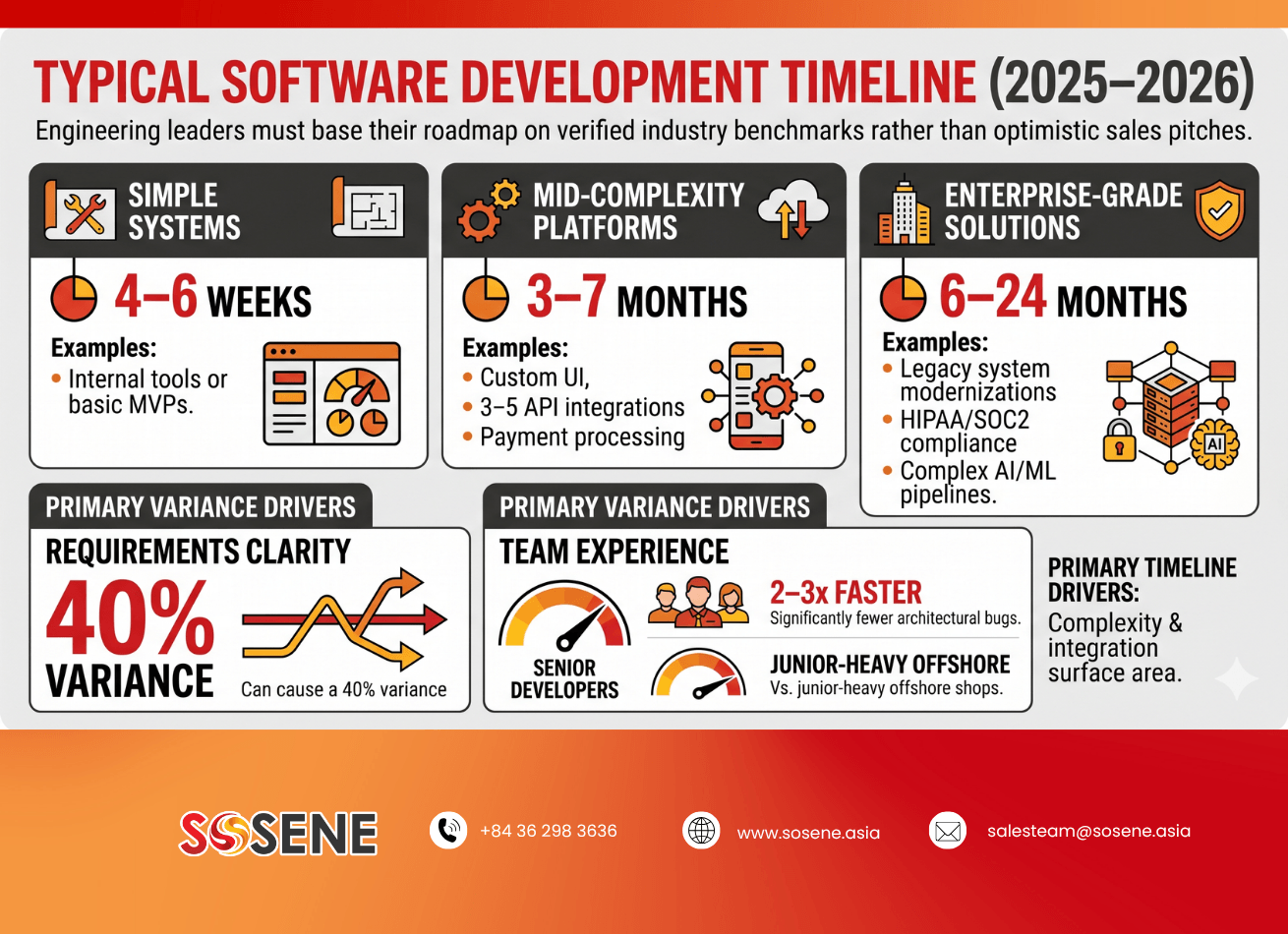
The primary timeline drivers are requirements clarity (which can cause a 40% variance) and team experience. Senior developers often complete tasks 2–3x faster with significantly fewer architectural bugs than junior-heavy offshore shops.
How to Evaluate Scoping for Your Project
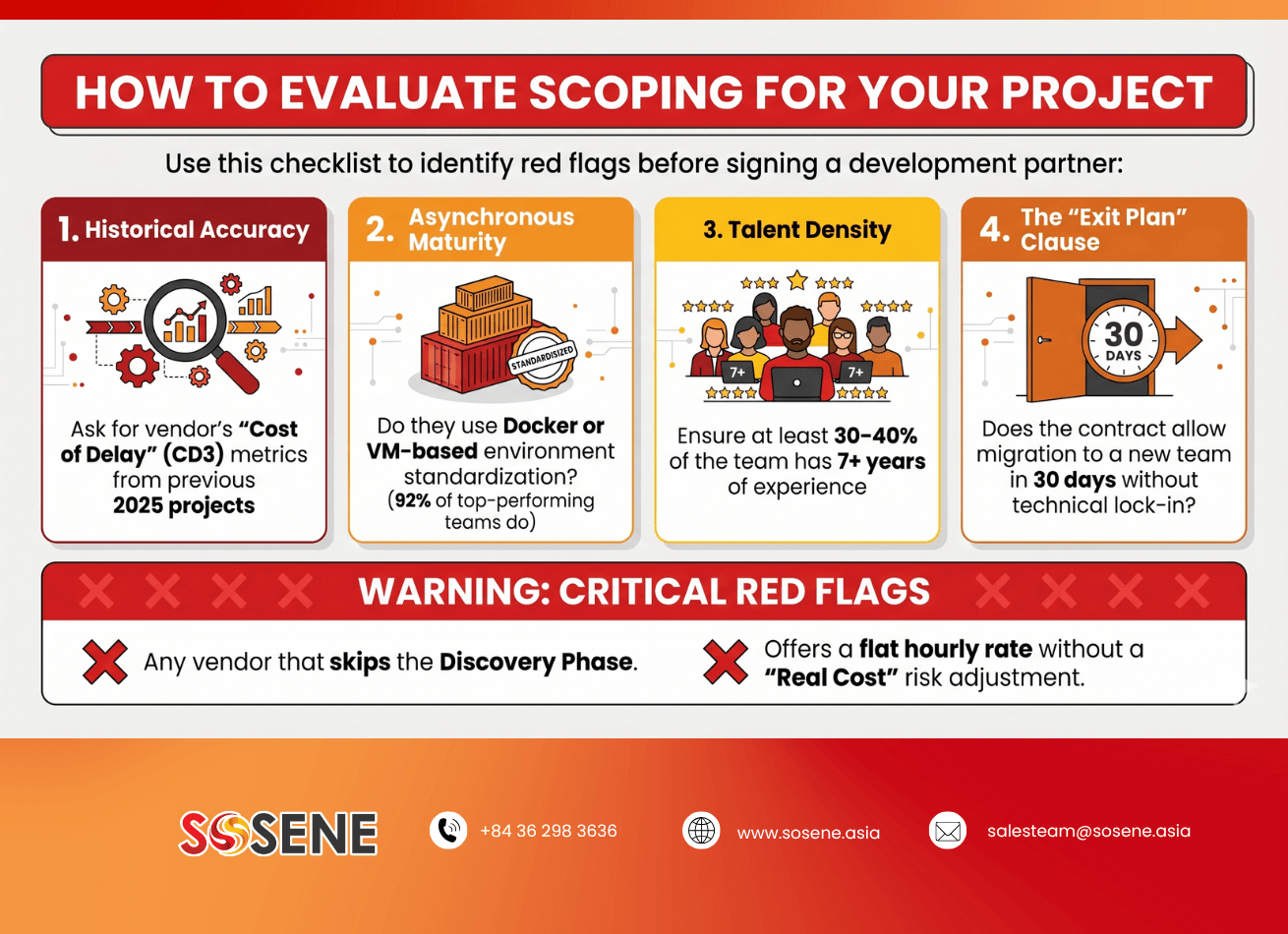
Use this checklist to identify red flags before signing a development partner:
- Historical Accuracy: Ask the vendor for their “Cost of Delay” (CD3) metrics from previous 2025 projects.
- Asynchronous Maturity: Do they use Docker or VM-based environment standardization? (92% of top-performing teams do).
- Talent Density: Ensure at least 30–40% of the team has 7+ years of experience.
- The “Exit Plan” Clause: Does the contract allow you to migrate to a new team in 30 days without technical lock-in?.
- Red Flag: Any vendor that skips the Discovery Phase or offers a flat hourly rate without a “Real Cost” risk adjustment.

Partnering with Sosone Software for Predictable Outcomes
If you are planning a project with high integration complexity or AI requirements, the structure of your delivery model matters more than the tech stack. In 2026, technology is the easy part—governance and process ownership are the differentiators. High-performing organizations treat their partners as “strategic collaborators” aiming for transformational outcomes rather than just tickets completed. If you are looking for a collaborator to engineer your delivery guardrails and ensure timeline predictability, contact our team to discuss your 2026 roadmap.
At Sosene, we provide the architectural oversight and process maturity needed to turn these partnerships into competitive advantages.
Sosene Team
Conclusion: Engineering the Future
Effective scope software development strategies in 2026 are centered on decision quality. By front-loading the discovery phase and adopting asynchronous handoff protocols, CTOs can reclaim thousands of engineering hours. The next step for your organization is not to find a cheaper rate, but to engineer a more mature delivery infrastructure that bridges the gap between your business objectives and code execution.
References List:
- Software Development Outsourcing Market Size, Share, Trends 2026 – 2031, accessed April 26, 2026, https://www.mordorintelligence.com/industry-reports/software-development-outsourcing-market
- 2026 Global Software Industry Outlook – Deloitte, accessed April 26, 2026, https://www.deloitte.com/us/en/insights/industry/technology/technology-media-telecom-outlooks/software-industry-outlook.html
- 2026 and Beyond: A CTO’s View on What’s to Come – Prove AI, accessed April 26, 2026, https://proveai.com/blog/2026-and-beyond-a-ctos-view-on-whats-to-come
FAQs
What is a scope in software development?
It is a defined framework of business goals, technical boundaries, and acceptance criteria that guides the development team. In 2026, it must also include AI guardrails and data sovereignty protocols.
How long does a typical software development project take?
Most projects span 4–9 months. Simple applications take 3–4 months, while complex enterprise platforms requiring legacy integrations often exceed 12 months.
Why do offshore projects often exceed their initial timelines?
Delays are usually caused by “communication loss” (adding 15–20% overhead) and “requirements volatility,” where vague specs can extend a timeline by 50–100%.
How does AI impact the software development lifecycle (SDLC)?
AI agents now write up to 80% of code, compressing traditional 6-month cycles into 6–12 weeks. However, this requires senior “engineers as managers” to prevent technical debt.
What is the ROI of a project discovery phase?
Investing in discovery typically saves 3–5x the cost in avoided rework. Projects with high cost clarity deliver 27% faster and have 18% fewer budget overruns.