In 2026, the primary risk for technology leaders in the US, Singapore, and Australia is no longer “can we build it,” but “can we ship before the market pivots.” Data from early 2026 shows that 70% of software projects still end in failure, budget overruns, or significant delays. Most of these failures are not caused by poor coding, but by choosing the wrong commercial “operating system” for the project.
For many, fixed price software development appears to be the safest route to budget predictability. However, as global IT spending exceeds US$6 trillion in 2026, the structural rigidity of fixed-bid contracts often results in “minimalistic compliance”—where vendors meet the letter of the contract while sacrificing the product’s long-term technical health . To manage a software development timeline effectively, decision-makers must distinguish between commodity builds and strategic IP.
Table of Contents
Key Takeaways
- The AI Productivity Shift: AI-native offshore teams are now delivering features 40–55% faster than traditional models, making speed-to-market a higher priority than upfront cost certainty .
- The “Fixed Price” Tax: Approximately 35% of fixed-price projects face scope disputes, with change orders averaging 15–25% of the original contract value.
- The Series A Inflection Point: While fixed-price works for pre-seed MVPs, 96% of growth-stage firms migrate to dedicated teams to maintain domain knowledge and architectural continuity.
- Compliance Deadlines: For AU-based firms, the July 1, 2026 deadline for APRA CPS 230 makes vendor “operational resilience” a legal requirement, favoring dedicated, transparent partnerships over opaque fixed-bid units .
Further Reading
Fixed Price Software: The Predetermined Budget Trap
A fixed price software contract is a commercial agreement where the scope, timeline, and budget are locked before development starts . On paper, it shifts the financial risk to the vendor. In reality, it often shifts the product risk to the buyer.
When a vendor accepts a fixed price for an evolving 2026 AI-first product, they must insulate their margins. This leads to a “Risk Premium” of 10–20% baked into the bid. If the project hits unexpected technical hurdles—common in 75% of IT projects—the vendor’s incentive shifts from innovation to cost-cutting.
What happens if done wrong:
- Change Request Spirals: Every pivot requires a formal renegotiation, stalling velocity.
- Technical Debt (The Shortcut Tax): Developers take shortcuts to meet fixed milestones, leading to a “fragile codebase” that requires a total refactor within 12 months.
- Gold Plating: Vendors may add unnecessary, easily-built features to show progress while ignoring complex, high-value integrations.
The 75/50/40 Framework: Why Real Delivery Decays
Managing timelines with a partner requires understanding the “75/50/40 Rule” observed across mid-market projects in 2025 and 2026 :
- 75% of projects exceed their initial budget estimates.
- 50% of schedules extend beyond the original launch date.
- 40% of delivered value falls short of the business case.
To avoid this, high-performing teams have moved toward a Dedicated Team Model—a monthly retainer for a full-time pod of engineers (e.g., 1 Tech Lead, 2 Devs, 1 QA).
| Model | Time to Start | Change Cost | Quality Incentive | Best For |
|---|---|---|---|---|
| Fixed Price | 4–8 weeks | High (Fees) | Low (Margins) | <$50k MVPs, <6 weeks |
| Dedicated Team | 3–7 days | Included | High (Ownership) | Core IP, >6 months |
What Most Vendors Don’t Tell You: The “Quality Tax”
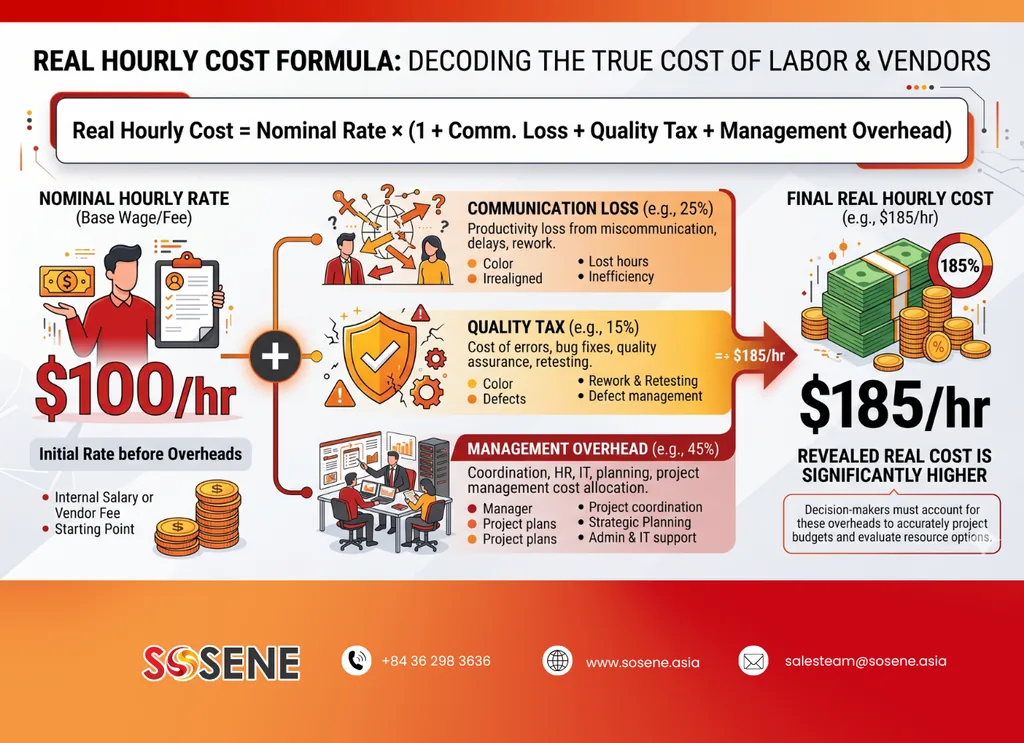
Behind the headline hourly rate lies the Real Hourly Cost. For buyers in Singapore or San Francisco, a senior developer in Vietnam ($35/hr) or India ($29/hr) looks attractive . However, without a process-led infrastructure, you pay a “Quality Tax” .
Hidden Delays and Costs:
- Asynchronous Communication Tax: Teams with a >8-hour time zone difference often face a 15–20% productivity loss due to approval latency.
- The Revision Cycle: In weak operating systems, revision cycles can consume 30–50% of the budget if quality checkpoints are not predefined.
- Ramp-Up Investment: An offshore team typically reaches 85% productivity only at the 4.6-month mark. If you use a fixed-price model for a 3-month project, you are paying for the team to learn your business, not to build it.
Formula for Real Cost:
Real Hourly Cost = Nominal Rate(1 + Comm. Loss + Quality Tax + Management Overhead)
What is the typical software development timeline in 2026?
For modern B2B software, delivery is measured in “Cycle Time” (the time from code start to production) rather than months. According to 2026 engineering benchmarks :
- Elite Teams: Achieve cycle times of <8 hours by using AI-native workflows (GitHub Copilot, Cursor) and automated CI/CD pipelines.
- High Performers: Ship in 8–24 hours, typically deploying to production daily or multiple times per day.
- Median Teams: Take 24–72 hours per feature, usually hindered by manual PR (Pull Request) reviews or legacy testing gates.
- Struggling Projects: Experience cycle times of >168 hours (7+ days), often due to “Scope Creep” or “Knowledge Silos” where offshore teams are treated as mere ticket-processors rather than domain owners.
How to Evaluate the Right Model for Your Project
Choosing between fixed price software projects and a dedicated team requires a cold assessment of your internal readiness. If you cannot document a workflow clearly enough for a new hire to execute it without a call, you are not ready for a fixed-price bid.
The Decision Checklist:
- Scope Stability: Is the roadmap locked for the next 12 weeks? (Yes = Fixed Price; No = Dedicated Team).
- Regulatory Load: Does the project fall under APRA CPS 230 (Australia) or MAS (Singapore) guidelines? If yes, the “Direct Control” of a dedicated team is essential for audit readiness .
- AI Readiness: Does the vendor use AI coding assistants to increase productivity by 35–45%? .
- Red Flag: If a vendor quotes a fixed price for a “Discovery Phase” shorter than two weeks, they are likely guessing on requirements.

Partnering with Sosone Software for Predictable Outcomes
If you are planning a project with high technical complexity, the structure of your delivery model matters more than the tech stack. In 2026, the most successful firms in Singapore and the US treat their offshore partners as “Strategic Pods” rather than “Labor Units.”
At Sosene, we’ve observed that the highest ROI—often exceeding 6x over 12 months—comes from teams that integrate deeply into your Slack channels and sprint ceremonies. This level of integration reduces “Decision Latency” and ensures that the software delivered in month six is what the market actually needs, not what was guessed in month one.
At Sosene, we've observed that the highest ROI—often exceeding 6x over 12 months—comes from teams that integrate deeply into your Slack channels and sprint ceremonies.
Sosene Team
Conclusion: The Maturity Shift
The debate over fixed price software vs. dedicated teams is a debate over rigidity vs. resilience. For one-time migrations or “bounded” MVPs, fixed price offers a clean exit. But for products intended to scale in the AI era, the dedicated model provides the continuity required to manage technical debt and pivot at market speed.
Next Step: Conduct a “3-week assessment” of your current roadmap. If more than 30% of your requirements are “evolving,” pivot your engagement model toward a dedicated team before the “Change Request” fees erode your margin.
References List:
- 2026 Global Hardware and Consumer Tech Industry Outlook – Deloitte, accessed April 26, 2026, https://www.deloitte.com/us/en/insights/industry/technology/technology-media-telecom-outlooks/hardware-consumer-tech-outlook.html
- Software Development Statistics for 2026: Key Facts & Trends – Itransition, accessed April 26, 2026, https://www.itransition.com/software-development/statistics
- Why software projects fail? The real causes of failure that leaders often ignore, accessed April 26, 2026, https://ardura.consulting/blog/why-software-projects-fail-real-causes-leaders-ignore/
- 2026 Global Software Industry Outlook – Deloitte, accessed April 26, 2026, https://www.deloitte.com/us/en/insights/industry/technology/technology-media-telecom-outlooks/software-industry-outlook.html
- Software Development Outsourcing Statistics 2026, accessed April 26, 2026, https://keyholesoftware.com/software-development-outsourcing-statistics/
FAQs
What is the average cost of an enterprise software project in 2026?
Enterprise builds typically range from US$200,000 to US$1M+, depending on complexity and compliance requirements like SOC 2 . For AI-integrated platforms, costs often start at $50,000 for a small MVP .
How do AI coding tools impact fixed-price contracts?
AI tools increase developer productivity by 35–45% . This allows projects to grow in scope rather than drop in price; companies are now getting more features for the same budget rather than lower total costs .
Why do 70% of fixed-price projects fail to meet their original timeline?
The primary cause is “Scope Creep” and “Fuzzy Requirements”. In a rigid contract, any requirement change triggers a renegotiation that halts development for 2–4 weeks.
What are the regional senior developer rates for 2026?
Senior specialists in the US bill $150–$350/hr, while Singapore averages $75–$120/hr . High-quality offshore hubs like Vietnam or Poland offer senior talent at $35–$70/hr .
How can I manage an offshore team without micromanaging?
Establish a “Hybrid Operating Rhythm” with a fixed 2–4 hour daily overlap window for synchronous blockers. Use outcome-based KPIs like “Cycle Time” and “Deployment Frequency” rather than tracking hours logged.