If you run an education business in Vietnam, 2026 is not “another digitization year”. It is a structural shift. New reforms are pushing more formal, digital-first operations across credentials, exams, and learning delivery. .
At the same time, the market is crowded. Parents, learners, and corporate buyers are comparing outcomes, not content libraries. In this environment, generic tools often create fragmented data, weak retention, and limited differentiation.
This article is for education owners and operators who want control, scale, and measurable learning outcomes. You will learn what to build, what to avoid, how to budget, and how to select a vendor with confidence. If you want a clear build plan and cost range for your platform, Sosene can run a short discovery sprint and give you a roadmap you can execute.
Table of Contents
Key Takeaways
- In 2026, education platforms in Vietnam must be designed for compliance, trust, and mobile-first usage, not just course hosting.
- The biggest risk is not “build cost”, it is building the wrong system that creates data silos and weak retention.
- A scalable platform usually costs more than an MVP, but it unlocks revenue streams and lowers per-student operating costs over time.
- Vendor selection should be evidence-based: live product proof, security posture, and post-launch support matter more than pitch decks.
Further Reading
Why “custom” is becoming the default strategy for Education Platforms in Vietnam
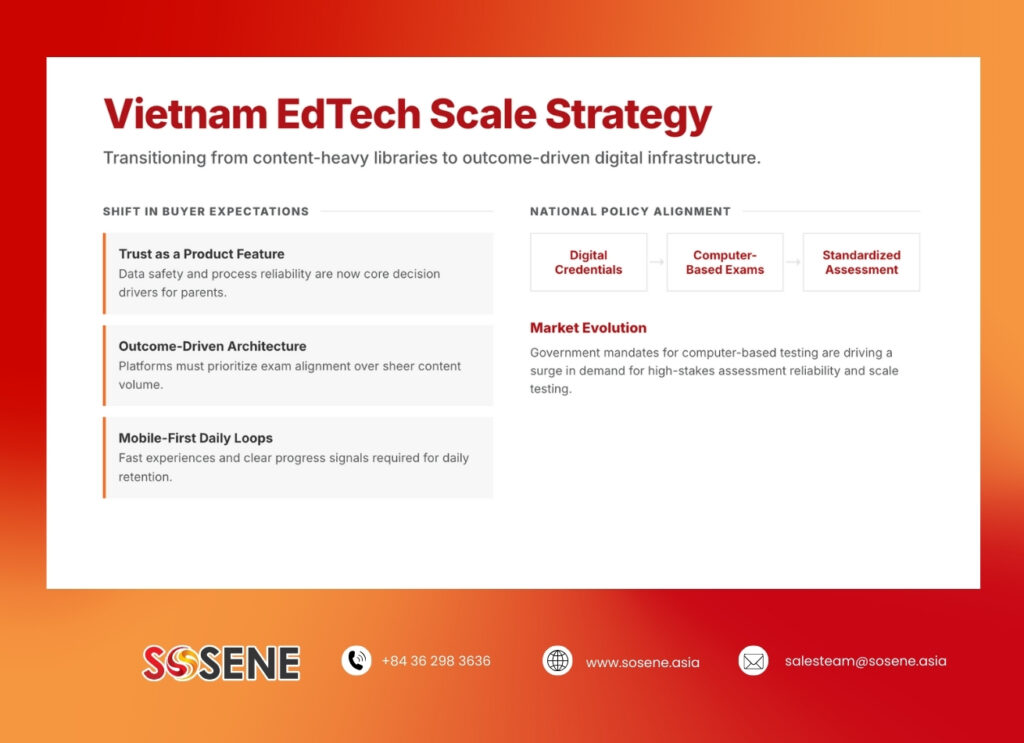
Vietnam’s education sector is moving toward more standardized digital operations, including reforms that support digital credentials and broader digital transformation expectations. Separately, the government direction toward computer-based national exams increases the need for reliable assessment workflows, scale testing, and data readiness.
For education businesses, this changes buyer expectations in three ways.
1) Trust is now a product feature.
Parents and corporate buyers care about student data safety and process reliability. They want clean progress reporting, stable access, and fewer manual steps.
2) Outcomes beat content libraries.
Vietnam’s EdTech market is growing with platforms that focus on personalization, exam alignment, and always-on support. That pushes the market toward measurable improvement, not “more videos”. .
3) Mobile-first is not optional.
Your platform has to win daily usage. In practice, that means fast mobile experiences, short learning loops, and clear progress signals.
In Vietnam, “custom” is not only a technology choice. It is a pricing model choice. SaaS tools often scale cost with users. Custom platforms scale capability with users. That difference becomes strategic once you cross a few hundred learners.
Should You Invest in Custom Software for Education?
At this stage of your business, will a custom platform create strategic advantage or unnecessary risk?
| Decision Factor | Strong Signal to Invest in Custom Software | Signal to Use Off-the-Shelf Tools |
|---|---|---|
| Regulatory & Compliance | You must comply with MOET standards, national testing formats, or local reporting requirements. | Compliance needs are minimal or non-existent. |
| Teaching Model | Your pedagogy or curriculum is unique and does not fit standard LMS workflows. | Your teaching model is generic and easy to standardize. |
| Branding & Ownership | You want full control over UX, student data, and long-term product roadmap. | You are comfortable depending on a third-party platform. |
| Scale Strategy | You plan to scale across locations or grow large online cohorts. | Your operation is small or growth plans are uncertain. |
| Technology Depth | You require AI tutors, advanced analytics, or deep internal system integrations. | Basic video, quizzes, and class management are sufficient. |
| Time-to-Market | You can invest 4–12 months to build long-term advantage. | You must launch within weeks, not months. |
| Financial Readiness | You can invest upfront to reduce long-term per-student costs. | Budget constraints require the lowest initial spend. |
If you already serve 500+ students or expect to reach that scale within 12–18 months, a custom education platform often pays for itself through:
- Higher student retention,
- Lower operational cost per learner
- The ability to introduce premium or B2B offerings.
If you are still validating demand, competing mainly on price, or experimenting with formats, off-the-shelf tools usually reduce risk.
If You Decide to Build: What Your Education Platform Must Include in 2026

Many education owners start with a feature wishlist. The better approach is an operating model.
A strong platform is a system that connects learning delivery to business outcomes. It reduces manual labor, increases retention, and enables premium pricing.
Core modules that most Vietnamese platforms need.
Identity and access. Roles for students, teachers, parents, and admins. Clear audit logs.
Learning delivery. Courses, lessons, live sessions, homework, and feedback loops.
Assessment. Quiz engine, question bank, timed tests, and proctoring options for higher-stakes scenarios. This matters more as computer-based testing grows. .
Analytics. Progress dashboards, cohort views, drop-off detection, and outcome reporting.
Add-ons that create differentiation.
AI personalization. Adaptive learning paths and targeted remediation. In Vietnam, this is increasingly tied to competition and learner expectations in AI-heavy course categories. .
Teacher assist tools. Lesson planning support, faster grading workflows, and content recommendation.
Parent reporting. Automated weekly reports and intervention alerts.
Integrations that prevent data silos.
Data silos happen when you bolt tools together without a single source of truth. Your platform should integrate at three levels:
- Content standards. SCORM or xAPI support if you sell B2B training programs.
- Payment and billing. Local payment rails and invoice workflows.
- CRM and messaging. Lifecycle automation for retention and re-enrollment.
“Most education platforms fail because they optimize learning content, not learning operations. The winners reduce friction and make outcomes visible.”
Budget and timeline: what “good” looks like for a serious platform.
In 2026, Vietnam is still cost-competitive for software development compared to many markets, which is one reason global buyers consider it for builds and scale work.
But education platforms are not simple apps. Your budget should reflect product risk, compliance needs, and post-launch iteration.
Practical budget bands for education owners.
MVP platform. Often used to validate demand and delivery.
- Typical scope: auth, course delivery, basic assessments, admin panel.
- Risk: you may lock in weak architecture that becomes expensive to fix later.
Scalable platform. The “growth-ready” tier for most serious centers.
- Scope: mobile-first UX, analytics, automation, integrations, strong content workflows.
- Outcome: better retention and operational leverage.
Enterprise ecosystem. Multi-tenant, B2B licensing, advanced security, and AI layers.
- Scope: deeper analytics, robust security, compliance-ready reporting, and scale testing.
Timeline expectations.
A real platform is built in phases, not one big release.
- Phase 1: Discovery and product blueprint.
- Phase 2: MVP build and pilot cohort.
- Phase 3: Scale features, analytics, automation, and integrations.
| Platform Type | Typical Timeline | Estimated Cost Range (USD) | Core Capabilities |
|---|---|---|---|
| Basic MVP | 2–4 months | $8,000 – $20,000 | User login, course upload, basic assessments. |
| Mid-Sized Platform | 6–9 months | $25,000 – $80,000 | LMS integrations, video classes, gamification, mobile access. |
| Enterprise / AI Platform | 9–18+ months | $80,000 – $150,000+ | AI personalization, advanced analytics, strong security, national integrations. |
Short timelines reduce cost but also reduce differentiation. Platforms built too quickly often require expensive rewrites later.
If your vendor cannot show a structured plan for post-launch iteration, you are not buying a platform. You are buying a one-time project, which is a different risk profile.
How to choose the right vendor in Vietnam: a buyer-side checklist.

Most vendor mistakes come from unclear requirements and shallow evaluation. The goal is not to hire “a dev team”. The goal is to hire a product delivery system.
Step 1: Define outcomes before features.
Write down:
- Your student segments and learning goals.
- Your retention targets.
- Your operational bottlenecks today.
- Your “premium tier” idea, if you want higher pricing.
This is where custom education solutions can become a real decision lens. If your market is “mass”, you need cost efficiency. If your market is “premium outcomes”, you need analytics and personalization.
Step 2: Demand proof, not promises.
Ask for:
- Live platforms they operate today.
- A walk-through of analytics dashboards.
- Evidence of handling peak load periods.
Step 3: Validate compliance readiness.
Vietnam’s education environment is evolving. Reforms and digital-first expectations make process alignment important. .
Ask how they handle:
- Data privacy and access controls.
- Audit logs and role-based permissions.
- Security practices and incident response.
Step 4: Evaluate the delivery model.
A serious vendor should show:
- Discovery sprint format.
- Product backlog and sprint cadence.
- QA approach and release checklist.
- Post-launch SLA and maintenance plan.
Step 5: Contract for learning, not just delivery.
Your contract should include:
- IP ownership terms.
- Milestone-based payments tied to deliverables.
- A change control process.
- Support terms for 6–12 months.
In education, your platform is not a cost center. It is your operating system. Treat vendor selection like hiring a leadership partner, not a production vendor.
Case example: English teaching center using custom software for education.
Imagine a fast-growing English center in Vietnam.
Before.
They use Zoom, spreadsheets, and chat apps. Teachers grade manually. Parents get inconsistent updates. Students churn after a few months.
After (custom platform).
They launch a mobile-first platform that includes:
- Daily speaking practice with instant feedback loops.
- Personalized homework based on weak skills.
- Gamified streaks and weekly goals.
- Automated parent dashboards and intervention alerts.
| Dimension | Before (Off-the-shelf tools) | After (Custom Software for Education) | Impact on Business |
|---|---|---|---|
| Learning Delivery | Video calls and PDFs via Zoom or Google Classroom. | Mobile-first platform with structured lessons and daily practice flows. | Learning becomes habitual, not session-based. |
| Speaking Practice | Limited to live class time only. | AI-supported speaking practice with instant feedback, available 24/7. | Faster skill improvement and higher perceived value. |
| Homework & Assessment | Manual grading by teachers, delayed feedback. | Personalized homework auto-generated and partially auto-graded by the system. | Teachers focus on high-value instruction instead of repetitive tasks. |
| Parent Communication | Inconsistent updates via messages or calls. | Automated parent dashboards with weekly progress reports. | Stronger trust, fewer complaints, higher renewal rates. |
| Student Engagement | Drops outside class hours. | Gamified daily practice, streaks, and progress milestones. | Higher engagement and course completion rates. |
| Student Retention | High churn due to low differentiation. | Learning history and progress are stored in one ecosystem. | Reduced churn and stronger long-term lock-in. |
| Revenue Model | Tuition only, price-sensitive competition. | Tuition + premium AI tiers + app-only subscriptions. | New revenue streams without increasing classroom capacity. |
| Brand Positioning | “Another English center”. | “Technology-enabled learning system”. | Easier premium pricing and word-of-mouth growth. |
Business impact.
- Higher retention because progress is visible and habit-based.
- Premium pricing because outcomes feel measurable.
- Lower admin load because reporting is automated.
- New revenue streams through app-only subscription tiers.
This is where education software programs become more than “tools”. They become distribution, retention, and brand trust.
Why is Sosene your strategic enabler?

Education platforms fail when they are built like generic apps. They win when they are built like outcome systems.
At Sosene, our approach is buyer-side and operator-first:
- We start with outcome design and data flows, not feature lists.
- We build to avoid silos, so you can scale operations and reporting.
- We plan for post-launch iteration, because education products are never “done”.
- We design for global market entry, so your platform can serve Vietnam and expand beyond it.
If you want a platform plan that aligns product, operations, and revenue, Sosene can run a structured discovery sprint and deliver a scope, budget, and launch roadmap you can execute with confidence.
Conclusion
In 2026, building custom software for education in Vietnam is no longer a niche move. It is a strategic response to compliance pressure, buyer expectations, and a market that rewards measurable outcomes. .
The platform you build should reduce friction, unify your data, and make progress visible. That is what increases retention and supports premium pricing. It is also what makes expansion easier when you move from one center to many, or from B2C to B2B licensing.
If you are hiring a vendor, focus less on hourly rates and more on delivery maturity, proof of live systems, and post-launch capability. Vietnam can be a strong build hub, but only if you approach it with an operating model mindset. .
Sosene exists to help education operators build platforms that behave like growth assets, not one-off IT projects. If you are targeting a $10,000+ initiative, the next best step is a discovery sprint that turns your idea into a buildable, measurable plan. Reach out to Sosene to map your platform scope, timeline, and ROI levers before you commit budget.
Citations
- VietNamNet, “Vietnam rolls out sweeping education reforms effective January 2026.” – https://vietnamnet.vn/en/vietnam-rolls-out-sweeping-education-reforms-effective-january-2026-2478081.html
- VietNamNet, “Government mandates computer-based national exams by 2026.” – https://vietnamnet.vn/en/government-mandates-computer-based-national-exams-by-2026-2443279.html
- VietNamNet, “Vietnam’s edtech market surges with AI-driven, locally adapted platforms.” – https://vietnamnet.vn/en/vietnam-s-edtech-market-surges-with-ai-driven-locally-adapted-platforms-2424532.html
FAQs
What is custom software for education?
Custom software for education is a platform built specifically around your teaching model, learners, and business goals, rather than adapting to a generic LMS. It gives full control over features, data, branding, and scalability.
Why is 2026 a critical year to build education platforms in Vietnam?
In 2026, Vietnam is enforcing more formal digital education operations, including computer-based exams and structured reporting. Education providers using only generic tools risk falling behind in compliance, trust, and outcomes.
How much does it cost to build a custom education platform in Vietnam?
A basic MVP typically costs $8,000–$20,000, while scalable platforms range from $25,000–$80,000. AI-driven or enterprise platforms can exceed $100,000, depending on complexity and integrations.
How long does it take to build custom software for education?
Most custom education platforms take 4–12 months to build. Simple MVPs may launch in 2–4 months, while AI or enterprise platforms often require 9–18 months.
When does a custom education platform pay for itself?
A custom platform often pays for itself when an organization reaches 500+ learners or plans to do so within 12–18 months. Returns come from higher retention, lower per-student costs, and premium offerings.
When should I NOT build a custom education platform?
You should not build a custom platform if you need to launch immediately, have a limited upfront budget, or are still testing market demand. In these cases, off-the-shelf tools reduce risk.
How does custom software improve student retention?
Custom platforms improve retention by centralizing learning data, personalizing practice, and making progress visible. When learners see measurable improvement, they are less likely to switch providers.
What features matter most in a 2026 education platform?
The most important features are identity management, assessments, analytics dashboards, mobile-first learning flows, and system integrations. AI personalization and automated reporting become key differentiators at scale.
How is a custom platform different from Moodle, Google Classroom, or Zoom?
Off-the-shelf tools scale cost with users and limit customization. Custom platforms scale capability with users and are designed around your specific operations and growth strategy.
What should I look for when choosing a development vendor in Vietnam?
Look for proven education platforms, a clear post-launch roadmap, compliance readiness, and long-term support. Vendor maturity matters more than hourly rates.
Can custom education software generate additional revenue?
Yes. Custom platforms enable premium AI tiers, app-only subscriptions, and B2B licensing. Over time, the platform itself becomes a monetizable business asset.
Why work with Sosene instead of a typical development agency?
Sosene designs education platforms as outcome-driven systems, not one-off IT projects. The focus is on scalability, measurable results, and long-term business value.