As Asian enterprises grow, IT often shifts from a support function into a structural business dependency. What once worked through informal processes, individual expertise, and quick fixes begins to break under scale. Incidents recur, costs fluctuate unpredictably, and delivery slows—not because technology is inadequate, but because IT operations have outgrown their maturity.
This is where a managed IT maturity model becomes a business tool rather than an IT abstraction. At scale, maturity determines whether IT enables growth or quietly constrains it. By the end of this article, you will understand how to assess managed IT maturity in an Asian enterprise context, why global models often fall short regionally, and how maturity progression translates directly into cost control, reliability, and execution speed.
Table of Contents
Key Takeaways
- Reactive IT operations scale risk faster than they scale value → enterprises experience higher cost volatility and slower delivery → maturity provides structural control.
- Asian enterprises require context-aware maturity models → regulatory diversity and uneven talent markets distort one-size-fits-all frameworks → adaptation matters more than labels.
- Managed IT maturity spans strategy, operations, data, people, and governance → focusing on tools alone creates false progress → process and alignment drive real gains.
- Mixed maturity across departments increases hidden operational risk → incidents and dependencies compound silently → assessment must be multi-dimensional.
- Phased maturity roadmaps reduce disruption → stability and visibility come before optimization → business continuity is preserved while capability improves.
Further Reading
What a Managed IT Maturity Model Is and Why It Matters
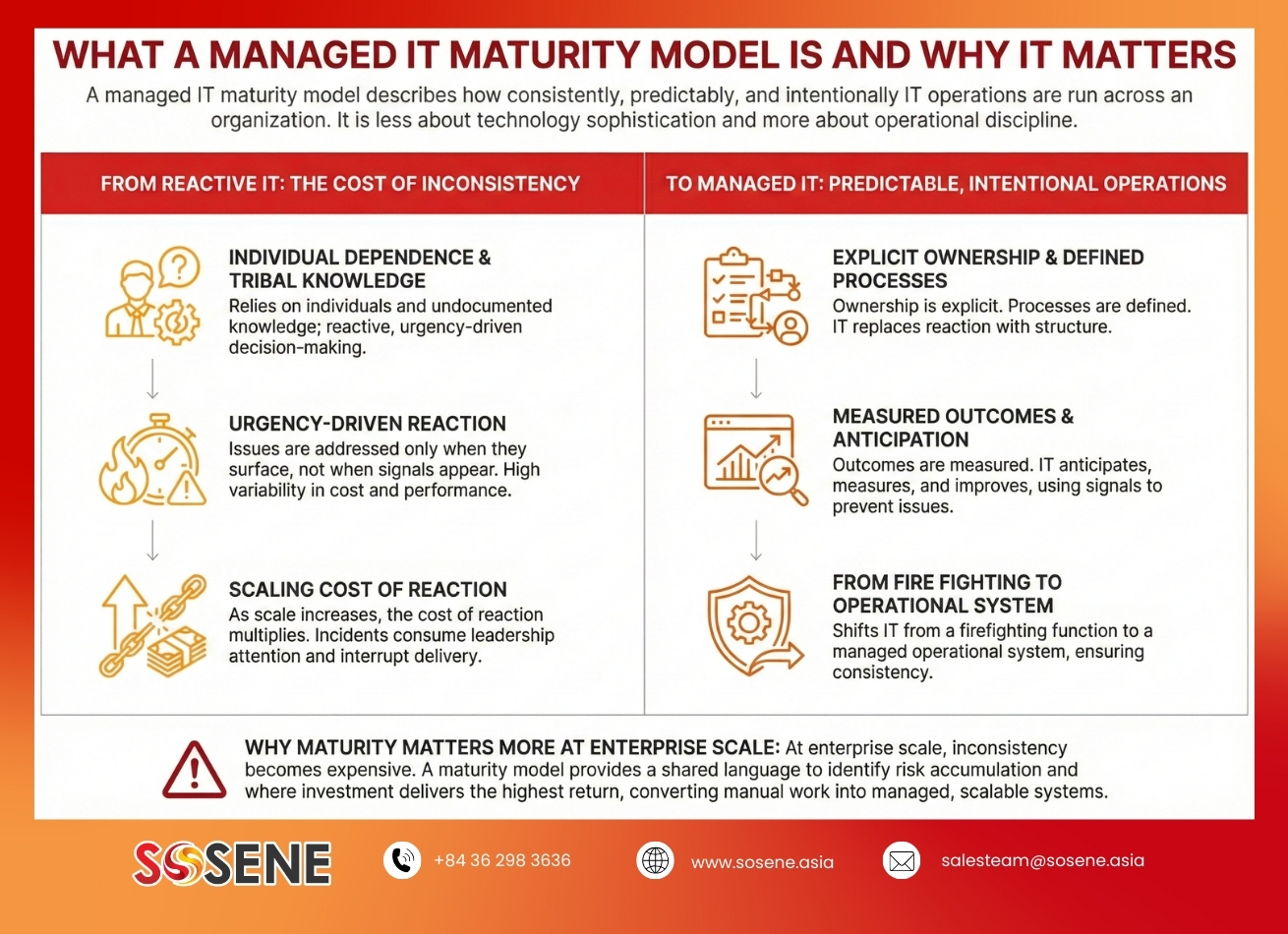
A managed IT maturity model describes how consistently, predictably, and intentionally IT operations are run across an organization. It is less about technology sophistication and more about operational discipline. At early stages, IT reacts. At higher stages, IT anticipates, measures, and improves.
From reactive IT to managed IT
Reactive IT relies on individuals, tribal knowledge, and urgency-driven decision-making. Issues are addressed when they surface, not when signals appear. This works in small environments, but as scale increases, the cost of reaction multiplies. Each incident consumes leadership attention, interrupts delivery, and introduces variability into cost and performance.
Managed IT replaces reaction with structure. Ownership is explicit. Processes are defined. Outcomes are measured. Over time, this shifts IT from a firefighting function to a managed operational system.
Why maturity models matter more at enterprise scale
At enterprise scale, inconsistency becomes expensive. One team following defined processes while another improvises creates systemic risk. Manual work that feels manageable in isolation compounds across hundreds of services and users. A maturity model provides a shared language to identify where risk accumulates and where investment delivers the highest return.
Why Asian Enterprises Need a Context-Aware IT Management Maturity Model
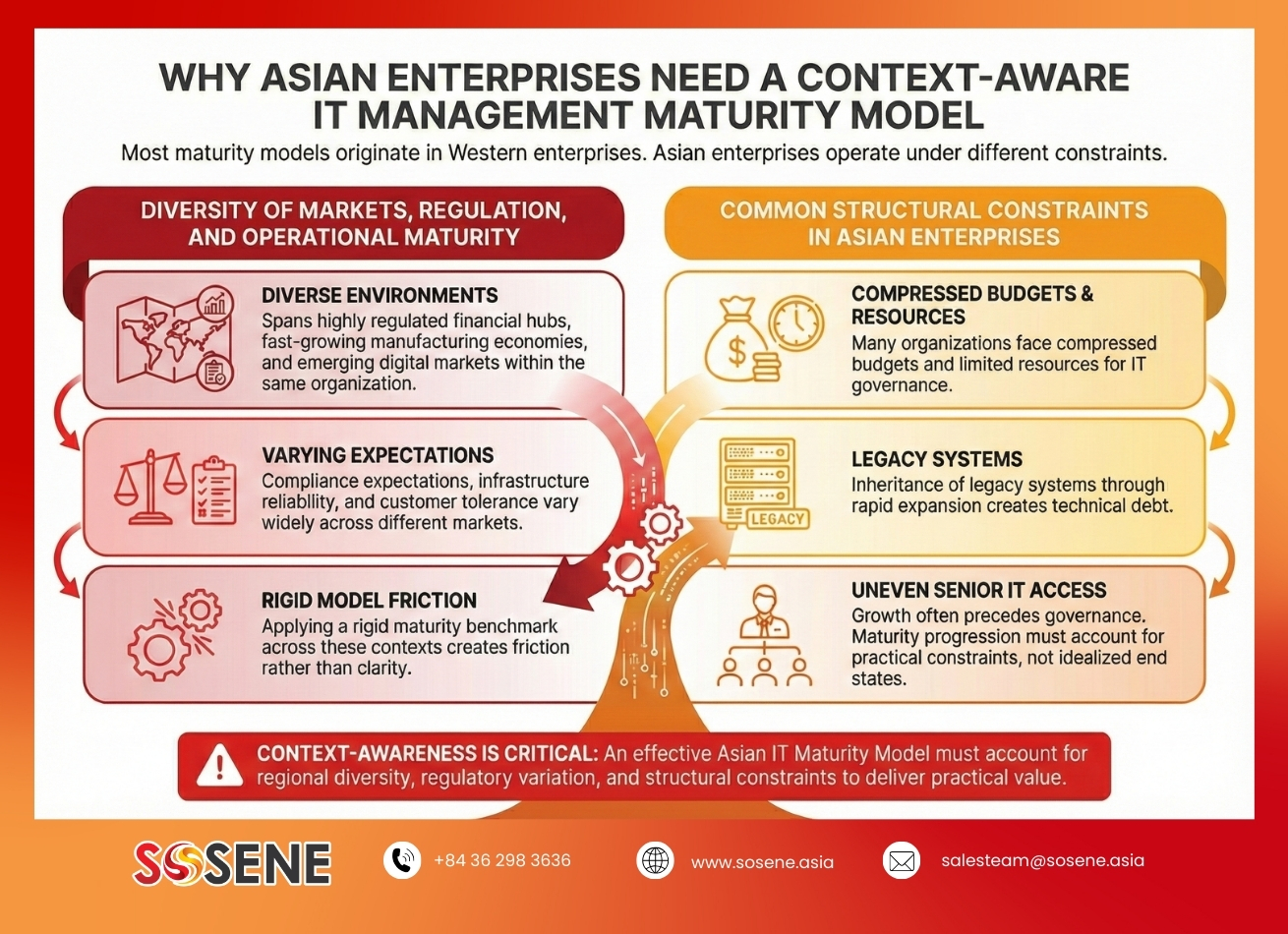
Most maturity models originate in Western enterprises with relatively uniform regulatory environments and mature talent markets. Asian enterprises operate under different constraints.
Diversity of markets, regulation, and operational maturity
Asia spans highly regulated financial hubs, fast-growing manufacturing economies, and emerging digital markets—often within the same organization. Compliance expectations, infrastructure reliability, and customer tolerance vary widely. Applying a rigid maturity benchmark across these contexts creates friction rather than clarity.
Common structural constraints in Asian enterprises
Many organizations face compressed budgets, legacy systems inherited through rapid expansion, and uneven access to senior IT leadership. Growth often precedes governance. As a result, maturity progression must account for practical constraints, not idealized end states.
Core Dimensions of a Managed IT Maturity Model
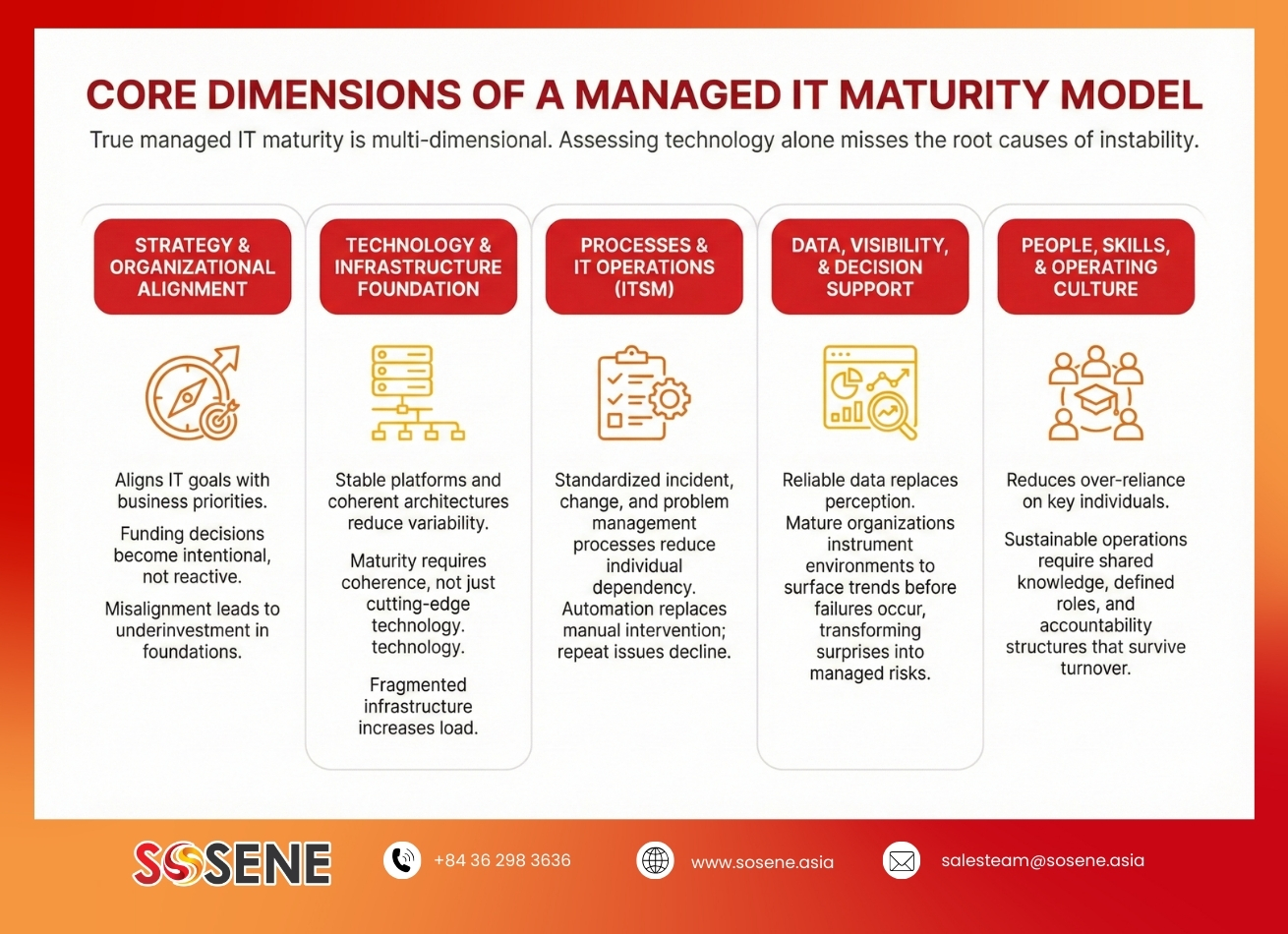
True managed IT maturity is multi-dimensional. Assessing technology alone misses the root causes of instability.
Strategy and organizational alignment
Maturity begins with clarity. When IT goals align with business priorities, funding decisions become intentional rather than reactive. Misalignment leads to underinvestment in critical foundations and overinvestment in visible tools.
Technology and infrastructure foundation
Stable platforms, consistent architectures, and baseline security controls reduce variability. Maturity does not require cutting-edge technology, but it does require coherence. Fragmented infrastructure increases operational load regardless of tool quality.
Processes and IT operations (ITSM)
Standardized incident, change, and problem management processes reduce dependency on individuals. As maturity increases, automation replaces manual intervention, and repeat issues decline measurably.
Data, visibility, and decision support
Without reliable data, IT decisions rely on perception. Mature organizations instrument their environments to surface trends before failures occur. Visibility transforms surprises into managed risks.
People, skills, and operating culture
Over-reliance on key individuals signals low maturity. Sustainable operations require shared knowledge, defined roles, and accountability structures that survive turnover and growth.
Typical Maturity Levels in an IT Management Maturity Model
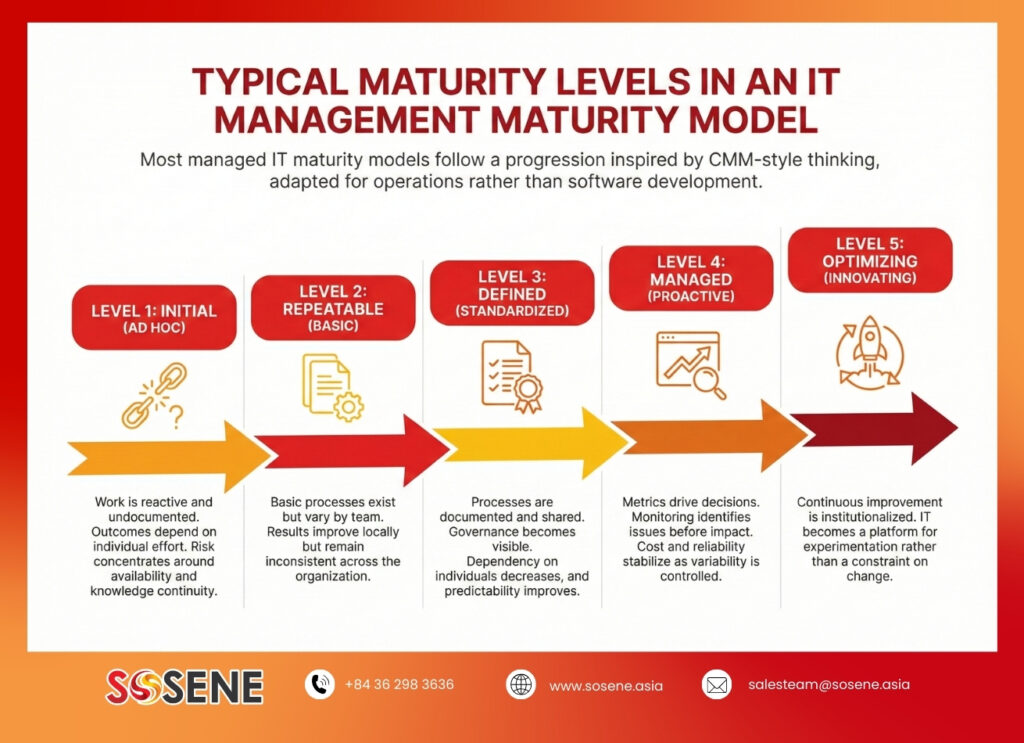
Most managed IT maturity models follow a progression inspired by CMM-style thinking, adapted for operations rather than software development.
Level 1: Initial (Ad hoc)
Work is reactive and undocumented. Outcomes depend on individual effort. Risk concentrates around availability and knowledge continuity.
Level 2: Repeatable (Basic)
Basic processes exist but vary by team. Results improve locally but remain inconsistent across the organization.
Level 3: Defined (Standardized)
Processes are documented and shared. Governance becomes visible. Dependency on individuals decreases, and predictability improves.
Level 4: Managed (Proactive)
Metrics drive decisions. Monitoring identifies issues before impact. Cost and reliability stabilize as variability is controlled.
Level 5: Optimizing (Innovating)
Continuous improvement is institutionalized. IT becomes a platform for experimentation rather than a constraint on change.
Common Anti-Patterns Observed in Asian Enterprises
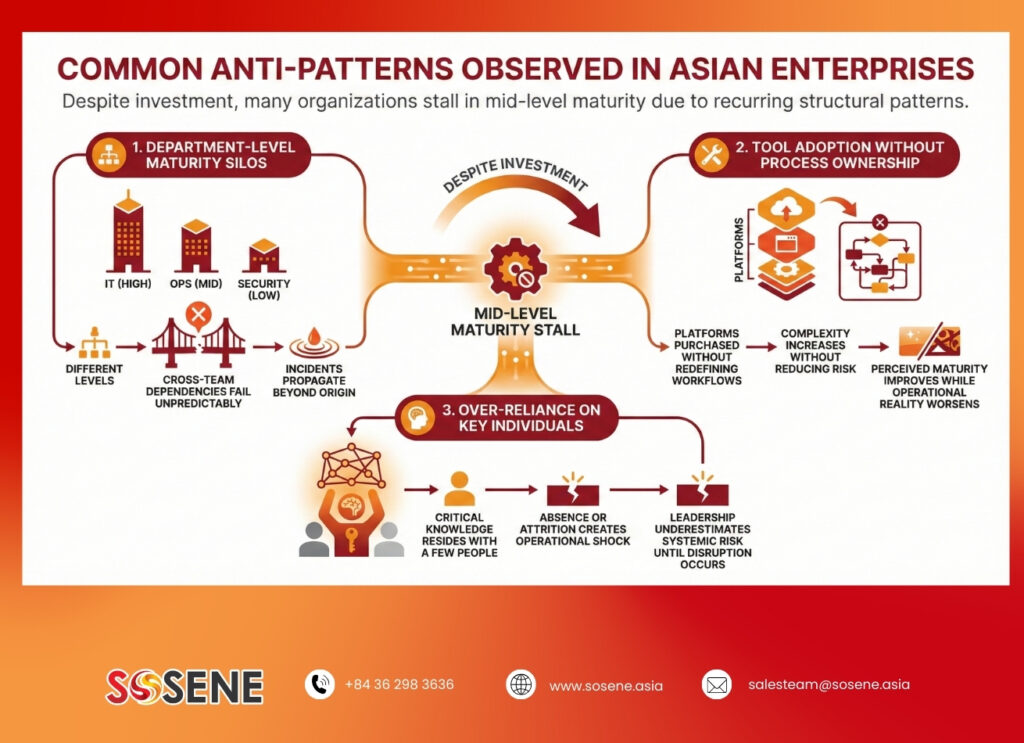
Despite investment, many organizations stall in mid-level maturity due to recurring structural patterns.
Department-level maturity silos
Different units operate at different maturity levels → cross-team dependencies fail unpredictably → incidents propagate beyond their origin.
Tool adoption without process ownership
Platforms are purchased without redefining workflows → complexity increases without reducing risk → perceived maturity improves while operational reality worsens.
Over-reliance on key individuals
Critical knowledge resides with a few people → absence or attrition creates operational shock → leadership underestimates systemic risk until disruption occurs.
How to Assess Your Current Managed IT Maturity
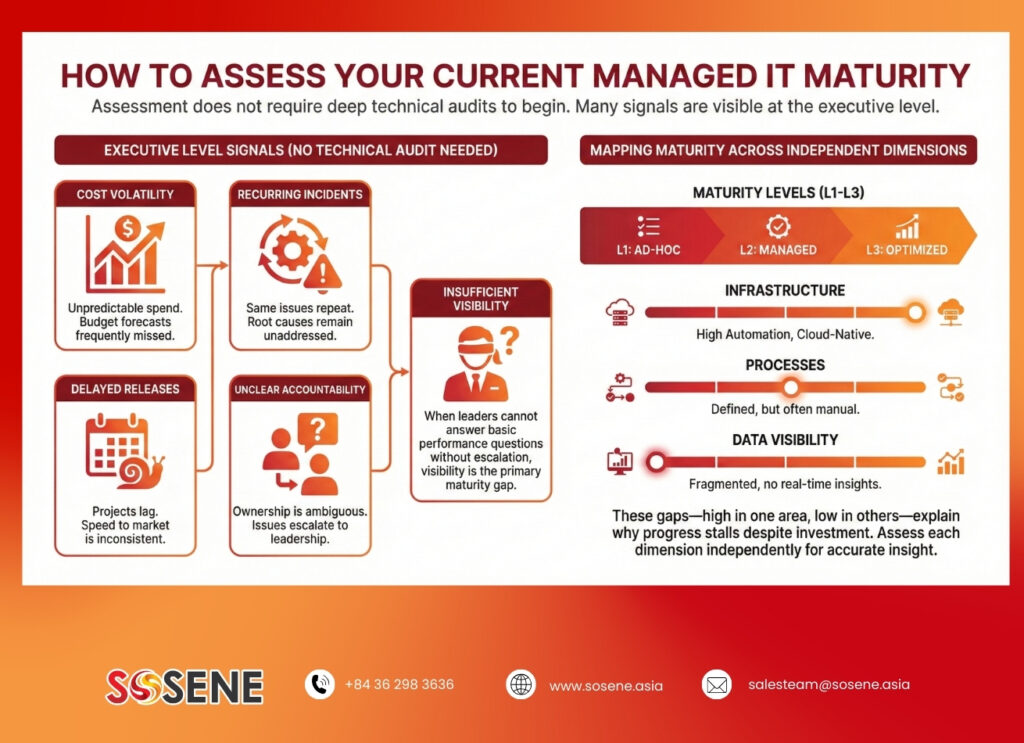
Assessment does not require deep technical audits to begin. Many signals are visible at the executive level.
Key signals leaders can observe without deep technical audits
Cost volatility, recurring incidents, delayed releases, and unclear accountability are maturity indicators. When leaders cannot answer basic questions about IT performance without escalation, visibility is insufficient.
Mapping current state across maturity dimensions
Rather than assigning a single maturity label, assess each dimension independently. Many enterprises operate at Level 3 in infrastructure, Level 2 in processes, and Level 1 in data visibility. These gaps explain why progress stalls despite investment.
Building a Managed IT Maturity Roadmap
Progression requires sequencing, not acceleration.
Prioritizing stability and visibility before optimization
Advanced automation and AI initiatives fail without stable foundations. Stability reduces noise; visibility reveals leverage points.
Phased improvement without disrupting operations
Incremental change limits risk. Each phase should reduce operational load before introducing new complexity.
Linking maturity improvements to business outcomes
Improved maturity correlates with fewer incidents, predictable cost curves, and faster delivery cycles. These outcomes justify investment more effectively than abstract capability claims.
How Sosene Helps Enterprises Progress IT Maturity

Sosene works with enterprises to translate maturity concepts into operational reality. The focus is not on achieving labels, but on reducing risk and friction where it matters most.
Sosene begins with maturity assessment grounded in operational data—examining incidents, workflows, governance signals, and cost behavior rather than surface-level tooling. From there, realistic, phased roadmaps are designed to move maturity forward without overengineering or disrupting ongoing operations.
Execution support spans people, process, and technology. This includes aligning ownership, standardizing workflows, and reinforcing visibility so improvements persist beyond initial interventions.
For organizations evaluating their current managed IT maturity and next steps, a structured conversation often clarifies priorities faster than internal debate. You can start that conversation at https://sosenesoftware.com/.
Conclusion
A managed IT maturity model is not a theoretical exercise. For Asian enterprises operating under diverse regulatory, talent, and growth conditions, it is a practical tool for making IT predictable at scale. Maturity clarifies ownership, reduces variability, and transforms IT from a reactive cost center into a managed operational capability.
The most effective organizations do not chase maturity labels. They focus on sequencing improvements that stabilize operations, increase visibility, and align IT with business priorities. Over time, this discipline compounds into faster delivery, controlled cost, and resilient systems that support growth rather than constrain it.
Revisiting your managed IT maturity model periodically ensures that operational foundations evolve alongside business ambition. With the right framework and execution approach, maturity becomes a lever for scale—not a barrier to change.
FAQs
What is a managed IT maturity model?
A managed IT maturity model is a framework that describes how structured, predictable, and proactive an organization’s IT operations are across strategy, processes, and governance.
How does an IT management maturity model differ from digital transformation frameworks?
Digital transformation frameworks focus on change initiatives, while an IT management maturity model focuses on operational stability and control that enable transformation to succeed.
What maturity level are most Asian enterprises currently at?
Many operate at mixed levels, typically between repeatable and defined, with significant variation across departments and functions.
How long does it take to move from basic to managed IT maturity?
Progression usually takes multiple phases over 12–36 months, depending on scale, complexity, and leadership alignment.
Can SMEs use the same managed IT maturity model as large enterprises?
The dimensions remain relevant, but scope and depth must be adjusted to reflect scale and resource constraints.
When should an enterprise involve an external partner to assess IT maturity?
Each unit should be assessed independently across dimensions, then analyzed collectively to identify systemic risk.
How should maturity be measured across different business units?
External assessment is most valuable when internal debates stall or when operational signals contradict leadership perception.