The operating reality of BFSI businesses in Southeast Asia.
Banks, insurers, and fintech companies across Southeast Asia are operating under growing pressure. Transaction volumes continue to rise, regulatory expectations are tightening, and customers increasingly expect uninterrupted digital services.
In this environment, even short system disruptions can lead to reputational damage, regulatory scrutiny, and direct revenue impact. Downtime is no longer just a technical issue. It is a business risk that affects trust and long-term viability.
As a result, many business leaders are reassessing whether their current IT operating model can realistically support long-term growth. Managed IT services often enter the discussion, not as a cost-cutting move, but as a way to stabilize operations and reduce execution risk.
Table of Contents
Key Takeaways
- Managed IT services are best viewed as an operating model, not a vendor decision.
- They shift execution responsibility but do not remove regulatory or business accountability.
- The benefits of managed IT services are strongest in environments with high uptime sensitivity and operational complexity.
- In-house IT offers control and differentiation but comes with higher fixed costs and scalability limits.
- Hybrid models can work well, but only with strong governance and clearly defined ownership.
Further Reading
What managed IT services really mean for B2B decision-makers.
Managed IT services refer to an operating model where a third-party provider takes responsibility for day-to-day IT operations. These typically include system monitoring, incident response, patch management, security operations, and infrastructure maintenance.
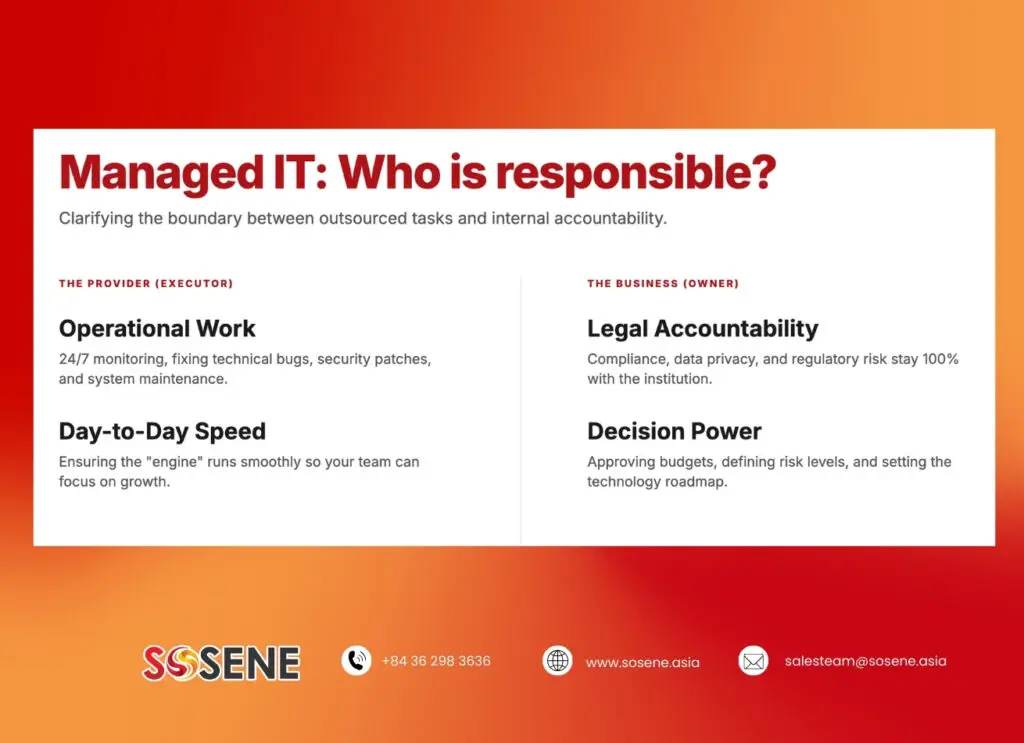
In a BFSI context, this does not mean transferring ownership or regulatory accountability. The business remains fully responsible for compliance, data protection, and risk management. Regulators will always engage directly with the financial institution, not the service provider.
The provider’s role is execution within clearly defined boundaries. This distinction is critical. Managed IT services are a structural operating decision with long-term business implications, not simply a technical outsourcing arrangement.
Why BFSI leaders consider managed IT services.
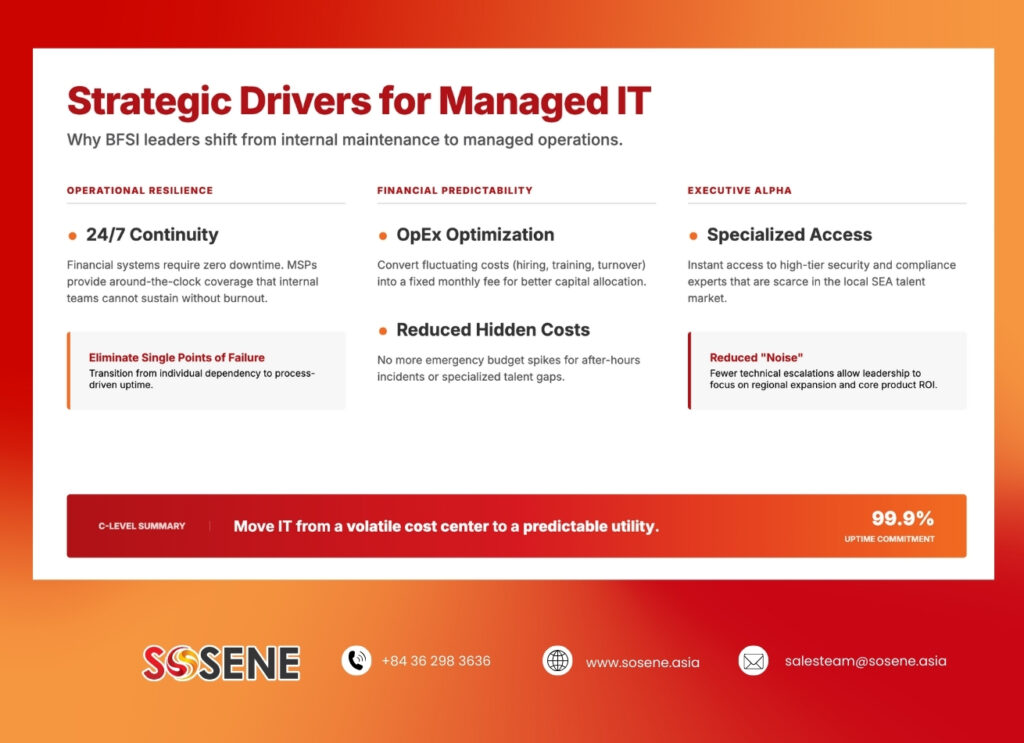
One of the strongest drivers is the need for continuous operations. Financial systems are expected to run reliably around the clock, including during peak transaction periods and regulatory reporting windows. Internal teams often struggle to sustain true 24/7 coverage without burnout or escalating costs.
Managed IT services are designed around continuous monitoring, predefined response processes, and service-level commitments. This reduces dependency on individual staff members and lowers the risk of single points of failure.
Cost predictability is another key factor. Internal IT teams often come with hidden and fluctuating costs related to hiring, training, turnover, and after-hours support. These costs are difficult to forecast accurately at scale.
Managed IT services convert much of this uncertainty into a predictable monthly operating expense. This supports better financial planning and clearer capital allocation decisions at the executive level.
Access to specialized expertise also matters. Security operations, infrastructure optimization, and compliance tooling require skill sets that are scarce in many SEA markets. Managed IT services aggregate these capabilities across multiple clients, making advanced expertise accessible without long-term internal investment.
Finally, managed IT services can reduce operational noise for leadership teams. When fewer incidents escalate to executives, leaders can spend more time on strategic priorities such as product development, regional expansion, and regulatory relationships.
A practical comparison of common IT operating models.
In-house IT teams offer maximum control and direct visibility. They are often preferred when systems are highly customized or strategically differentiated. However, they come with high fixed costs, slower scalability, and heavy management overhead.
Managed IT services offer faster scalability and more predictable costs. They reduce operational burden but require strong governance and clear accountability to avoid blind spots.
Hybrid models combine internal ownership of core systems with external management of standardized operations. They offer balance but introduce coordination complexity. Clear role definition is essential for this model to work effectively.
There is no universally correct choice. The right model depends on business maturity, growth trajectory, and risk tolerance.
| Decision Factor | In-House IT Team | Managed IT Services | Hybrid Model |
|---|---|---|---|
| Cost Structure | High fixed cost | Predictable recurring cost | Mixed fixed and variable cost |
| Scalability | Slow, hiring-dependent | Fast, contract-based | Moderate |
| Control | Full internal control | Operational control delegated | Shared control |
| Compliance Burden | Fully internal | Shared execution, internal accountability | Internal oversight required |
| Resilience | Depends on team depth | Built into service design | Varies by scope |
| Management Overhead | High | Lower | Medium |
Comparison of IT Operating Models for BFSI Organizations.
Risks and trade-offs that must be understood early
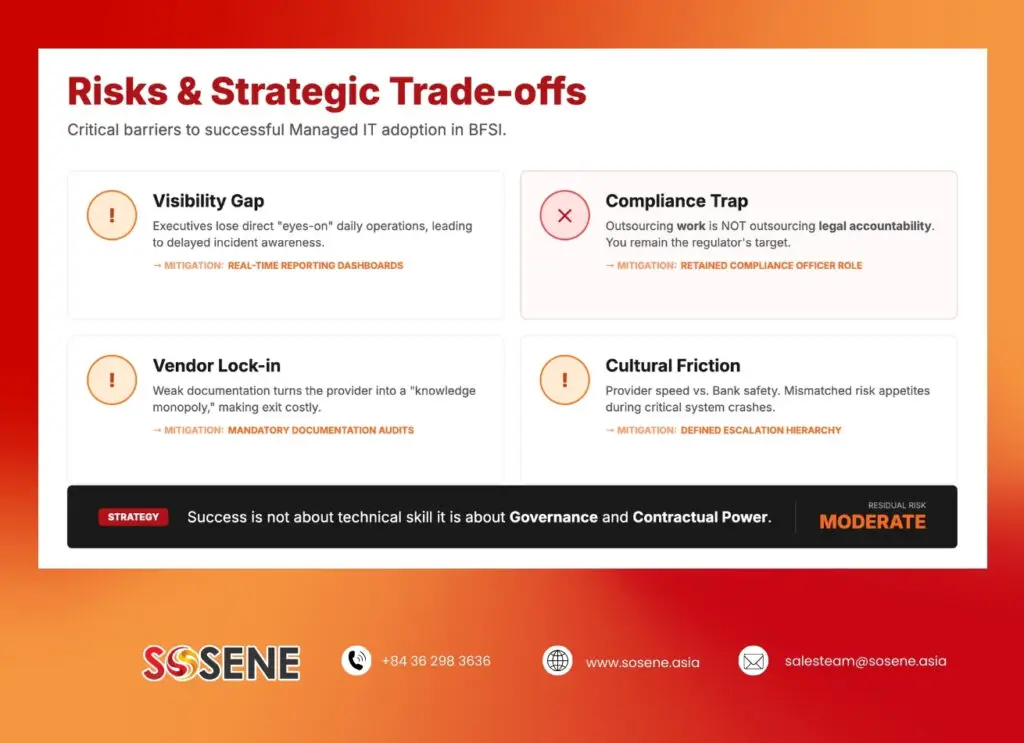
Managed IT services introduce risks if they are adopted without sufficient structure. Reduced day-to-day visibility can become a problem when reporting and escalation mechanisms are weak. Leaders may only see issues once they become severe.
Vendor dependency can increase over time. If operational knowledge remains with the provider and documentation is weak, switching vendors becomes costly and risky.
In BFSI environments, the most serious risk is misunderstanding compliance responsibility. Outsourcing operations does not outsource accountability. Any ambiguity here can lead to regulatory consequences.
Cultural misalignment is another factor. Service providers optimized for speed and efficiency may not naturally align with the conservative risk culture common in financial institutions. This mismatch often surfaces during incident response.
When in-house IT still makes strategic sense.
In-house IT remains a strong choice for organizations with highly proprietary systems or technology that directly supports competitive differentiation. It also suits enterprises with mature IT governance and the ability to attract and retain senior technical talent.
In these cases, internal teams provide strategic control rather than operational efficiency. The trade-off is higher cost, slower scaling, and greater management responsibility.
Managed IT services in such environments often play a supporting role rather than a central one.
Hybrid models as a transition path.
Many BFSI organizations in Southeast Asia adopt hybrid models during periods of growth or transformation. Core platforms and sensitive systems remain under internal control, while infrastructure monitoring, standard operations, or security monitoring are handled through managed IT services.
This approach can reduce operational risk while preserving strategic control. However, it only works when roles, responsibilities, and escalation paths are explicitly defined.
Hybrid models tend to fail when ownership becomes ambiguous or when teams assume the other side is responsible.
How B2B leaders should approach the decision.
Before choosing an IT operating model, leadership teams should step back from vendor comparisons and focus on fundamental business questions.
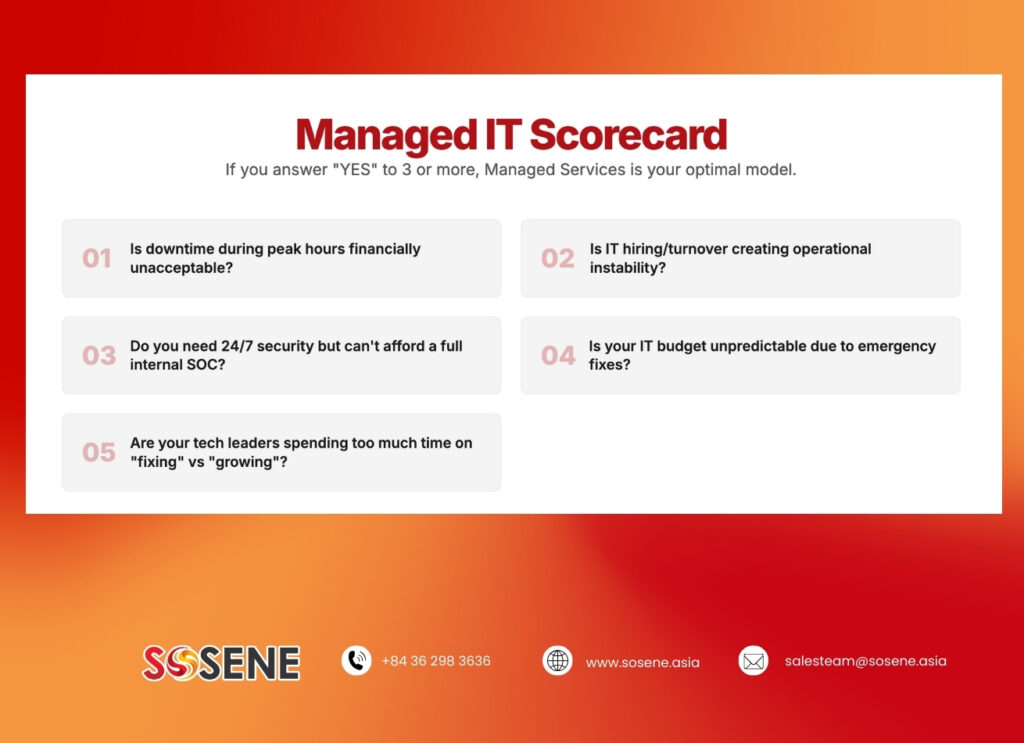
How damaging would downtime be during peak business periods. How predictable does the IT cost structure need to be. Does the organization have the internal capacity to support 24/7 operations sustainably. How fast is the business expected to scale or change. Where does regulatory risk realistically sit today.
Clear answers to these questions provide more decision value than feature lists or pricing tables.
If you are considering Managed IT for peak performance and want a clear, unbiased perspective, request a strategic consultation with Sosene to evaluate fit, risks, and next steps before making a commitment.
Conclusion
Managed IT services are not a shortcut and not a universal solution for BFSI organizations in Southeast Asia. They are a strategic operating choice that can support stability, scalability, and focus when applied with clear governance and realistic expectations.
The benefits of managed IT services emerge when leaders understand that responsibility remains internal while execution can be shared. The strongest outcomes come from aligning the IT operating model with business maturity and risk appetite, rather than reacting to short-term operational pressure.
FAQs
Is managed IT suitable for regulated BFSI organizations in Southeast Asia?
Yes, but only when accountability is clearly defined. Managed IT providers can execute operational tasks, but regulatory responsibility always remains with the financial institution. Strong governance, audit access, and documentation are essential for regulatory alignment.
How do managed IT services differ from traditional IT outsourcing?
Managed IT services focus on ongoing operational responsibility under service-level agreements. Traditional outsourcing often focuses on projects or staff augmentation. For BFSI organizations, managed IT aligns more closely with uptime, resilience, and compliance needs.
What are the main benefits of managed IT services for BFSI leaders?
The primary benefits include improved operational stability, predictable costs, access to specialized expertise, and reduced management overhead. These benefits are most valuable when systems must operate continuously and reliably under regulatory scrutiny.
When should a BFSI organization avoid managed IT services?
Organizations with highly proprietary systems or weak internal governance may struggle with managed IT models. If ownership, escalation paths, and compliance responsibilities are unclear, managed IT can increase risk rather than reduce it.
How should leaders evaluate a managed IT service provider?
Evaluation should focus on governance structure, regulatory experience, incident response maturity, reporting transparency, and knowledge transfer practices. Technical capabilities matter, but alignment with risk culture and accountability expectations is more critical.