Digital transformation in education rarely fails because of a lack of tools. It fails because of architectural ambiguity.
Many institutions adopt a school management system assuming it will address all operational and academic needs. Others invest heavily in a student information system only to discover that finance, HR, and communication workflows remain fragmented.
At first glance, the distinction between a school management system (SMS) and a student information system (SIS) appears functional. In reality, it is architectural. It influences governance models, compliance exposure, scalability pathways, and long-term digital strategy.
As enrollment grows, regulatory reporting intensifies, and parent expectations increase, the decision becomes increasingly consequential. This article provides a comprehensive framework to help education leaders determine when to adopt an SMS, an SIS, or an integrated platform—and how that choice shapes the institution’s digital future.
Table of Contents
Key Takeaways
- A school management system governs the institutional ecosystem—finance, HR, communication, scheduling, and operations.
- A student information system manages the student lifecycle—admissions, attendance, grading, transcripts, and longitudinal academic records.
- Modern school management software often embeds SIS modules, but depth and compliance capability vary significantly.
- The right architecture depends on scale, reporting obligations, governance maturity, and integration needs.
- Integration between SMS and SIS eliminates silos and improves leadership visibility across operational and academic performance.
- The decision affects long-term scalability, cybersecurity posture, and regulatory compliance—not just feature sets.
Further Reading
What Is a School Management System?
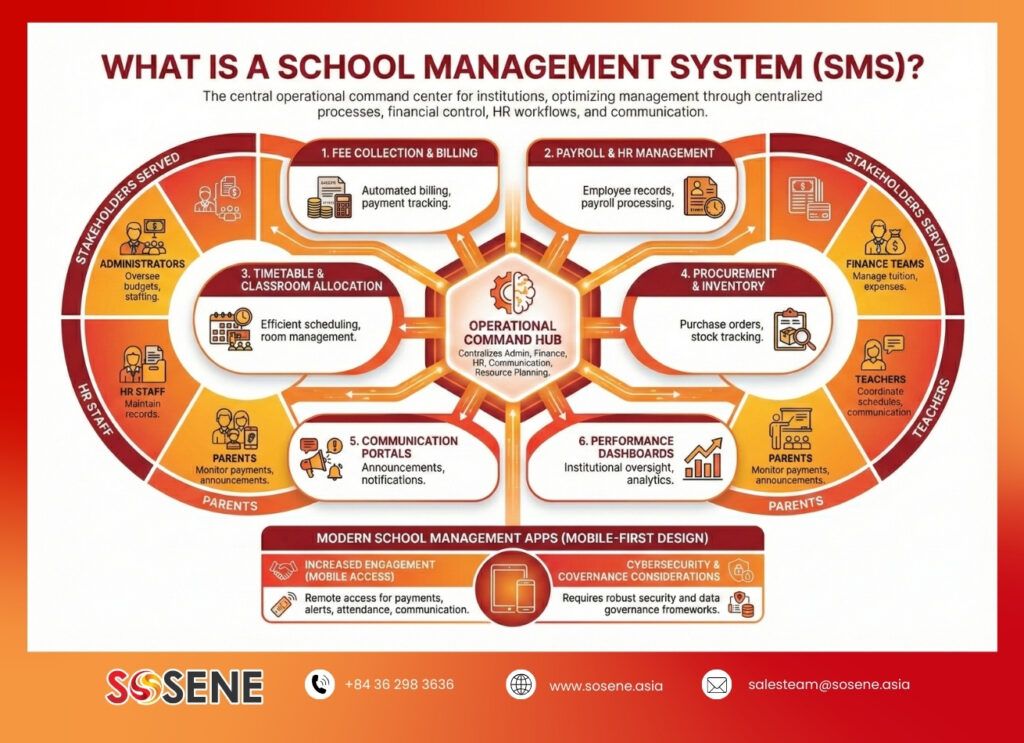
A school management system is the operational backbone of an institution. It centralizes administrative processes, financial management, HR workflows, communication channels, and institutional resource planning. It exists to optimize school management and administration across departments.
Core functions of a school management system
Typical SMS capabilities include:
- Fee collection and billing automation.
- Payroll and HR record management.
- Timetable scheduling and classroom allocation.
- Procurement and inventory management.
- Communication portals for announcements and notifications.
- Performance dashboards for institutional oversight.
By consolidating these workflows, a school management application reduces manual processes, improves transparency, and supports data-driven administration.
Stakeholders served by school management software
The SMS serves multiple stakeholders:
- Administrators overseeing budgets and staffing.
- Finance teams managing tuition and expenses.
- HR staff maintaining employee records.
- Teachers coordinating schedules and communication.
- Parents monitoring payments and school announcements.
It functions as the institution’s operational command center.
School management apps in modern institutions
Modern school management apps extend this functionality through mobile-first design. In many Southeast Asian contexts, mobile access is essential. Parents track payments and receive alerts through apps for school management, while teachers update attendance or communicate with families remotely.
Mobility increases engagement, but it also raises cybersecurity and governance considerations.
What Is a Student Information System?
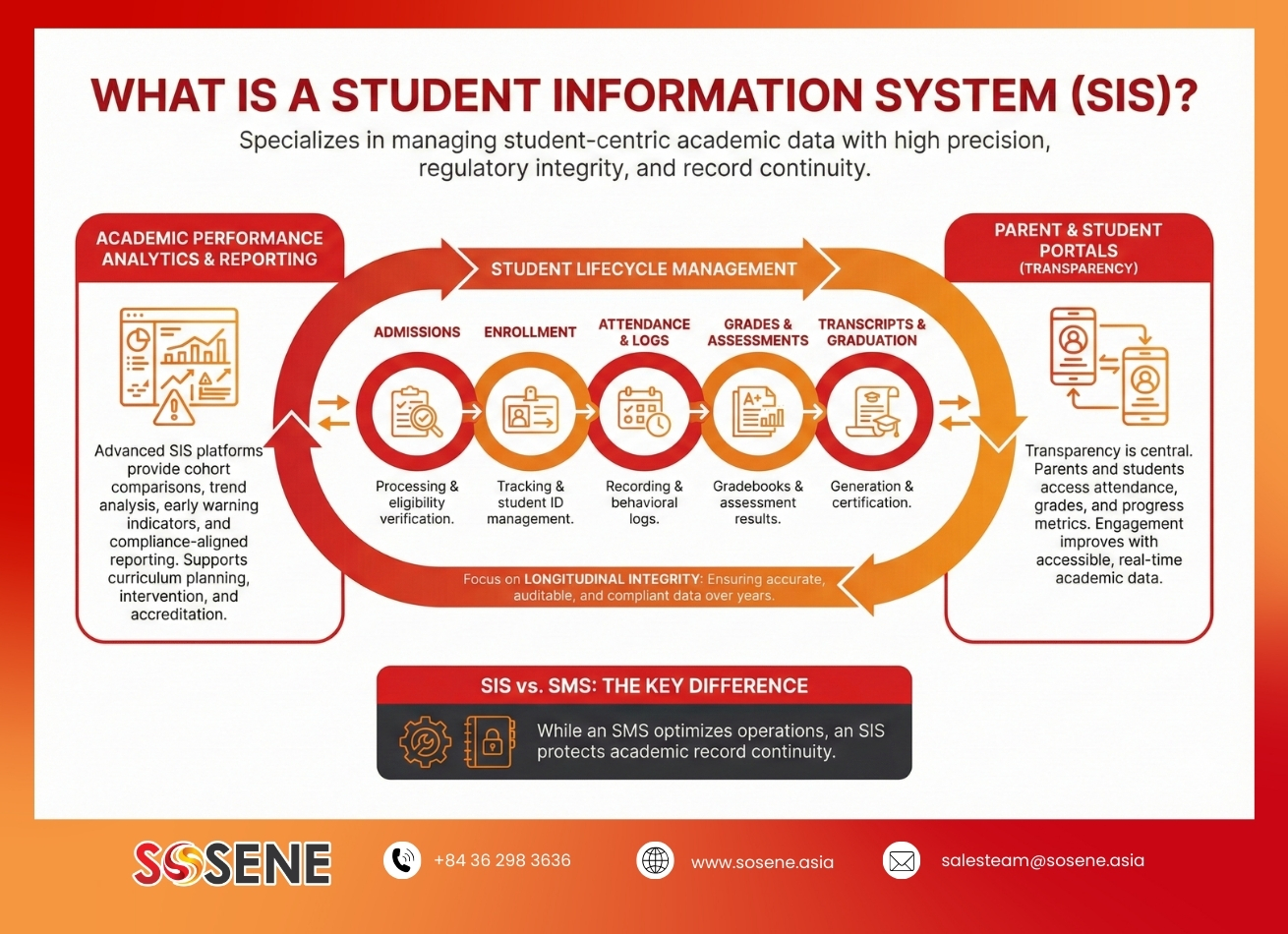
A student information system specializes in managing student-centric academic data with high precision and regulatory integrity.
While an SMS optimizes operations, an SIS protects academic record continuity.
Student lifecycle management
An SIS supports the entire academic journey:
- Admissions processing and eligibility verification.
- Enrollment tracking and student ID management.
- Attendance recording and behavioral logs.
- Gradebooks and assessment results.
- Transcript generation and graduation certification.
The focus is longitudinal integrity—ensuring data remains accurate, auditable, and compliant over years.
Academic performance analytics and reporting
Advanced SIS platforms provide cohort comparisons, academic trend analysis, early warning indicators, and compliance-aligned reporting. These capabilities support curriculum planning, intervention strategies, and accreditation requirements.
Parent and student portals
Transparency is central to SIS functionality. Parents and students access attendance records, grades, and progress metrics. Engagement improves when academic data is accessible and real-time.
Key Differences Between School Management System and SIS
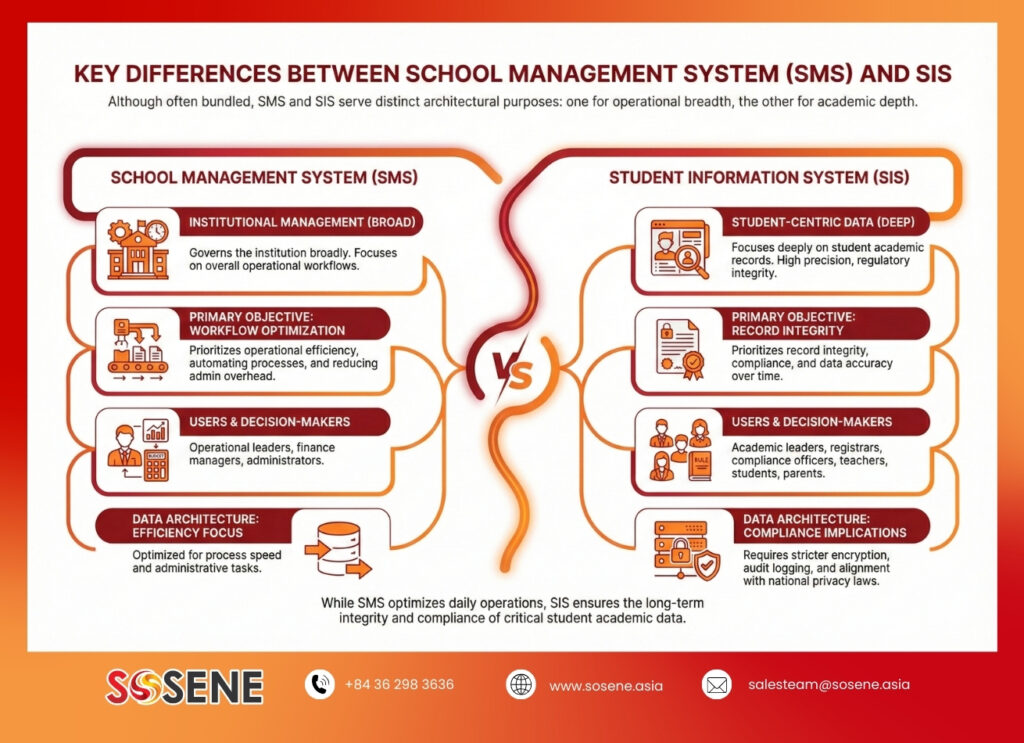
Although often bundled together, SMS and SIS serve distinct architectural purposes.
Institutional management vs student-centric data
An SMS governs the institution broadly. An SIS focuses deeply on student academic records. The difference is breadth versus depth.
Primary objective: Workflow optimization vs record integrity
The SMS prioritizes operational efficiency—automating processes and reducing administrative overhead. The SIS prioritizes record integrity, compliance, and data accuracy.
Users and decision-makers
SMS users are typically operational leaders and finance managers. SIS users include academic leaders, registrars, compliance officers, teachers, students, and parents.
Data architecture and compliance implications
Student data is highly sensitive. SIS platforms often require stricter encryption, audit logging, and regulatory reporting mechanisms. In jurisdictions with strict data privacy laws, the SIS architecture must align with national compliance frameworks.
When Schools Need an SMS, an SIS, or Both
The appropriate system configuration depends on institutional context.
Small and mid-sized institutions
Smaller schools with limited reporting requirements may function effectively with a unified school management application that includes basic SIS capabilities.
However, leaders must evaluate whether the embedded student module supports long-term record integrity.
Large or multi-campus institutions
Large institutions, universities, or multi-campus organizations typically require a dedicated SIS layered alongside an SMS.
Scale increases complexity. Multi-year academic histories, regulatory audits, and cross-campus reporting demand specialized data architecture.
Regulatory and reporting complexity
Institutions operating under government oversight, accreditation audits, or funding-linked reporting require specialized SIS depth.
Compliance obligations often exceed the capabilities of basic school management software modules.
Integration: Creating a Unified Digital School Platform
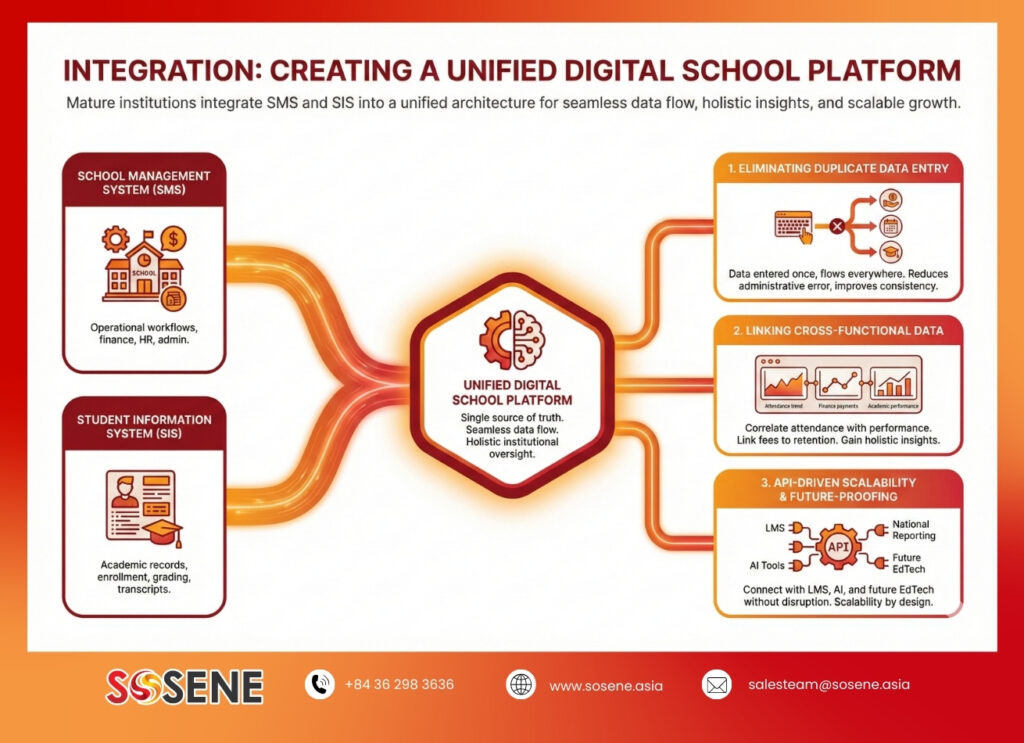
The most mature institutions integrate SMS and SIS into a unified architecture.
Eliminating duplicate data entry
Integrated systems ensure enrollment information entered once flows into finance, attendance, and academic modules. This reduces administrative error and improves data consistency.
Linking attendance, finance, and academic outcomes
When SMS and SIS data converge, leaders gain cross-functional visibility. Attendance trends can be correlated with academic performance. Fee payment patterns can be linked to retention metrics. Institutional oversight becomes holistic.
API-driven architecture for scalability
Modern architecture should rely on APIs rather than monolithic integration. This enables connection with LMS platforms, AI analytics tools, national reporting systems, and future EdTech innovations without structural disruption. Scalability becomes a design principle rather than an afterthought.
Common Implementation Challenges
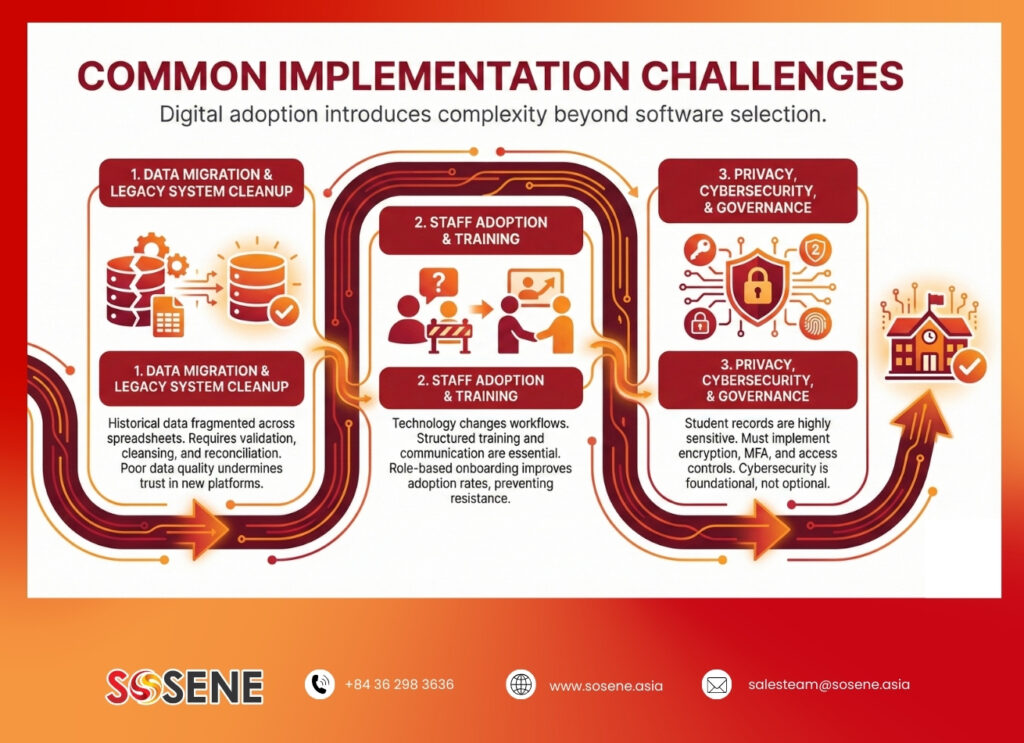
Digital adoption introduces complexity beyond software selection.
Data migration and legacy system cleanup
Historical data may be fragmented across spreadsheets and legacy systems. Migration requires validation, cleansing, and reconciliation.
Poor data quality undermines trust in new platforms.
Staff adoption and training
Technology changes workflows. Without structured training and communication, resistance can stall implementation. Role-based onboarding improves adoption rates.
Privacy, cybersecurity, and governance
Student records are highly sensitive. Institutions must implement encryption, multi-factor authentication, access control policies, and incident response frameworks. Cybersecurity is not optional—it is foundational.
Evaluating a School Management Application: What Leaders Should Ask
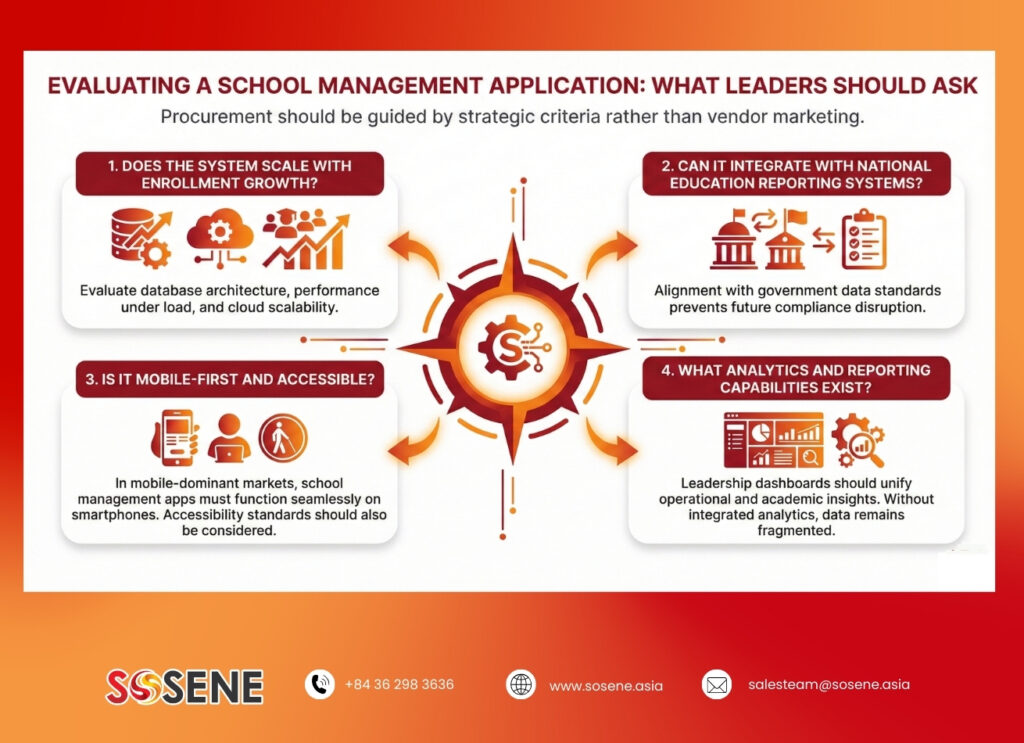
Procurement should be guided by strategic criteria rather than vendor marketing.
Does the system scale with enrollment growth?
Evaluate database architecture, performance under load, and cloud scalability.
Can it integrate with national education reporting systems?
Alignment with government data standards prevents future compliance disruption.
Is it mobile-first and accessible?
In mobile-dominant markets, school management apps must function seamlessly on smartphones. Accessibility standards should also be considered.
What analytics and reporting capabilities exist?
Leadership dashboards should unify operational and academic insights.
Without integrated analytics, data remains fragmented.
Strategic Considerations for Digital Transformation in School Management and Administration
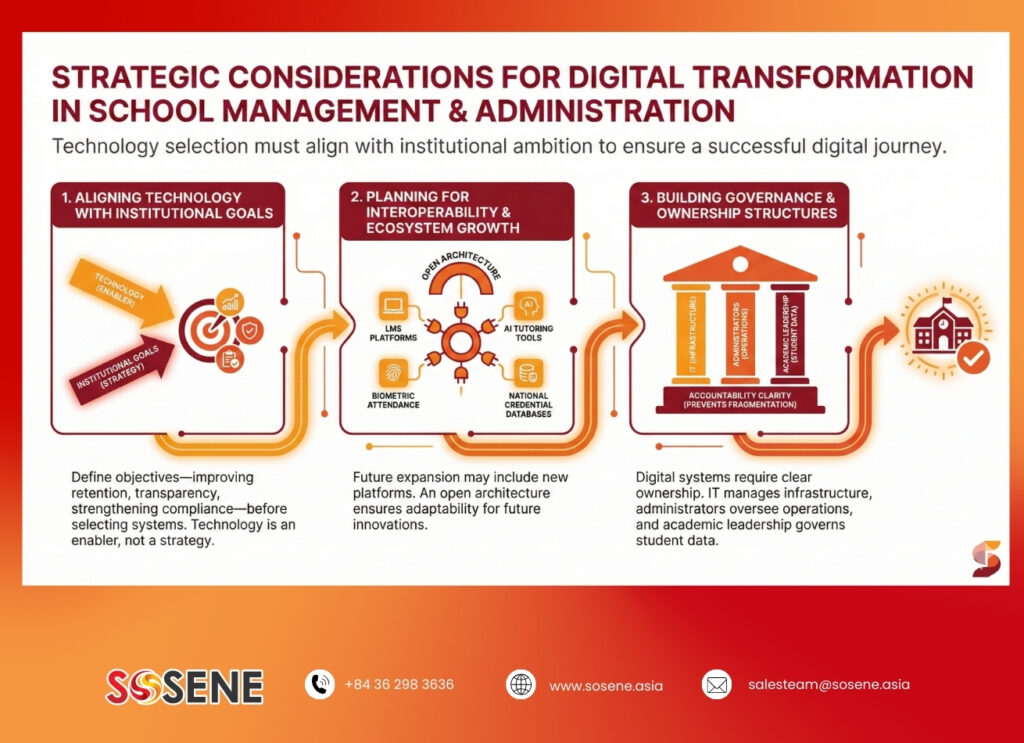
Technology selection must align with institutional ambition.
Aligning technology with institutional goals
Schools should define objectives—improving retention, increasing transparency, strengthening compliance—before selecting systems. Technology is an enabler, not a strategy.
Planning for interoperability and ecosystem growth
Future expansion may include LMS platforms, AI tutoring tools, biometric attendance systems, or national credential databases. An open architecture ensures adaptability.
Building governance and ownership structures
Digital systems require clear ownership. IT manages infrastructure, administrators oversee operations, and academic leadership governs student data. Accountability clarity prevents fragmentation.
How Sosene Supports School Management System and SIS Implementation

Sosene approaches school management system and student information system implementation as a strategic architecture decision rather than a software deployment project.
Through structured needs assessments, Sosene evaluates institutional scale, governance maturity, compliance requirements, and integration complexity.
Platform modernization initiatives emphasize scalable, API-driven architecture that unifies SMS and SIS environments while preserving data integrity and regulatory compliance.
Sosene also embeds cybersecurity and data governance frameworks to ensure long-term resilience.
Education leaders exploring digital transformation in school management and administration can begin a structured consultation at https://sosenesoftware.com/.
Conclusion
The decision between a school management system and a student information system is not about features—it is about architecture.
An SMS optimizes institutional workflows. An SIS safeguards academic integrity and compliance. Together, they form the foundation of a modern digital school ecosystem.
Institutions that align system selection with governance maturity, scalability planning, and long-term digital strategy position themselves for sustainable transformation.
In an era where data transparency, cybersecurity, and educational accountability are increasing, architectural clarity becomes the cornerstone of effective school management and administration.
FAQs
What is the difference between a school management system and a student information system?
A school management system governs institutional operations, while a student information system manages academic records and student lifecycle data.
Can a school management software replace a dedicated SIS?
For smaller schools, integrated platforms may suffice. Larger institutions with strict reporting requirements typically require a dedicated SIS.
What features should a school management application include?
Core features include finance management, HR modules, scheduling, communication tools, analytics dashboards, and mobile accessibility.
Is it better to choose an all-in-one school management app or separate systems?
The decision depends on institutional complexity and compliance needs. Integration quality matters more than consolidation alone.
How does an SIS improve student performance tracking?
An SIS centralizes academic records, enabling longitudinal analysis and early identification of performance trends.
What are the data privacy risks in school management systems?
Risks include unauthorized access, data breaches, and regulatory non-compliance. Strong governance and encryption controls mitigate exposure.
When should a school upgrade from a basic app for school management to a full enterprise platform?
When enrollment growth, reporting complexity, or integration demands exceed the capabilities of entry-level systems.