
Most companies that try hiring software engineers offshore get the structure wrong before they get the people wrong. They treat offshore developers as a separate track parallel to their core team, loosely connected, and managed through weekly status calls. Six months in, delivery is slow, context gets lost at every handoff, and the engagement feels more like vendor management than engineering.
A hybrid team model fixes this but only when it’s structured deliberately. Blending in-house product ownership with nearshore or offshore engineering capacity is now how mid-market SaaS companies and enterprise engineering teams alike scale without the cost and lead time of full-time local hires.
This article explains how to build hybrid software engineering teams that actually perform across borders: the right composition, where Vietnam fits in the model, how to handle the real risks timezone gaps, quality variance, and team integration and what you need in place before your first sprint.
Table of Contents
Key Takeaways
- Hybrid teams outperform pure offshore models because strategy and product ownership stay in-house while engineering capacity scales offshore.
- Vietnam produces over 57,000 engineering graduates annually, with senior developers charging 40–60% less than equivalent Singapore or Australian roles.
- The follow-the-sun model reduces project timelines by up to 30% when handoffs are structured correctly but it requires documentation discipline, not just timezone overlap.
- Team integration, not headcount, is the primary failure point. Most hybrid engagements fail at the handoff between internal teams and offshore developers, usually in the first four weeks.
- Staff augmentation and dedicated teams serve different needs: staff augmentation works for existing teams that need capacity; dedicated teams work for companies building a new product or capability.
Further Reading
What a hybrid software engineering team actually looks like
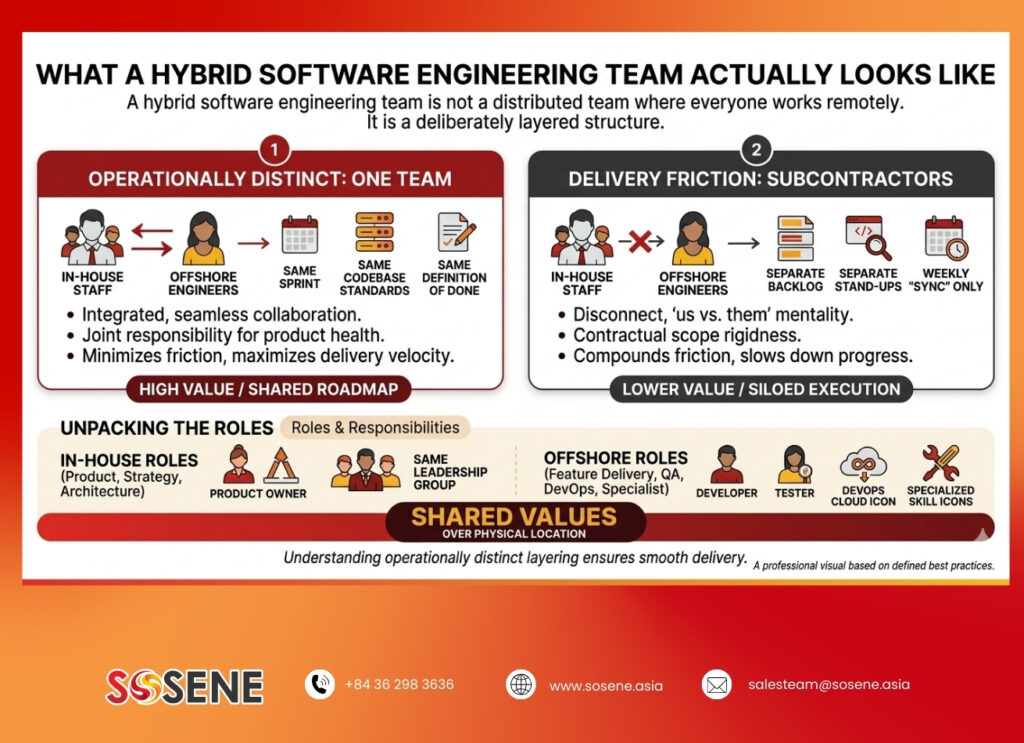
A hybrid software engineering team is not a distributed team where everyone works remotely from different cities. It is a deliberately layered structure: in-house staff hold product direction, architecture decisions, and client relationships; offshore or nearshore engineers own feature delivery, QA, DevOps, or specialist development.
The distinction matters operationally. When in-house and offshore engineers share the same sprint, the same codebase standards, and the same definition of done, they function as one team. When offshore developers work on a separate backlog with separate stand-ups and a weekly “sync,” they operate as subcontractors — and delivery friction compounds quickly.
The three layers of a working hybrid team
Most effective hybrid teams across logistics, SaaS, and fintech engagements share the same layered structure:
| Layer | Who | Owns |
|---|---|---|
| Core (in-house) | Product manager, tech lead, CTO or engineering lead | Product vision, architecture, stakeholder decisions |
| Extension (offshore/nearshore) | Dedicated developers, QA engineers, DevOps specialists | Feature delivery, test coverage, infrastructure management |
| Specialist (on-demand) | Security engineers, AI/ML specialists, mobile developers | Specific capabilities not viable to hire full-time |
The core layer does not need to be large. A Singapore-based SaaS company running a product team of three can scale engineering delivery to a team of ten Vietnam-based developers under this model — provided documentation, sprint structure, and technical standards are owned at the core layer.
Why companies hire software engineers in Vietnam for hybrid teams
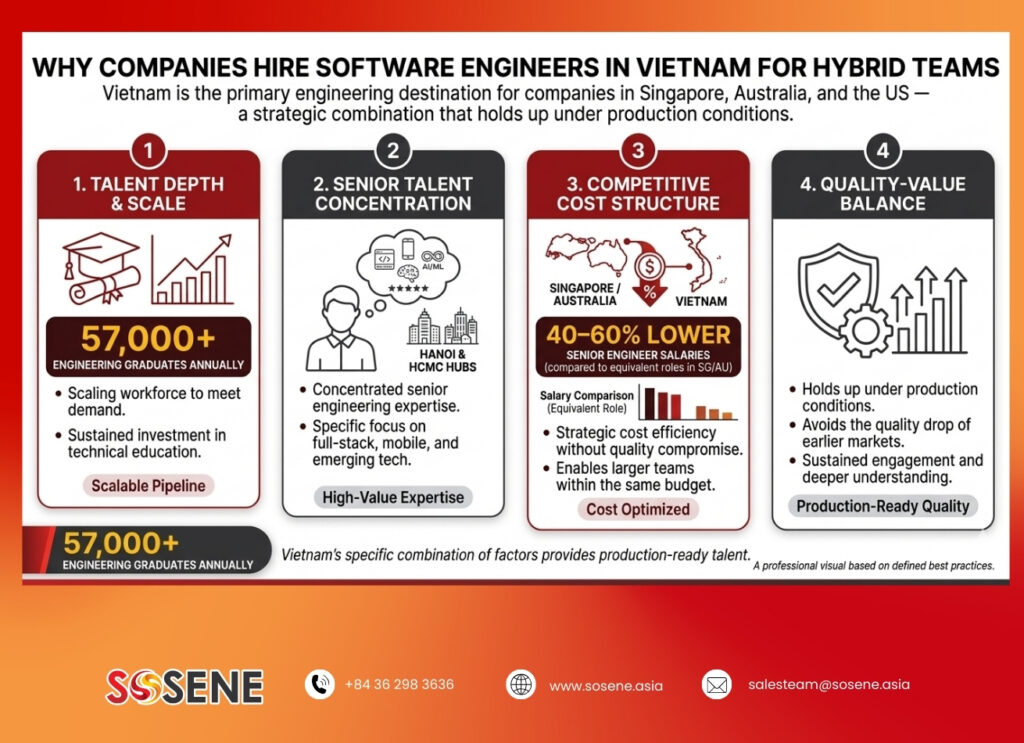
Vietnam has become the primary offshore engineering destination for companies in Singapore, Australia, and the US — not because of low cost alone, but because of a specific combination of factors that hold up under production conditions.
Vietnam produces over 57,000 engineering graduates annually. Ho Chi Minh City and Hanoi concentrate the majority of senior talent, particularly in full-stack web development, mobile, DevOps, and AI/ML. Salaries for senior engineers run 40–60% lower than equivalent roles in Singapore or Australia, without the quality drop that historically characterized early-generation offshore markets.
How Vietnam compares to other offshore locations
| Factor | Vietnam | India | Eastern Europe | Philippines |
|---|---|---|---|---|
| Cost vs Singapore baseline | 40–60% lower | 35–55% lower | 20–35% lower | 30–45% lower |
| Timezone overlap (SGT) | 1 hr difference | 1.5 hrs difference | 5–7 hrs difference | 0 hrs difference |
| English proficiency | Moderate–High | High | Moderate–High | High |
| Developer pool size | Large, growing | Very large | Medium | Medium |
| Avg. senior dev experience | 5–8 yrs | 5–10 yrs | 6–10 yrs | 4–7 yrs |
For Singapore-based companies, the Vietnam timezone advantage is significant. A one-hour difference means a full shared workday real-time collaboration without async delay. For US-based teams, Vietnam works in a follow-the-sun model: US engineers end their day with a handoff, Vietnam engineers continue delivery overnight, and work is ready for review by US morning.
The objection on code quality
The most common concern CTOs raise when evaluating Vietnam is quality. It is a legitimate concern and it has a specific answer. Code quality in offshore engagements is almost never a function of geography. It is a function of technical standards enforcement.
Teams that ship clear acceptance criteria, require PR reviews with a senior reviewer in the loop, and run CI/CD pipelines with test gates consistently produce quality output from Vietnam-based teams. Teams that send requirements in Slack and review code once a fortnight do not. Quality is an input you control, not a characteristic of the country
How to structure cross-border team communication and delivery
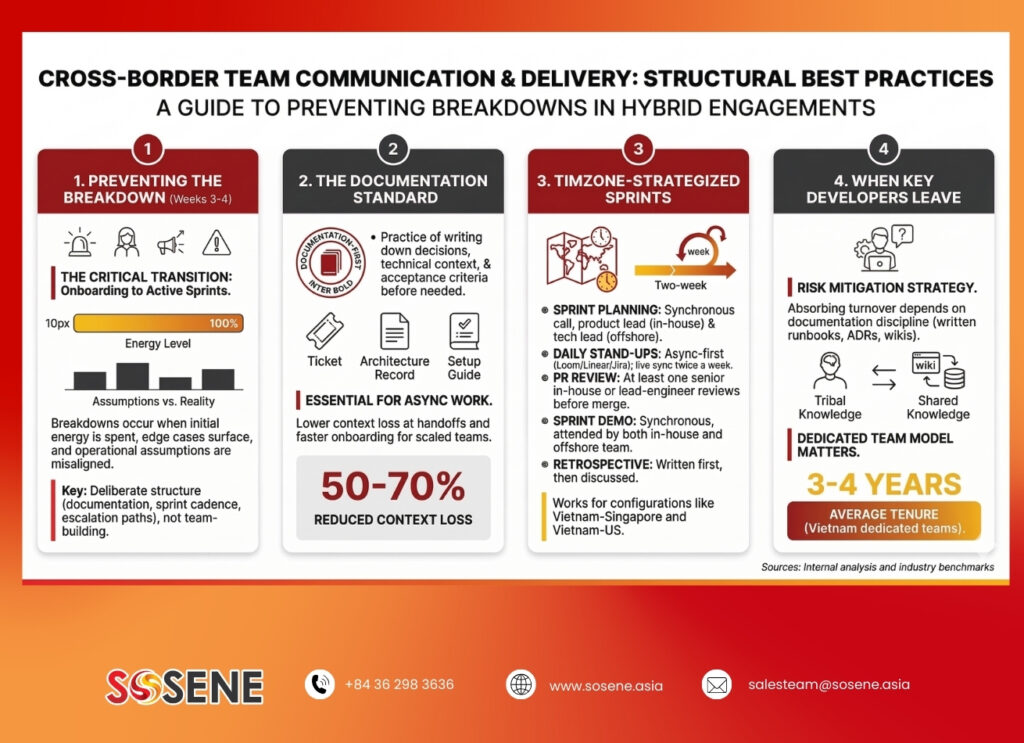
The breakdown in most hybrid engagements happens at the same point: the transition from onboarding to active sprint delivery, usually around weeks three to four. By that point, initial energy is spent, edge cases in the codebase start surfacing, and both teams realize their assumptions about “how we work” are not aligned.
Preventing that breakdown requires deliberate structure from day one not team-building exercises, but operational decisions about documentation, sprint cadence, and escalation paths.
The documentation standard that prevents most failures
Documentation-first means writing down decisions, technical context, and acceptance criteria before they are needed — not after they are lost. For cross-border teams, it is not a nice-to-have. It is the only thing that makes async work functional.
Concretely: every ticket has a written description, not just a title. Every architecture decision has a record. Every environment has a setup guide a new developer can follow without asking anyone. Teams that operate this way see dramatically lower context loss at handoffs and faster onboarding when the team scales.
Sprint structure for teams across timezones
Two-week sprints with a defined handoff protocol at the midpoint work reliably for Vietnam–Singapore and Vietnam–US configurations:
- Sprint planning: synchronous call between product lead (in-house) and tech lead (offshore) — 60 minutes
- Daily stand-ups: async-first via Loom or written updates in Linear/Jira; live sync twice a week is sufficient for most teams
- PR review: at least one senior engineer reviews before merge
- Sprint demo: synchronous, both in-house and offshore attend
- Retrospective: written first, then discussed — surfaces issues from both sides before the call
What happens when a key developer leaves
Teams that operate with written runbooks, architecture decision records, and well-maintained wikis absorb developer turnover with minimal disruption. Teams that rely on tribal knowledge held in one person’s head are exposed — regardless of whether that person is in-house or offshore.
Vietnam-based developers in dedicated team arrangements average three to four years of tenure — comparable to in-house developers in many markets.
"Across logistics and manufacturing engagements, we see the same breakdown happen at the same point: the handoff between the client's internal team and the offshore developers, usually around week three. The fix is never a process overhaul. It is having the right documentation and the right escalation path in place before the first sprint begins."
Sosene Team
Staff augmentation vs. dedicated team choosing the right model
When companies say they want to hire software developers overseas, they usually mean one of two different things — and the difference determines the engagement model, management overhead, and risk profile.
IT staff augmentation means adding individual developers to an existing in-house team. They work under your management, your tooling, your sprint cadence. The offshore partner recruits, vets, and employs the developers; you direct the work. This model suits companies with a functioning team that needs to scale specific capabilities.
A dedicated team is a structured unit managed by an offshore partner under your direction — developers, QA, and a team lead on the offshore side. This model suits companies building a product or capability from the ground up and wanting a self-contained delivery unit.
| Consideration | Staff Augmentation | Dedicated Team |
|---|---|---|
| Best for | Scaling an existing team's capacity | Building a new product or capability |
| Management overhead | Higher — you manage individual contributors | Lower — team lead manages day-to-day |
| Integration with in-house | Direct — developers join your team | Interface-based — team works in parallel |
| Ramp-up time | 2–4 weeks per developer | 4–6 weeks for full team productivity |
| Minimum engagement | 1–2 developers, 3-month minimum | 3–5 developers, 6-month minimum |
| IP and security control | Defined in your employment/NDA terms | Defined in engagement contract with partner |
IP protection and data security in cross-border engagements
IP protection in offshore engagements is a contract and process matter, not a geography matter. Concretely: IP assignment clauses in the services agreement and individual developer contracts, NDAs covering confidential information, restricted access architecture where developers access only the systems they need, and no production data in development environments.
If a vendor cannot clearly articulate how they handle IP assignment and access control, that is a qualification problem — not a Vietnam problem.
What to evaluate before you hire software developers overseas
The decision to build a hybrid team across borders is not primarily a hiring decision. It is an operational readiness decision. Companies that run successful hybrid teams share four characteristics before they bring on the first offshore developer.
1. A clear product or engineering spec
Offshore teams cannot compensate for scope ambiguity. If acceptance criteria are unclear for local engineers, they will be worse for offshore ones — because the informal back-and-forth that resolves ambiguity in a shared office does not survive a timezone gap. Before engaging an offshore partner, you need written definitions of what “done” means for each sprint, and who owns the decision when scope shifts.
2. A communication infrastructure
Most companies already use Slack, Jira or Linear, and Confluence or Notion. The question is whether the team’s communication discipline is compatible with distributed work. If your team relies heavily on in-person whiteboarding, ad-hoc hallway decisions, and verbal context-setting, those workflows need to be formalized before you add a cross-border layer.
3. An internal technical contact point
Every hybrid engagement needs a senior technical point of contact on the in-house side — someone who can do PR reviews, answer architecture questions, and own the integration between in-house and offshore work. This does not have to be a full-time role, but it has to be a named person with protected time.
4. A realistic onboarding timeline
Most hybrid teams reach full delivery productivity within four to six weeks: the first two weeks on technical onboarding, weeks three and four on workflow integration with the internal team. Planning for this ramp eliminates most of the sprint-one disappointments that cause early-stage hybrid teams to be written off prematurely.
What should I look for when hiring software engineers for a hybrid cross-border team?
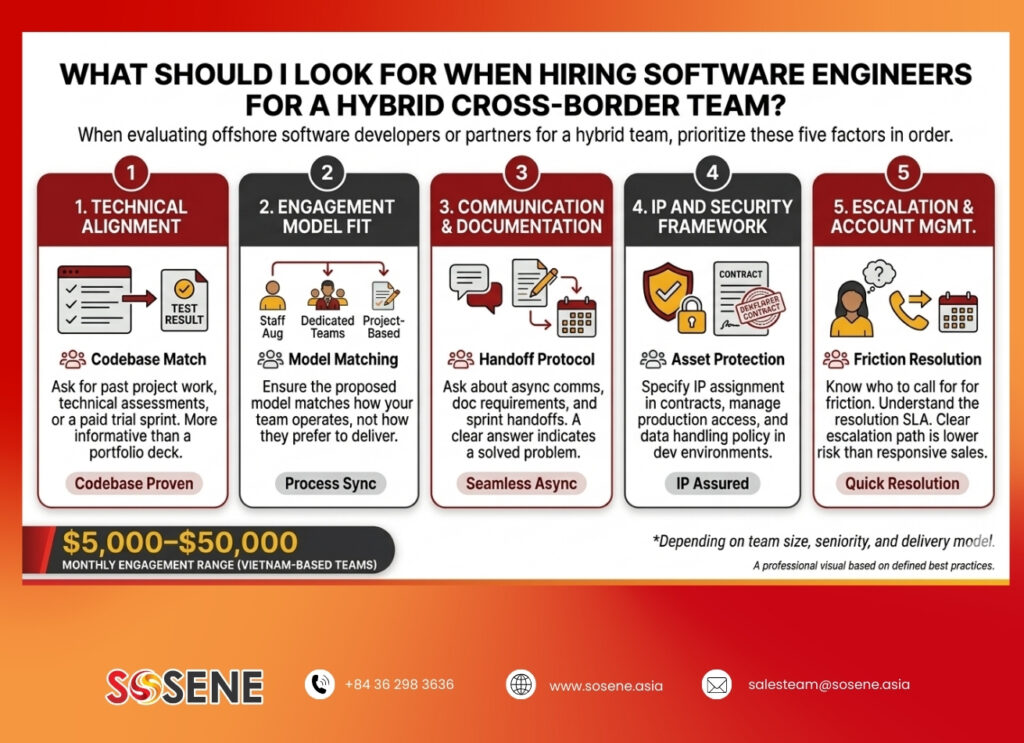
When evaluating offshore software developers or partners for a hybrid team, prioritize these five factors in order.
Technical alignment: can their developers operate at the level your codebase requires? Ask for evidence — past project work, technical assessments, or a paid two-week trial sprint is more informative than a portfolio deck.
Engagement model fit: do they offer staff augmentation, dedicated teams, or project-based delivery? Make sure the model they propose matches how your team actually operates, not how they prefer to deliver.
Communication and documentation standards: ask how they handle async communication, what their documentation requirements are, and how they manage sprint handoffs. A vendor who cannot answer this clearly has not solved it.
IP and security framework: ask specifically how IP assignment is handled in developer contracts, how access to production systems is managed, and what their data handling policy is for client data in development environments.
Escalation and account management: who do you call when something goes wrong? What is the resolution path? Hybrid team engagements have friction points — what matters is how quickly they get resolved. A vendor with a clear escalation path is structurally lower risk than one with a responsive sales team and no post-sale account management.
Vietnam-based teams that meet all five criteria are available at competitive rates across the $5,000–$50,000/month engagement range, depending on team size, seniority, and delivery model.
How Sosene approaches hybrid software engineering engagements

Sosene’s approach to hybrid team engagements starts before the first developer is placed. We run a two-session discovery process to map your existing engineering structure, identify where offshore capacity creates the most leverage, and surface any operational gaps — documentation, sprint structure, access control — that would reduce delivery quality in a distributed model.
From there, we match team composition to the engagement model: IT Staff Augmentation for companies scaling existing teams, dedicated development teams for companies building new capabilities, and AI Integration where automation and intelligent systems are part of the roadmap.
We do not start sprints until the technical onboarding is complete. We maintain a senior Sosene technical lead as a named contact throughout the engagement — not just during sales.
Most companies we work with in Singapore, Australia, and the US share one thing in common: they evaluated several vendors, asked a version of the same five questions above, and chose based on how clearly the answers came back. If you want to see how Sosene structures hybrid engagements for your industry, the consultation page is the right next step.
Conclusion
Building a hybrid software engineering team across borders is an operational model decision, not a talent sourcing exercise. The companies that do it well design the integration layer — documentation standards, sprint structure, technical oversight, escalation paths — before they hire the first offshore developer. The ones that struggle skip that step and pay for it in the third or fourth sprint.
Vietnam provides the right combination of talent depth, timezone compatibility, and cost structure for most SEA and US-based companies evaluating this model. The risks — quality variance, timezone friction, IP exposure — are all manageable with the right engagement structure in place from day one.
If you are evaluating offshore development partners for a hybrid team, start with the engagement model and the operational structure. Get that right and most of the other risks manage themselves. If you want to see how Sosene structures hybrid engagements for your industry, the consultation page is the right next step.
FAQs
What is a hybrid software engineering team?
A hybrid software engineering team combines in-house staff — typically product managers, tech leads, and senior engineers — with offshore or nearshore developers who handle feature delivery, QA, or specialist work. The key difference from traditional outsourcing is that hybrid teams operate on a shared sprint, shared codebase standards, and shared definition of done, rather than as a separate parallel workstream.
How do I hire software engineers in Vietnam for a cross-border team?
You have two main options: staff augmentation, where individual developers join your team under your management, or a dedicated team, where an offshore partner staffs and manages a delivery unit under your direction. Vietnam-based partners handle recruiting, employment, and HR administration — you direct the technical work. The process from brief to first sprint typically runs four to six weeks.
How do hybrid teams handle timezone gaps between Vietnam and Singapore or the US?
For Singapore-based companies, Vietnam’s one-hour timezone difference means a full shared workday with no async lag. For US-based companies, a follow-the-sun model works well: US engineers close their day with a written handoff, Vietnam-based engineers continue delivery overnight, and completed work is ready for review by US morning. The critical requirement is documented handoff protocols — not just timezone overlap.
How do I protect IP when hiring offshore software developers?
IP protection in offshore engagements is handled at the contract and process level: IP assignment clauses in the services agreement and individual developer NDAs, restricted access architecture where developers access only the systems they need, and no production data in development environments. These are standard requirements for any reputable offshore partner. If a vendor cannot clearly explain their IP framework, treat it as a disqualifying signal.
What is the difference between IT staff augmentation and a dedicated development team?
Staff augmentation adds individual developers directly to your existing team — they work under your management and integrate into your sprint. A dedicated team is a structured offshore unit managed by your partner, operating in parallel to your in-house team on a defined scope. Staff augmentation suits companies that need to scale existing capacity; dedicated teams suit companies building new products or capabilities from the ground up.