Choosing a software vendor is no longer a simple procurement decision. Across Southeast Asia, software platforms increasingly sit at the core of operations, compliance, and growth. Yet many evaluations still default to headline pricing, overlooking the structural costs and risks that emerge only after implementation.
As technology portfolios grow more interconnected, the consequences of a poor vendor choice compound quickly. Integration bottlenecks, unclear support models, rigid contracts, and misaligned roadmaps can turn a cost-saving decision into a long-term operational burden.
This guide focuses on how to evaluate software vendors beyond price by examining Total Cost of Ownership (TCO), delivery and support maturity, product evolution, integration readiness, security posture, and long-term alignment. The aim is to provide a clear, defensible framework for making vendor decisions that hold up over time, not just on paper.
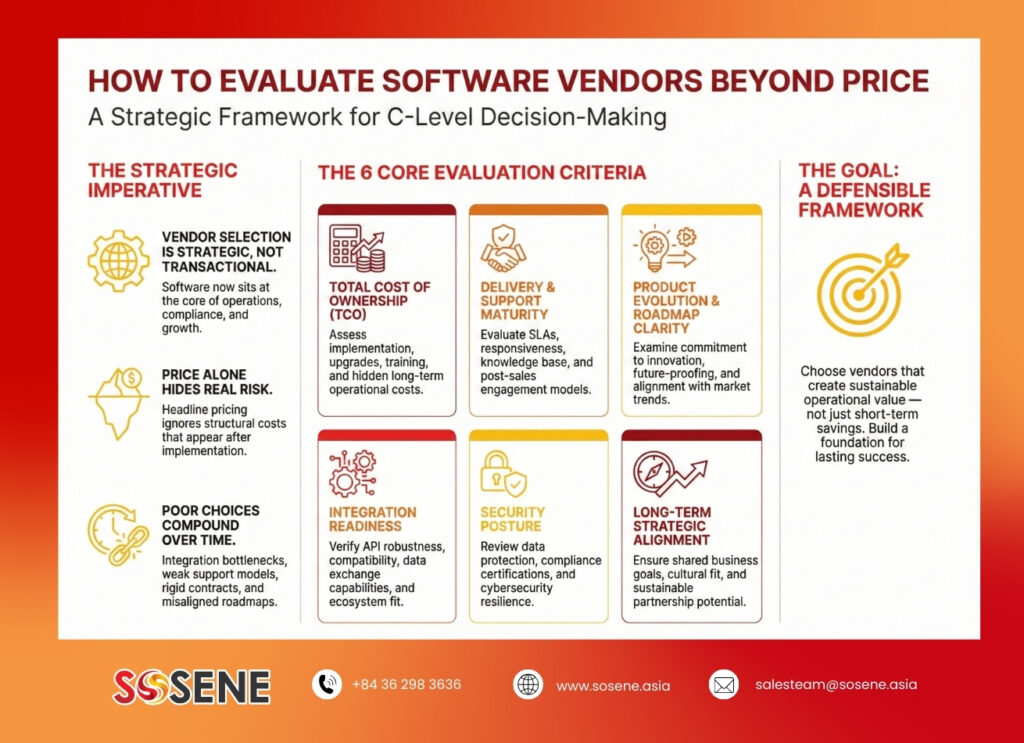
Table of Contents
Key Takeaways
- Price is a weak proxy for long-term value and risk.
- Total Cost of Ownership (TCO) provides a more realistic cost baseline.
- Vendor stability and delivery maturity reduce operational uncertainty.
- Integration, security, and support drive hidden costs.
- Strong roadmaps and scalability protect against early replacement.
Further Reading
Why Price Alone Is a Poor Evaluation Signal
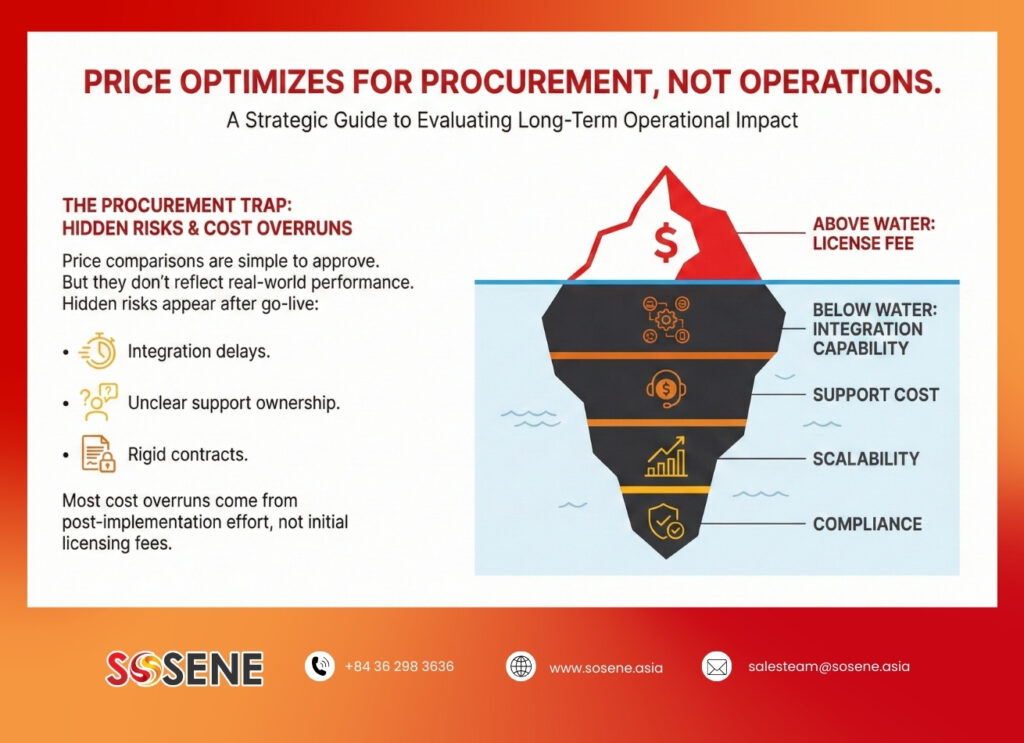
Price Optimizes for Procurement, Not Operations.
Price comparisons are easy to justify internally, but they rarely reflect how software behaves in real environments. Integration delays, unclear support ownership, and rigid contracts tend to surface only after go-live.
Industry research consistently shows that most enterprise software cost overruns come from underestimated post-implementation effort rather than initial licensing fees.
Evaluating beyond price shifts attention from short-term savings to long-term operational impact.
Total Cost of Ownership as the Real Cost Baseline.
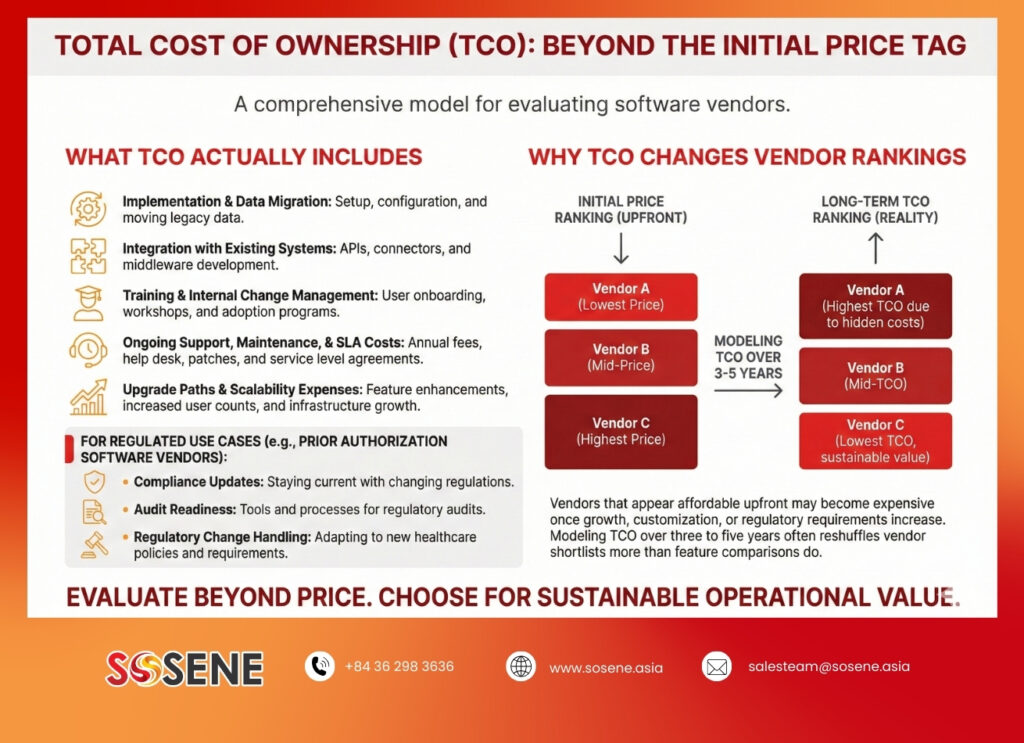
What TCO Actually Includes.
A meaningful TCO assessment should cover:
- Implementation and data migration.
- Integration with existing systems.
- Training and internal change management.
- Ongoing support, maintenance, and SLA costs.
- Upgrade paths and scalability expenses.
For regulated use cases involving prior authorization software vendors, compliance updates, audit readiness, and regulatory change handling should be explicitly included in TCO models.
Why TCO Changes Vendor Rankings.
Vendors that appear affordable upfront may become expensive once growth, customization, or regulatory requirements increase. Modeling TCO over three to five years often reshuffles vendor shortlists more than feature comparisons do.
Vendor Stability and Partnership Risk
Long-Term Viability Matters.
Selecting a software vendor implicitly creates dependency. Organizations should evaluate:
- Financial stability and ownership structure.
- Customer retention and churn trends.
- Industry focus and reference depth.
- Willingness to share roadmap and metrics.
Vendor instability introduces risks that price discounts cannot offset.
Cultural and Operating Fit.
How vendors communicate, escalate issues, and manage accountability often determines success more than contractual terms. Cultural misalignment increases friction and slows decision-making under pressure.
Execution Capability: Integration, Security, and Support
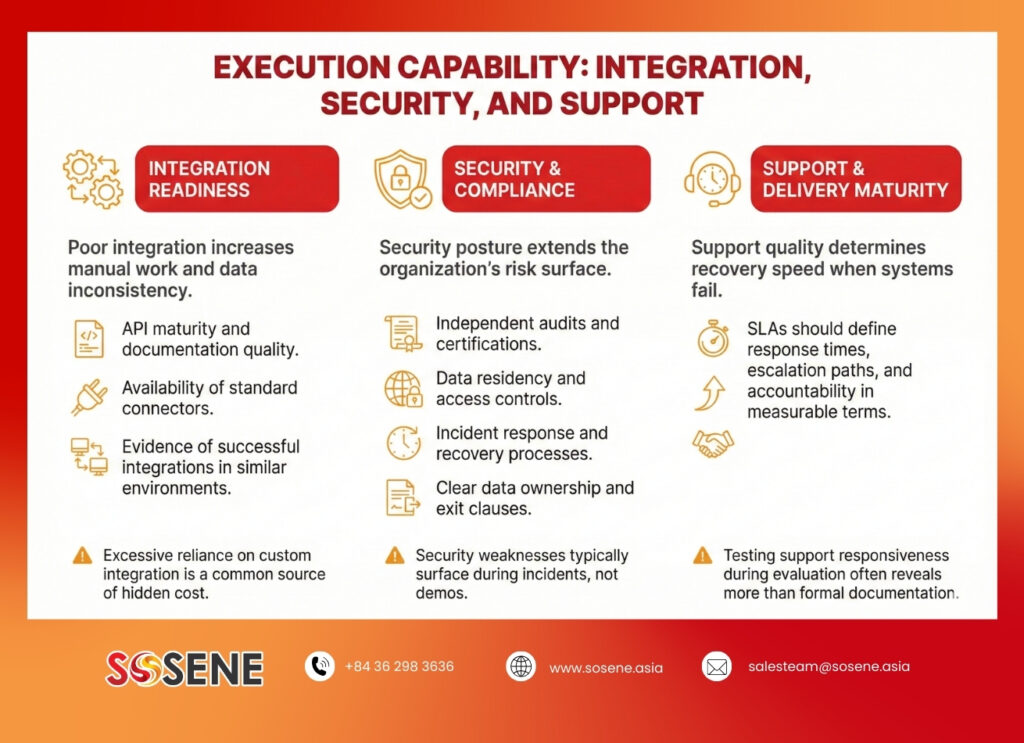
Integration Readiness.
Poor integration increases manual work and data inconsistency. Evaluation should include:
- API maturity and documentation quality.
- Availability of standard connectors.
- Evidence of successful integrations in similar environments.
Excessive reliance on custom integration is a common source of hidden cost.
Security and Compliance.
Security posture extends the organization’s risk surface. Enterprises should verify:
- Independent audits and certifications.
- Data residency and access controls.
- Incident response and recovery processes.
- Clear data ownership and exit clauses.
Security weaknesses typically surface during incidents, not demos.
Support and Delivery Maturity.
Support quality determines recovery speed when systems fail. SLAs should define response times, escalation paths, and accountability in measurable terms.
Testing support responsiveness during evaluation often reveals more than formal documentation.
Product Roadmap and Scalability
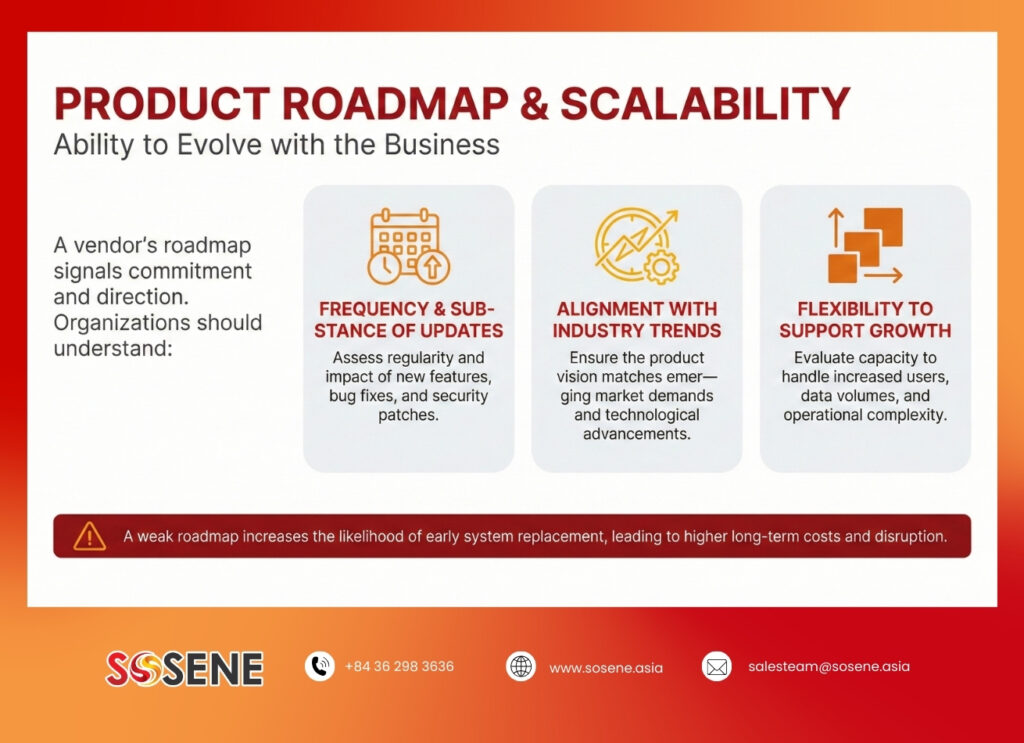
Ability to Evolve with the Business.
A vendor’s roadmap signals commitment and direction. Organizations should understand:
- Frequency and substance of product updates.
- Alignment with industry trends.
- Flexibility to support growth in users, data, and complexity.
A weak roadmap increases the likelihood of early system replacement.
Practical Example.
A regional enterprise compared several software vendors for a compliance-sensitive platform. While one option offered the lowest price, deeper evaluation revealed high integration effort, limited support coverage, and unclear roadmap commitments.
By selecting a vendor with higher upfront cost but clearer TCO visibility, stronger integration capability, and predictable support, the organization reduced operational risk and avoided rework within the first year.
The decision held up not because it was cheaper, but because it was easier to operate and scale.
Conclusion
Evaluating software vendors beyond price requires shifting focus from surface-level comparisons to long-term cost, risk, and fit. TCO transparency, vendor stability, execution capability, and product evolution are the factors that ultimately determine success.
Price still matters, but only as part of a broader evaluation framework. Organizations that adopt this approach make vendor decisions that remain viable as business conditions and technology landscapes evolve.
If you are reviewing software vendors or reassessing existing vendor relationships in Southeast Asia, Sosene can support objective discussions around cost, risk, and delivery models. Sosene works with organizations across industries to help structure vendor evaluations and engagement models aligned with long-term operational goals.
To get started, you can contact Sosene and share your requirements. Sosene will support you in reviewing your context and exploring appropriate next steps based on your priorities.
FAQs
How do you evaluate software vendors beyond price?
By examining Total Cost of Ownership, vendor stability, execution capability, integration readiness, security posture, and roadmap alignment rather than relying on initial pricing alone.
What are the key criteria for evaluating software vendors?
Core criteria include TCO, technical capability, support quality, integration, security and compliance, scalability, and cultural fit.
How do organizations evaluate vendor performance over time?
Through KPIs, SLA adherence, delivery outcomes, and regular stakeholder reviews to ensure alignment with evolving needs.
What role does TCO play in vendor evaluation?
TCO reveals the true cost of a vendor relationship over time, including hidden and indirect costs not reflected in upfront pricing.
Are lower-priced vendors always at higher risk?
No. Risk depends on transparency, execution maturity, and alignment, not price alone.