
Across Southeast Asia, digital transformation in education is no longer a pilot initiative confined to individual schools. It has become a national and regional priority embedded in economic competitiveness, workforce development, and digital inclusion agendas.
Governments are aligning policy, infrastructure, and curriculum reforms under ASEAN frameworks. Ministries are redefining governance models. Institutions are rethinking pedagogy and technology architecture.
Yet transformation remains uneven. Device distribution alone does not improve learning outcomes. Connectivity gaps persist. Teacher readiness varies significantly.
This article presents a structured roadmap for digital transformation education across Southeast Asia. It connects regional policy direction with institutional execution, outlining practical steps ministries and education leaders can take to ensure long-term, sustainable transformation.
Table of Contents
Key Takeaways
- Digital transformation in education in Southeast Asia is policy-driven and regionally coordinated → systemic reform is prioritized over isolated school initiatives.
- Transformation extends beyond devices → infrastructure, pedagogy, governance, and workforce alignment must evolve together.
- The digital divide remains the most critical constraint → urban–rural disparities limit equitable access.
- Teacher readiness and digital pedagogy capability determine long-term impact → technology alone does not change outcomes.
- Ethical AI governance and data protection are becoming foundational pillars → compliance and cybersecurity risks cannot be secondary considerations.
- ASEAN cooperation enables interoperability and policy alignment → regional coordination supports scalable progress.
Further Reading
What Is Digital Transformation in Education?
Digital transformation in education is often misunderstood as digitization—moving textbooks online or deploying devices. In reality, transformation is structural.
From digitization to systemic transformation
Digitization converts analog processes into digital formats. Transformation redesigns how education systems function. It reshapes teaching models, governance frameworks, student engagement, and institutional operations.
In a transformed system, digital tools support personalized learning, real-time assessment, and data-informed policy decisions. Technology becomes an enabler of pedagogical innovation rather than a layer added onto traditional structures.
Digital transformation and education outcomes
The objective is not technology adoption; it is measurable improvement in access, equity, quality, and workforce readiness. When transformation is effective, rural access improves, dropout rates decline, digital literacy increases, and graduates align more closely with labor market demands.
National Roadmaps Shaping EdTech in Southeast Asia
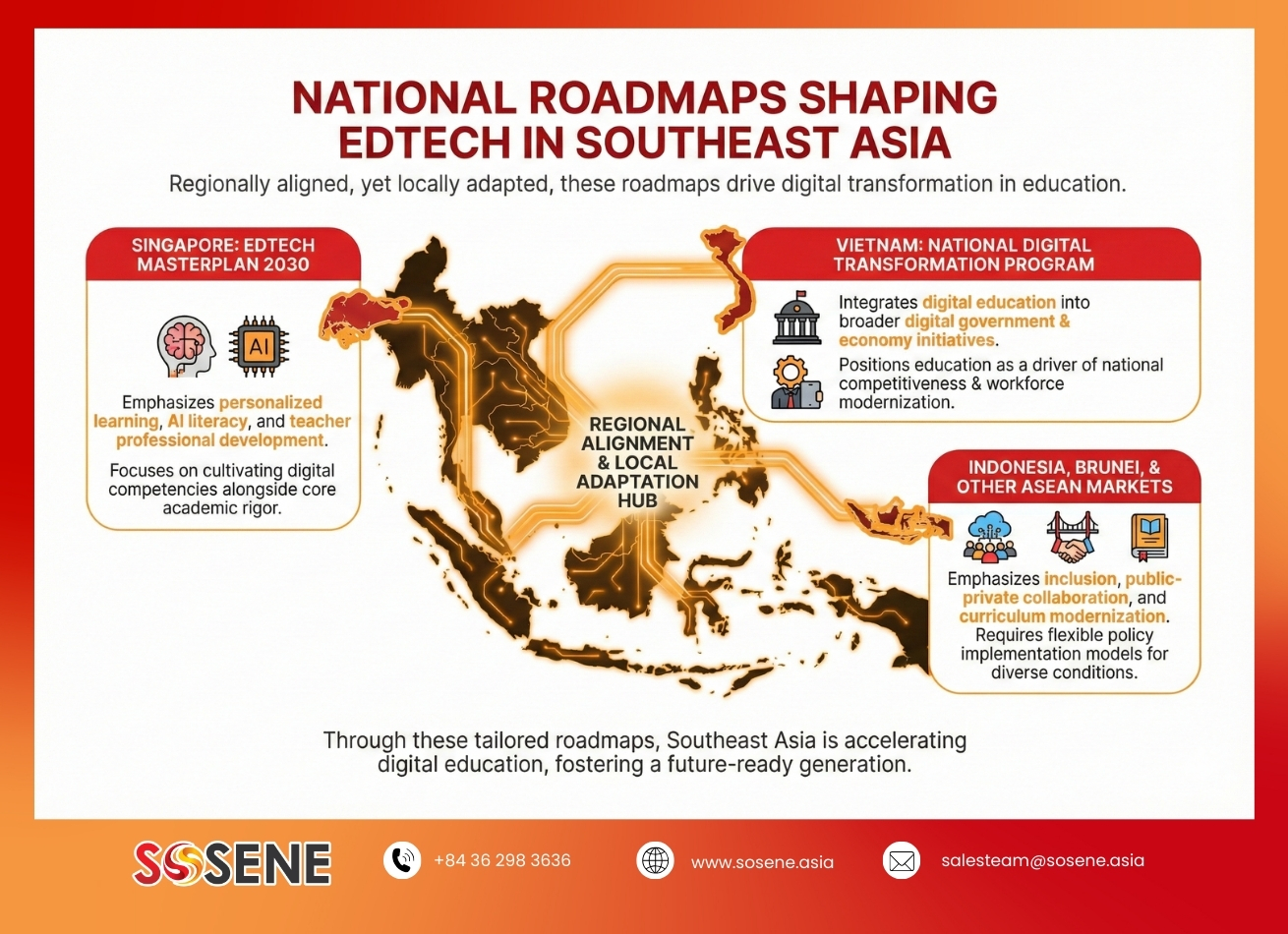
While aligned regionally, each country adapts digital transformation education to local priorities.
Singapore: EdTech Masterplan 2030
Singapore emphasizes personalized learning, AI literacy, and teacher professional development. The focus is on cultivating digital competencies alongside core academic rigor.
Vietnam: National Digital Transformation Program
Vietnam integrates digital education into its broader digital government and digital economy initiatives. Education is positioned as a driver of national competitiveness and workforce modernization.
Indonesia, Brunei, and other ASEAN markets
Other markets emphasize inclusion, public-private collaboration, and curriculum modernization. Diverse economic and geographic conditions require flexible policy implementation models.
Core Pillars of an EdTech Digital Transformation Roadmap
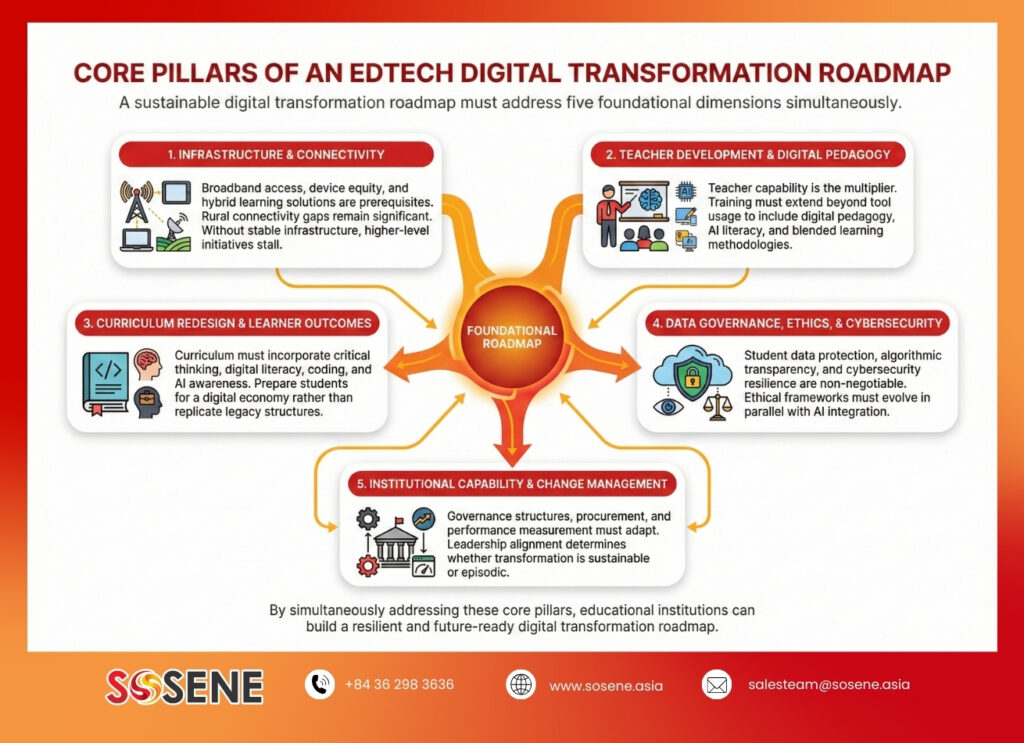
A sustainable digital transformation roadmap must address foundational dimensions simultaneously.
Infrastructure and connectivity
Broadband access, device equity, and hybrid learning solutions are prerequisites. Rural connectivity gaps remain significant across parts of Southeast Asia. Without stable infrastructure, higher-level initiatives stall.
Teacher development and digital pedagogy
Teacher capability is the multiplier of transformation. Training must extend beyond tool usage to include digital pedagogy, AI literacy, and blended learning methodologies.
Curriculum redesign and learner outcomes
Curriculum must incorporate critical thinking, digital literacy, coding fundamentals, and AI awareness. Transformation should prepare students for a digital economy rather than replicate legacy learning structures.
Data governance, ethics, and cybersecurity
Student data protection, algorithmic transparency, and cybersecurity resilience are non-negotiable. As AI integration expands, ethical frameworks must evolve in parallel.
Institutional capability and change management
Governance structures, procurement policies, and performance measurement mechanisms must adapt. Leadership alignment determines whether transformation is sustainable or episodic.
Key Challenges in Southeast Asia’s Digital Transformation Education Journey
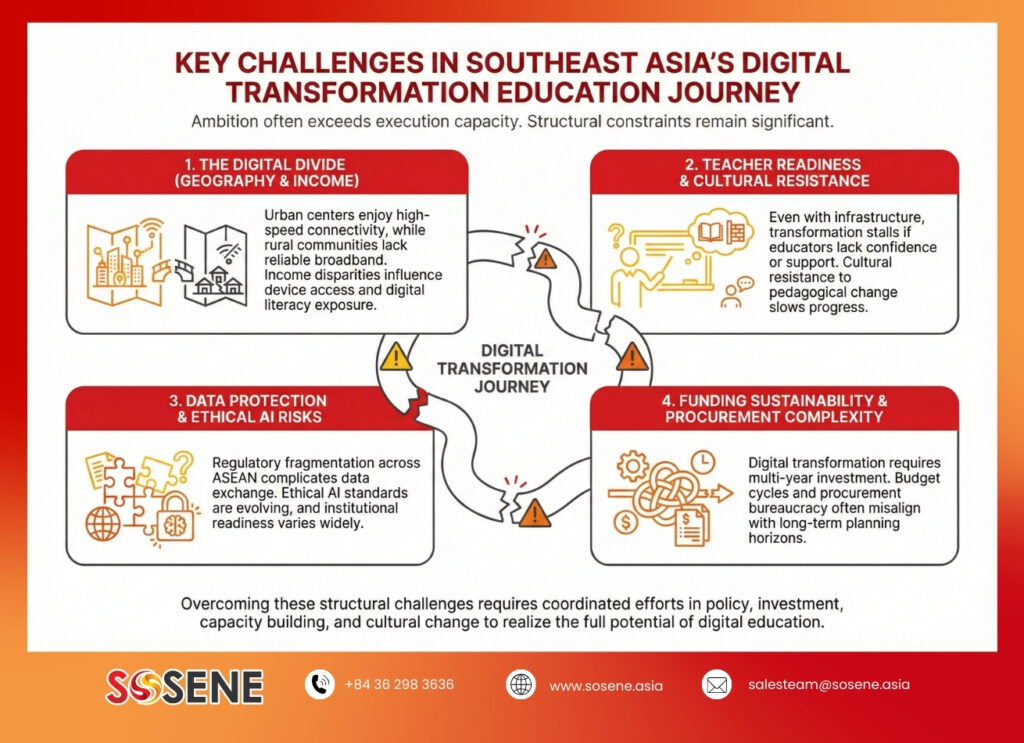
Ambition often exceeds execution capacity. Structural constraints remain significant.
The digital divide across geography and income levels
Urban centers may enjoy high-speed connectivity, while rural communities lack reliable broadband. Income disparities influence device access and digital literacy exposure.
Teacher readiness and cultural resistance
Even with infrastructure in place, transformation can stall if educators lack confidence or institutional support. Cultural resistance to pedagogical change slows progress.
Data protection and ethical AI risks
Regulatory fragmentation across ASEAN markets complicates cross-border data exchange. Ethical AI standards are evolving, and institutional readiness varies widely.
Funding sustainability and procurement complexity
Digital transformation requires multi-year investment. Budget cycles and procurement bureaucracy often misalign with long-term planning horizons.
Emerging Trends for 2025–2030
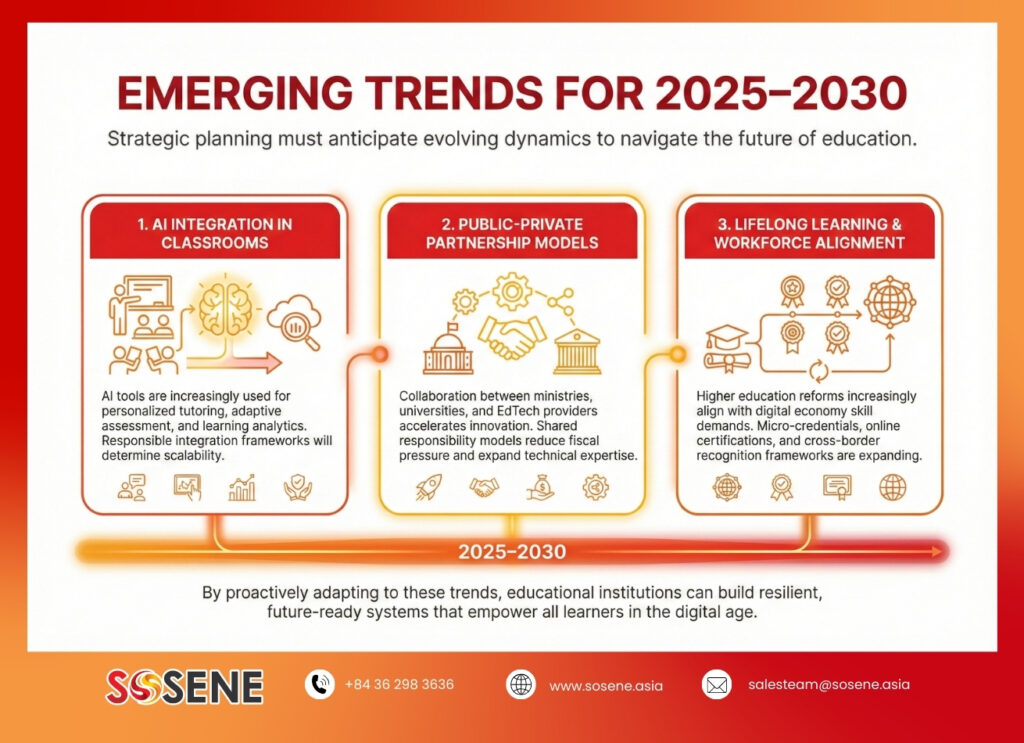
Strategic planning must anticipate evolving dynamics.
AI integration in classrooms
AI tools are increasingly used for personalized tutoring, adaptive assessment, and learning analytics. Responsible integration frameworks will determine scalability.
Public-private partnership models
Collaboration between ministries, universities, and EdTech providers accelerates innovation. Shared responsibility models reduce fiscal pressure and expand technical expertise.
Lifelong learning and workforce alignment
Higher education reforms increasingly align with digital economy skill demands. Micro-credentials, online certifications, and cross-border recognition frameworks are expanding.
A Practical Roadmap for Institutions and Ministries
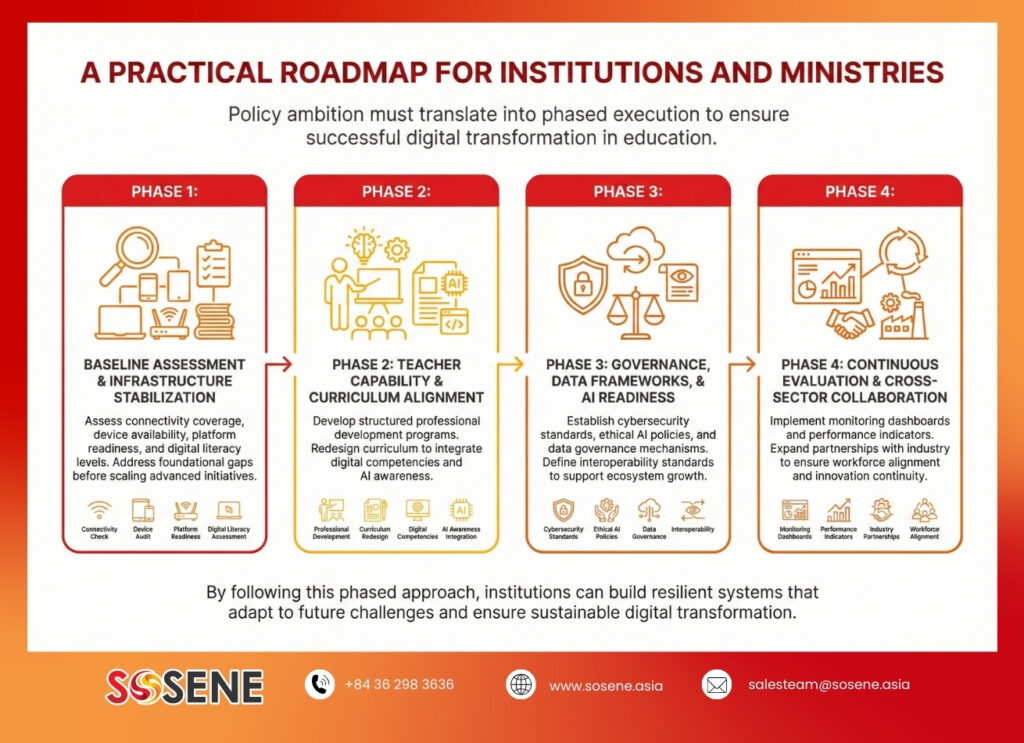
Policy ambition must translate into phased execution.
Phase 1: Baseline assessment and infrastructure stabilization
Assess connectivity coverage, device availability, platform readiness, and digital literacy levels. Address foundational gaps before scaling advanced initiatives.
Phase 2: Teacher capability and curriculum alignment
Develop structured professional development programs. Redesign curriculum to integrate digital competencies and AI awareness.
Phase 3: Governance, data frameworks, and AI readiness
Establish cybersecurity standards, ethical AI policies, and data governance mechanisms. Define interoperability standards to support ecosystem growth.
Phase 4: Continuous evaluation and cross-sector collaboration
Implement monitoring dashboards and performance indicators. Expand partnerships with industry to ensure workforce alignment and innovation continuity.
How Sosene Supports EdTech Digital Transformation in Southeast Asia
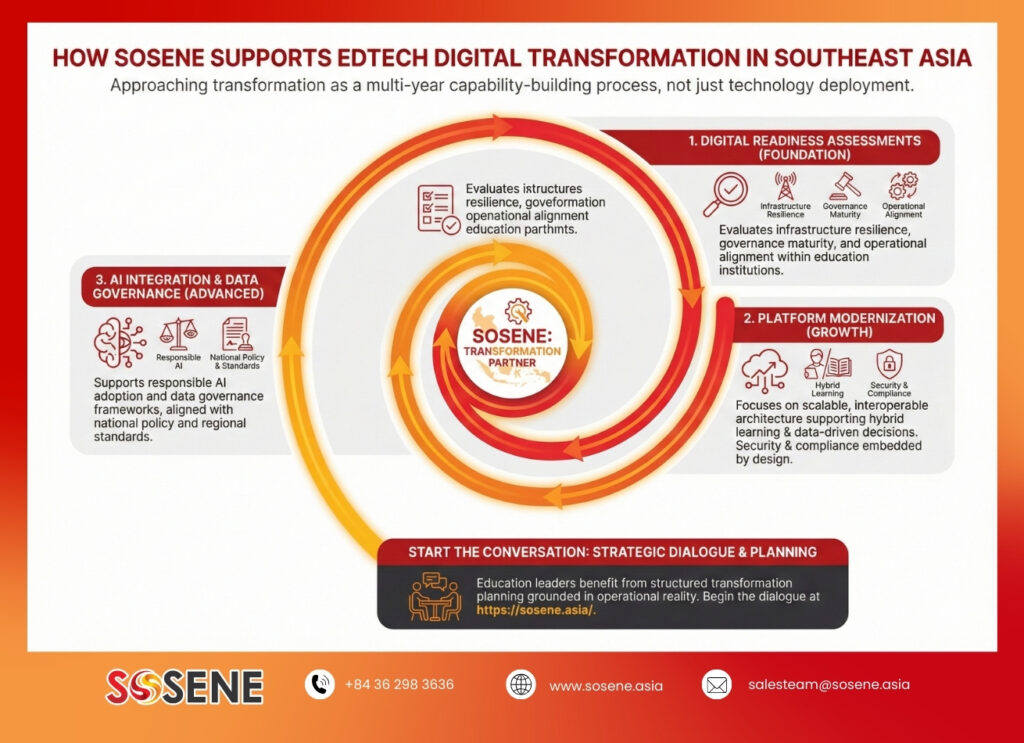
Sosene approaches digital transformation education as a multi-year capability-building process rather than a technology deployment project.
Sosene conducts digital readiness assessments to evaluate infrastructure resilience, governance maturity, and operational alignment within education institutions.
Platform modernization initiatives focus on scalable, interoperable architecture that supports hybrid learning and data-driven decision-making. Security and compliance are embedded by design.
Sosene also supports AI integration and data governance frameworks, ensuring responsible AI adoption aligned with national policy and regional standards.
Education leaders seeking structured transformation planning often benefit from strategic dialogue grounded in operational reality. You can start that conversation at https://sosenesoftware.com/.
Conclusion
Digital transformation in education across Southeast Asia is a coordinated regional effort shaped by national strategies and ASEAN collaboration. Success depends not only on deploying technology, but on redesigning systems, empowering teachers, and strengthening governance.
Infrastructure investment must align with pedagogy reform. AI adoption must be paired with ethical safeguards. Funding must sustain multi-year execution rather than short-term pilots.
Institutions and ministries that approach digital transformation education as a phased, structured roadmap—rather than a technology initiative—position themselves to reduce inequity, strengthen workforce alignment, and build resilient education systems for the digital economy.
FAQs
What is digital transformation in education?
Digital transformation in education involves systemic reform across infrastructure, pedagogy, governance, and curriculum to improve access, quality, and workforce readiness through digital technologies.
How does digital transformation education differ across Southeast Asian countries?
While aligned under ASEAN frameworks, each country adapts strategy to local economic, regulatory, and infrastructure conditions.
What are the core pillars of digital transformation and education strategy?
Infrastructure, teacher development, curriculum redesign, data governance, and institutional capability are foundational pillars.
How can schools bridge the digital divide effectively?
By prioritizing connectivity expansion, device equity programs, hybrid learning models, and targeted teacher training in underserved regions.
What role does AI play in Southeast Asia’s EdTech roadmap?
AI supports personalized learning, adaptive assessment, and data analytics, but requires strong governance and ethical oversight frameworks.
How can ministries ensure data privacy and ethical AI adoption?
Through clear regulatory standards, cybersecurity investment, interoperability policies, and transparent algorithmic governance guidelines.
When should institutions engage a technology partner for digital transformation planning?
When internal capability gaps, infrastructure complexity, or governance challenges exceed in-house expertise and structured roadmap development is required.