Enterprises today rarely ask whether to adopt AI. The real question is how. Should AI be integrated into existing workflows to improve efficiency, or should it become the foundation of a new AI-driven product?
This distinction is strategic, not technical. It influences capital allocation, talent strategy, governance complexity, and long-term competitive positioning. Many organizations overbuild AI capabilities before validating business value. Others underinvest and reduce AI to a tactical automation layer, missing opportunities for differentiation.
This article provides a structured framework to evaluate AI integration versus AI product development. By the end, decision-makers will understand how to align AI investments with business objectives, risk appetite, and long-term strategy.
Table of Contents
Key Takeaways
- AI integration enhances existing workflows for efficiency → faster time-to-value with lower risk → ideal for standardized or internal automation use cases.
- AI product development positions AI as a core differentiator → higher upfront investment and complexity → stronger defensibility and IP ownership.
- The right path depends on data uniqueness, governance requirements, and strategic importance → misalignment leads to overbuilding or underleveraging AI.
- Integration-first pilots reduce uncertainty → validated value supports future product-level investment.
- Long-term success depends more on data readiness, operating model, and change management than on the algorithm itself.
Further Reading
Understanding the Strategic Difference: AI Integration vs AI Products
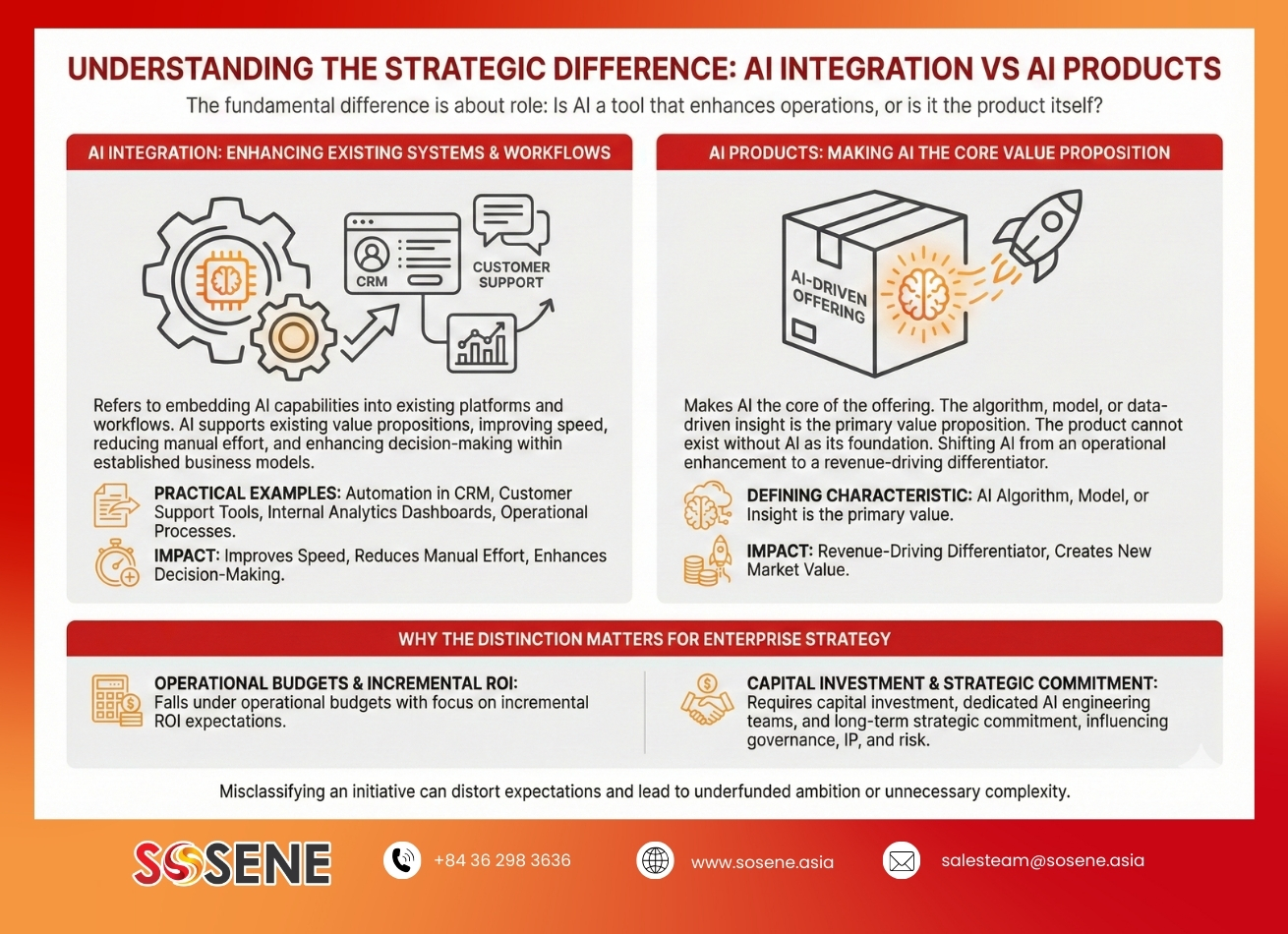
The difference between AI integration and AI product development is fundamentally about role. Is AI a tool that enhances operations, or is it the product itself?
What AI integration means in practice
AI integration refers to embedding AI capabilities into existing systems, platforms, and workflows. This often includes automation and AI integration in CRM systems, customer support tools, internal analytics dashboards, or operational processes.
In this model, AI supports existing value propositions rather than redefining them. It improves speed, reduces manual effort, and enhances decision-making within established business models.
What defines an AI product
An AI product, by contrast, makes AI the core of the offering. The algorithm, model, or data-driven insight becomes the primary value proposition. The product cannot exist without AI as its foundation.
This path shifts AI from an operational enhancement to a revenue-driving differentiator.
Why the distinction matters for enterprise strategy
AI integration typically falls under operational budgets and incremental ROI expectations. AI product development often requires capital investment, dedicated AI engineering teams, and long-term strategic commitment.
The strategic implications extend to governance, compliance, IP ownership, and risk exposure. Misclassifying an initiative can distort expectations and lead to underfunded ambition or unnecessary complexity.
When AI Integration Is the Right Path
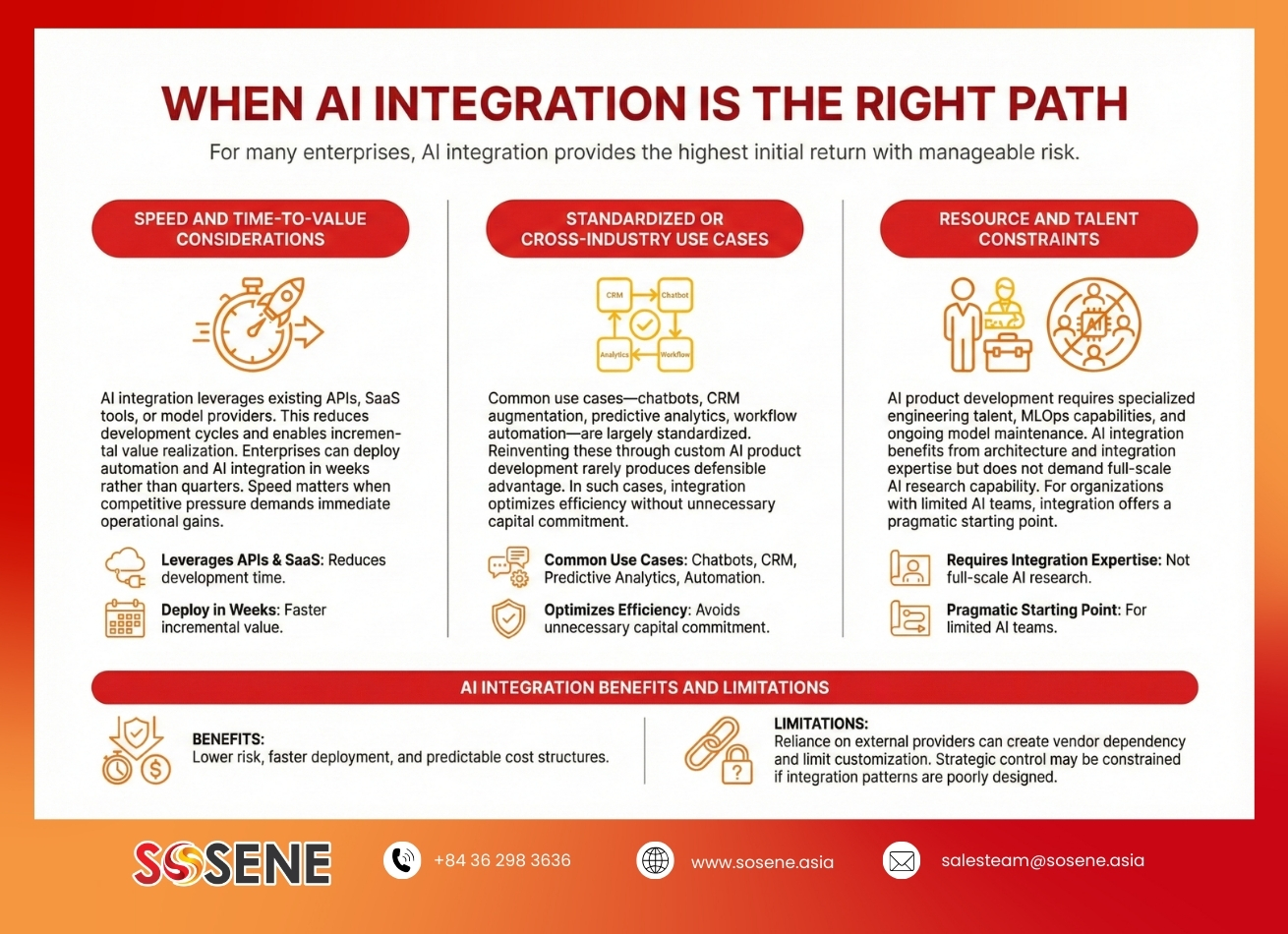
For many enterprises, AI integration provides the highest initial return with manageable risk.
Speed and time-to-value considerations
AI integration leverages existing APIs, SaaS tools, or model providers. This reduces development cycles and enables incremental value realization. Enterprises can deploy automation and AI integration in weeks rather than quarters.
Speed matters when competitive pressure demands immediate operational gains.
Standardized or cross-industry use cases
Common use cases—chatbots, CRM augmentation, predictive analytics, workflow automation—are largely standardized. Reinventing these through custom AI product development rarely produces defensible advantage.
In such cases, integration optimizes efficiency without unnecessary capital commitment.
Resource and talent constraints
AI product development requires specialized engineering talent, MLOps capabilities, and ongoing model maintenance. AI integration benefits from architecture and integration expertise but does not demand full-scale AI research capability.
For organizations with limited AI teams, integration offers a pragmatic starting point.
AI integration benefits and limitations
AI integration benefits include lower risk, faster deployment, and predictable cost structures. However, reliance on external providers can create vendor dependency and limit customization. Strategic control may be constrained if integration patterns are poorly designed.
When Building an AI Product Makes Strategic Sense
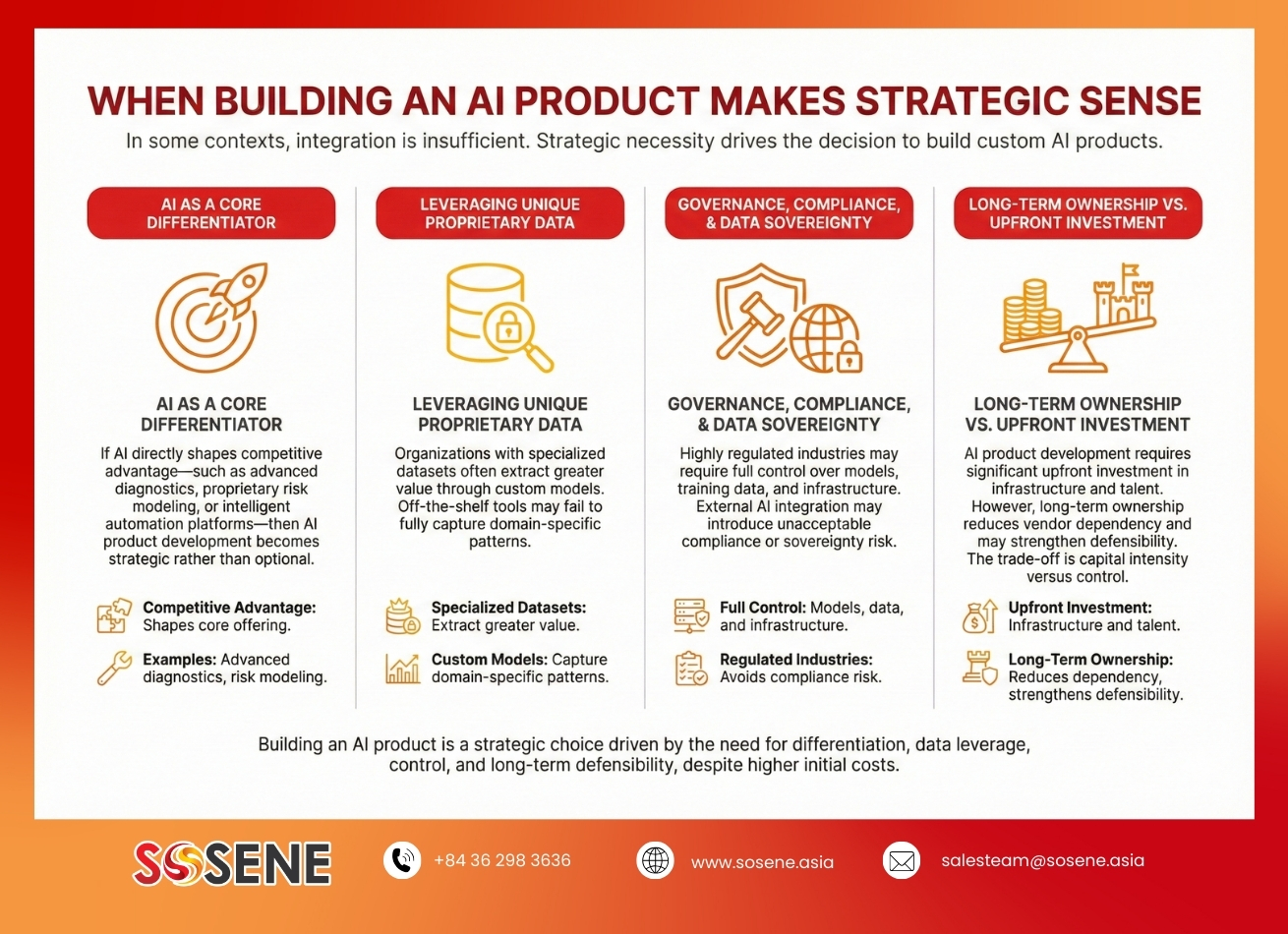
In some contexts, integration is insufficient.
AI as a core differentiator
If AI directly shapes competitive advantage—such as advanced diagnostics, proprietary risk modeling, or intelligent automation platforms—then AI product development becomes strategic rather than optional.
Leveraging unique proprietary data
Organizations with specialized datasets often extract greater value through custom models. Off-the-shelf tools may fail to fully capture domain-specific patterns.
Governance, compliance, and data sovereignty requirements
Highly regulated industries may require full control over models, training data, and infrastructure. External AI integration may introduce unacceptable compliance or sovereignty risk.
Long-term ownership vs. upfront investment trade-offs
AI product development requires significant upfront investment in infrastructure and talent. However, long-term ownership reduces vendor dependency and may strengthen defensibility. The trade-off is capital intensity versus control.
Comparing AI Integration and AI Products: A Decision Matrix
| Dimension | AI Integration | AI Product Development |
|---|---|---|
| Strategic Objective | Operational efficiency | Market differentiation |
| Time-to-Value | Fast deployment | Longer development cycle |
| Cost Structure | Subscription/API-based, predictable | Higher upfront CapEx and talent investment |
| Control & IP | Limited ownership | Full IP control |
| Risk Profile | Lower technical risk | Higher technical and market risk |
| Vendor Dependency | Moderate to high | Lower after build |
This comparison highlights that the decision is not binary but context-dependent.
A Step-by-Step Framework for Choosing the Right Path
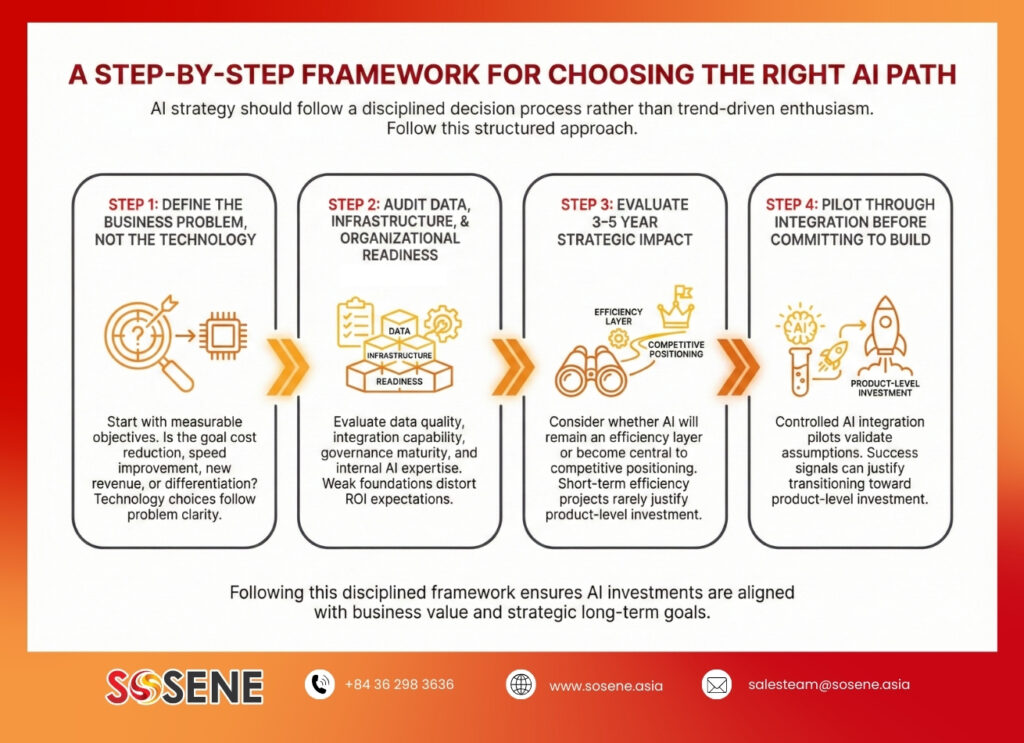
AI strategy should follow a disciplined decision process rather than trend-driven enthusiasm.
Step 1: Define the business problem, not the technology
Start with measurable business objectives. Is the goal cost reduction, speed improvement, new revenue, or differentiation? Technology choices follow problem clarity.
Step 2: Audit data, infrastructure, and organizational readiness
Evaluate data quality, integration capability, governance maturity, and internal AI expertise. Weak foundations distort ROI expectations.
Step 3: Evaluate 3–5 year strategic impact
Consider whether AI will remain an efficiency layer or become central to competitive positioning. Short-term efficiency projects rarely justify product-level investment.
Step 4: Pilot through integration before committing to build
Controlled AI integration pilots validate assumptions. Success signals can justify transitioning toward product-level investment.
AI Integration Best Practices for Enterprise Adoption
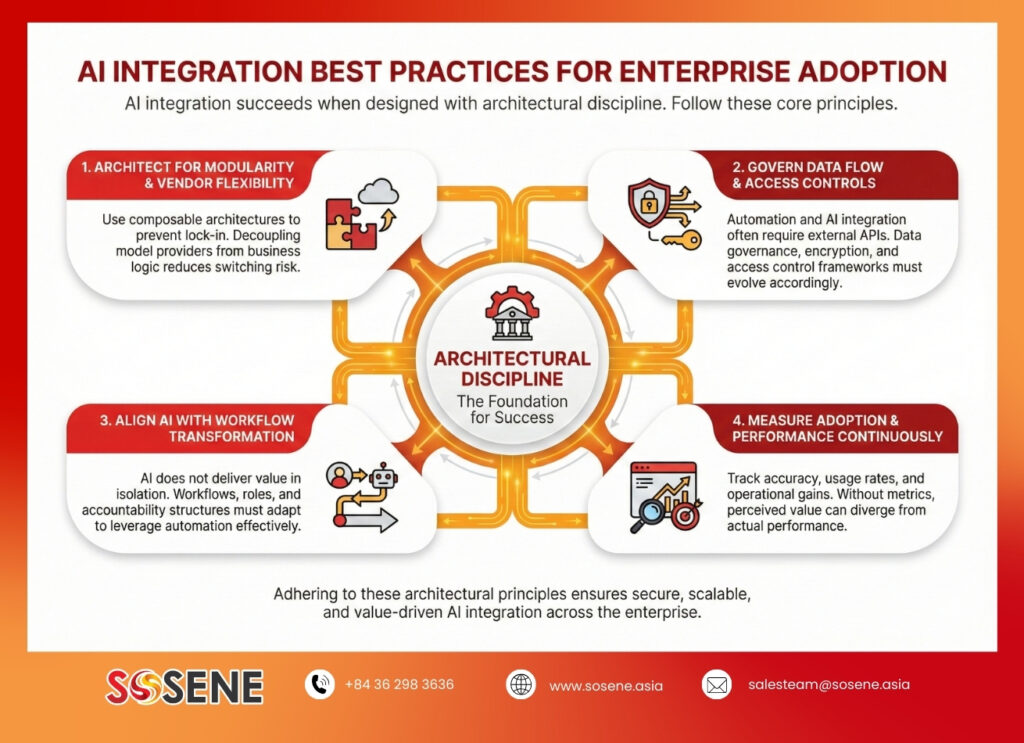
AI integration succeeds when designed with architectural discipline.
Architect for modularity and vendor flexibility
Use composable architectures to prevent lock-in. Decoupling model providers from business logic reduces switching risk.
Govern data flow and access controls
Automation and AI integration often require external APIs. Data governance, encryption, and access control frameworks must evolve accordingly.
Align AI initiatives with workflow transformation
AI does not deliver value in isolation. Workflows, roles, and accountability structures must adapt to leverage automation effectively.
Measure adoption and performance continuously
Track accuracy, usage rates, and operational gains. Without metrics, perceived value can diverge from actual performance.
Organizational Readiness: The Often Overlooked Factor
Technology readiness does not guarantee organizational readiness.
Talent and capability requirements
AI integration requires strong architecture and systems thinking. AI product development demands data scientists, ML engineers, and long-term model governance expertise.
Change management and process adaptation
Automation alters roles and responsibilities. Without structured change management, resistance undermines ROI.
The 10-20-70 rule in AI transformation
In many AI initiatives, roughly 10% of effort lies in algorithms, 20% in data and infrastructure, and 70% in people and process transformation. Overemphasizing models while neglecting adoption is a common failure pattern.
Hybrid Strategies: Blending Integration and Build
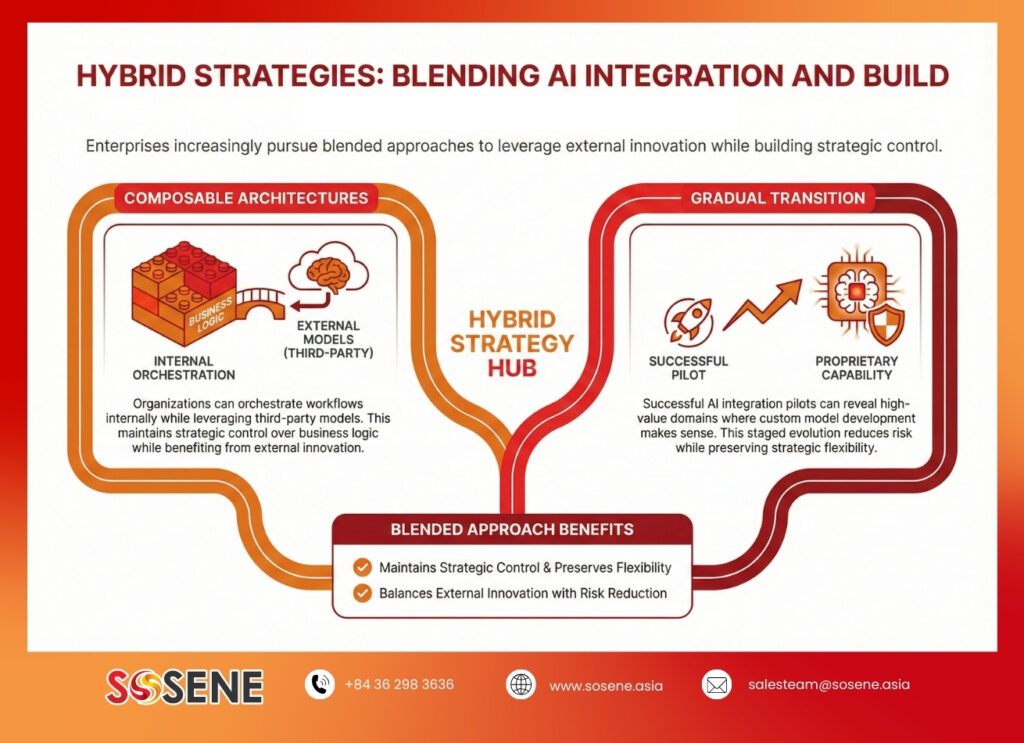
Enterprises increasingly pursue blended approaches.
Composable architectures using external models with internal orchestration
Organizations can orchestrate workflows internally while leveraging third-party models. This maintains strategic control over business logic while benefiting from external innovation.
Gradual transition from integration to proprietary capabilities
Successful AI integration pilots can reveal high-value domains where custom model development makes sense. This staged evolution reduces risk while preserving strategic flexibility.
How Sosene Supports AI Integration and AI Product Strategy

Sosene approaches AI integration and AI product strategy from a business-first perspective. Engagements begin with strategic AI readiness assessment, evaluating business objectives, data maturity, and governance posture.
For integration initiatives, Sosene designs modular, vendor-agnostic architectures that reduce dependency risk while enabling scalable automation and AI integration across workflows.
When differentiation demands proprietary capabilities, Sosene supports structured AI product development with controlled scope, measurable milestones, and governance mechanisms aligned with enterprise risk tolerance.
Organizations evaluating their AI roadmap often benefit from a structured conversation grounded in business impact rather than tool selection. You can start that conversation at https://sosenesoftware.com/
Conclusion
AI integration and AI product development represent distinct strategic paths. One prioritizes operational efficiency and speed; the other seeks differentiation and long-term defensibility.
Choosing between them requires clarity on business objectives, data uniqueness, governance requirements, and risk tolerance. A structured decision framework prevents overinvestment in unnecessary complexity or underinvestment in strategic capability.
Ultimately, sustainable AI success depends less on the sophistication of the model and more on readiness across data, operating model, and organizational change. Enterprises that approach AI integration and product strategy deliberately—rather than reactively—position themselves for scalable, resilient growth in an increasingly AI-driven market.
FAQs
What is the difference between AI integration and AI product development?
AI integration embeds AI into existing workflows to improve efficiency, while AI product development makes AI the core value proposition of a product or service.
When should a business prioritize AI integration over building its own AI product?
When the objective is operational efficiency, rapid deployment, or standardized use cases, AI integration typically offers faster ROI with lower risk.
What are the main AI integration benefits for enterprises?
AI integration benefits include faster implementation, predictable cost structures, improved operational efficiency, and reduced need for specialized AI engineering teams.
How does automation and AI integration impact operational efficiency?
It reduces manual workload, accelerates decision-making, and improves consistency in workflows, leading to measurable productivity gains.
What are the risks of building an AI product internally?
Risks include high upfront investment, technical complexity, talent scarcity, extended time-to-market, and uncertain market adoption.
Can companies start with AI integration and later transition to a proprietary AI product?
Yes. Many enterprises begin with integration pilots to validate value before investing in custom AI product development.
What are AI integration best practices to avoid vendor lock-in and scalability issues?
Best practices include modular architecture design, vendor-agnostic orchestration layers, strong data governance, and continuous performance monitoring.