Introduction
As we enter 2026, the transportation and logistics industry stands at a critical juncture. The digital transformation wave of the early 2020s has crested, leaving a clear divide between firms that merely digitized paper processes and those that have leveraged Agentic AI and Enterprise Mobility to fundamentally rewrite their operational DNA. In 2026, the margin for error is non-existent. Fuel volatility, the “Silver Tsunami” of retiring drivers, and customer demands for hyper-transparency have created a “survival of the fittest” environment where your mobile infrastructure is your primary competitive moat.
This guide is for C-Suite executives and fleet managers who are done with “pilot purgatory” and are ready to scale. We move beyond basic tracking to explore how 2026-era mobile apps serve as the neural network of the supply chain—autonomously negotiating routes, predicting maintenance failures before they happen, and serving as the primary retention tool for a scarce workforce. We also highlight why forward-thinking firms are turning to Sosene Software —a Vietnam-based leader in high-end software outsourcing—to build these mission-critical systems at a fraction of the cost of Western alternatives.
Table of Contents
Key Takeaways
The Era of Agentic AI: In 2026, mobile apps are shifting from passive reporting tools to active agents. “Agentic AI” can now autonomously reroute drivers based on real-time traffic or negotiate freight loads without human dispatch intervention, a trend identified by Gartner as a top priority for supply chain viability.
Mobility as a Retention Engine: With the driver shortage intensifying, the mobile user experience (UX) is a critical retention lever. Apps that gamify safety, automate compliance (ELD/DVIR), and offer instant payouts are proven to reduce turnover rates by improving the daily quality of life for drivers.
The High Cost of the Last Mile: Last-mile delivery costs now consume upwards of 53% of total shipping expenses. Enterprise mobile apps that integrate deep analytics can reduce these costs by optimizing drop density and reducing failed delivery attempts.
Vietnam as the 2026 Tech Hub: Developing enterprise-grade mobility solutions no longer requires a Silicon Valley budget. Vietnam has emerged as the premier destination for logistics tech, offering cost efficiencies of 40–70% while providing access to a workforce highly skilled in AI and cloud-native development.
Further Reading
The 2026 Imperative: From Digitization to Autonomy
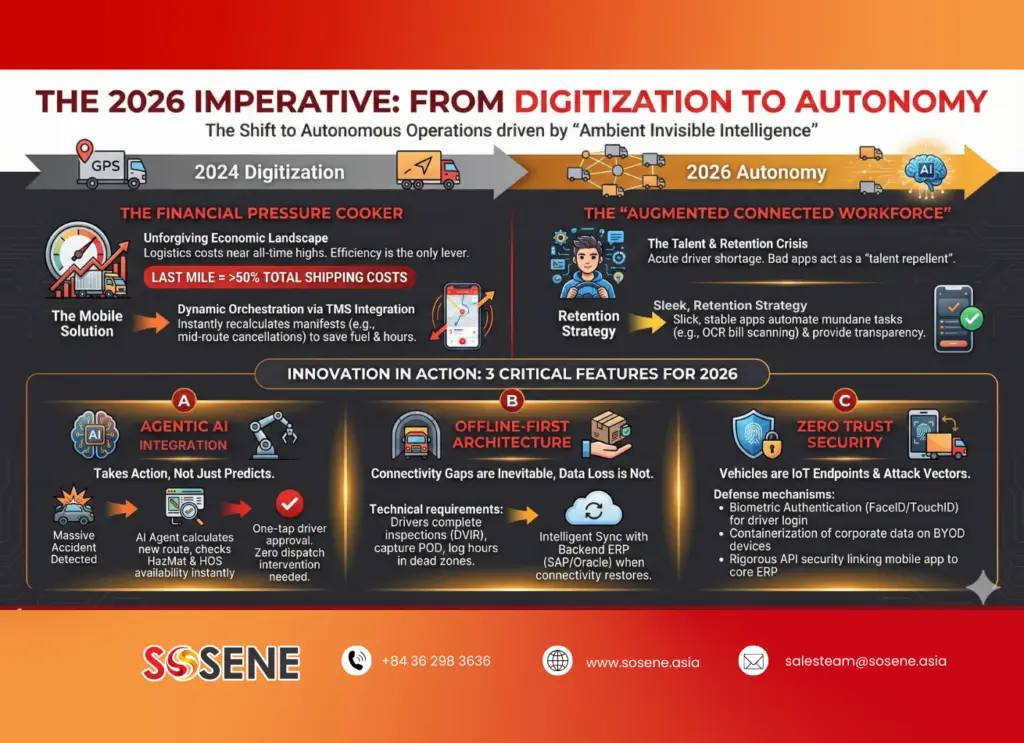
The transportation sector in 2026 is defined by the move toward Autonomous Operations. While self-driving trucks are still maturing, the management of fleets has already become autonomous. This is driven by what Gartner calls “Ambient Invisible Intelligence”—technology so embedded it becomes invisible.
The Financial Pressure Cooker
The economic landscape of 2026 is unforgiving. With logistics costs hovering near all-time highs relative to revenue, efficiency is the only lever left to pull. Inefficiencies in the “last mile” are particularly damaging, accounting for over half of total shipping costs.
The Mobile Solution: Modern enterprise apps are no longer just about GPS dots on a map. They are deeply integrated with Transport Management Systems (TMS) to provide dynamic orchestration. For example, if a customer cancels an order mid-route, the app instantly recalculates the manifest, saving fuel and driver hours.
The “Augmented Connected Workforce”
The driver shortage remains the industry’s most acute pain point. In 2026, the workforce will be younger and digital-native. They expect their work tools to be as intuitive as the apps they use at home.
Retention Strategy: An enterprise app that is buggy or difficult to use acts as a “repellent” for talent. Conversely, a slick, stable app that automates boring tasks (like scanning bills of lading via OCR) and provides transparency on pay is a massive differentiator. Accenture notes that digital tools which improve decision accuracy and reduce friction are essential for the “Augmented Connected Workforce”.
"We combine deep domain knowledge in Transportation & Logistics with the rigorous engineering standards required in industrial sectors."
Sosene Team
Innovation in Action: 3 Critical Features for 2026
To stay competitive, your enterprise mobile app must move beyond the basics. Here are the three non-negotiable features for 2026:
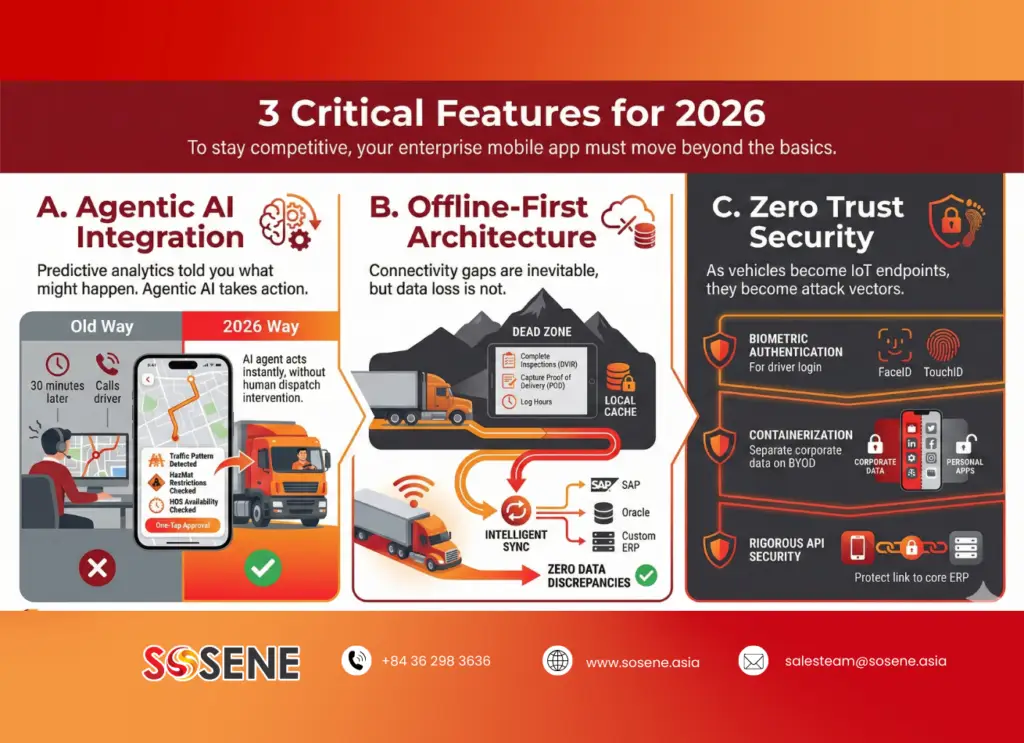
Agentic AI Integration
Predictive analytics told you what might happen. Agentic AI takes action.
- Scenario: A massive accident closes a highway.
- Old Way: The dispatcher notices the delay 30 minutes later and calls the driver.
- 2026 Way: The mobile app’s AI agent detects the traffic pattern instantly, calculates a new route that adheres to HazMat restrictions, checks the driver’s Hours of Service (HOS) availability, and pushes the new route to the driver for one-tap approval—all without human dispatch intervention.
Offline-First Architecture
Connectivity gaps are inevitable, but data loss is not.
- Requirement: Your app must be built on an offline-first architecture. Drivers must be able to complete inspections (DVIR), capture Proof of Delivery (POD), and log hours even in dead zones. The app should locally cache data and intelligently sync with the backend (SAP, Oracle, or custom ERP) once connectivity is restored, ensuring zero data discrepancies.
Zero Trust Security
As vehicles become IoT endpoints, they become attack vectors.
- Defense: Implementing Zero Trust architecture on mobile devices is critical. This includes biometric authentication (FaceID/TouchID) for driver login, containerization of corporate data to separate it from personal apps on BYOD devices, and rigorous API security to protect the link between the mobile app and your core ERP.
Strategic Sourcing: Why Vietnam is the 2026 Nexus for Logistics Tech
Building these sophisticated tools in-house is often cost-prohibitive and slow. This has led to a strategic pivot toward Vietnam as the preferred outsourcing destination for enterprise software.
The Vietnam Advantage
High-Value Skills: Unlike other regions that focus on basic maintenance, Vietnam’s tech sector has pivoted hard toward AI, Machine Learning, and Cloud Computing. With over 500,000 IT professionals and government-backed digital transformation programs, the talent pool is deep and modern.
Cost Efficiency: Development rates in Vietnam remain 30-50% lower than Eastern Europe and up to 70% lower than the US. This “budget arbitrage” allows transportation firms to reinvest savings into R&D and advanced features like AI.
Partner Spotlight: Sosene Software – Where Domain Expertise Meets Engineering Precision
Partner Spotlight: In the crowded market of software outsourcing, Sosene Software distinguishes itself not just by coding, but by comprehending the intricate pulse of global industries. With a strategic stronghold in Transportation & Logistics (T&L), Sosene has evolved into a specialized technology partner for enterprises that move the world.
Sosene’s T&L practice is built on a foundation of operational reality. We understand that modern Fleet Management requires more than just GPS tracking; it demands predictive maintenance algorithms, EV-ready infrastructure, and real-time driver behavior analytics. Our solutions in Supply Chain Optimization are designed to break down data silos, offering the “Control Tower” visibility that logistics leaders typically struggle to achieve with off-the-shelf software.
Yet, what truly sets Sosene apart is their cross-industry engineering heritage. Beyond logistics, Sosene possesses profound experience in the Manufacturing and Materials sectors. This duality is their competitive edge: we apply the rigorous, zero-error tolerance of manufacturing process automation to the dynamic, high-velocity world of logistics.
Whether you need to modernize a legacy Transportation Management System (TMS), build a scalable cross-docking platform, or integrate AI-driven demand forecasting, Sosene brings the architectural maturity of a top-tier systems integrator with the agility of a dedicated partner. We don’t just build features; we engineer ecosystems that drive cost-effectiveness and operational resilience
Implementation Roadmap for 2026
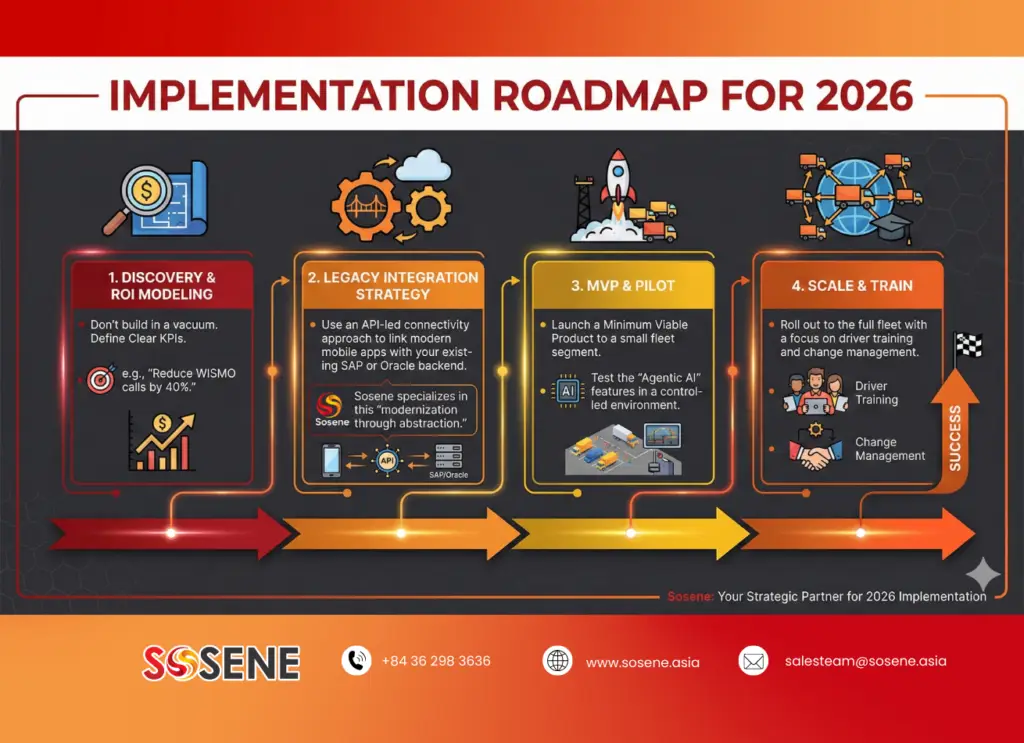
Discovery & ROI Modeling: Don’t build in a vacuum. Define clear KPIs (e.g., “Reduce WISMO calls by 40%”).
Legacy Integration Strategy: Use an API-led connectivity approach to link modern mobile apps with your existing SAP or Oracle backend. Sosene specializes in this “modernization through abstraction.”
MVP & Pilot: Launch a Minimum Viable Product to a small fleet segment. Test the “Agentic AI” features in a controlled environment.
Scale & Train: Roll out to the full fleet with a focus on driver training and change management.
Case studies
Among the providers in this region, Sosene Software has established itself as a premier partner for enterprises requiring high-performance software. We combine deep domain knowledge in Transportation & Logistics with the rigorous engineering standards required in industrial sectors.
Deep Industry Expertise: Sosene works extensively with logistics providers to solve critical challenges in Fleet Management, Supply Chain Optimization, and Real-time Visibility. We understand the nuances of cross-docking, multimodal transport, and freight brokerage, ensuring their software speaks the language of your business.
Engineering Rigor: While Sosene delivers specific solutions for logistics clients, our engineering depth is best illustrated by their massive modernization project for them, a leader in the Materials & Manufacturing sector.
The Challenge: Our client needed to modernize a complex legacy platform to handle massive data throughput and automate financial settlements.
The Solution: Sosene acted as an extension of their team, refactoring the backend and overhauling the frontend for usability.
The Result: The solution saved 5,000+ operational hours annually and achieved 100% SOX compliance.
The Relevance: Sosene applies this same level of architectural discipline—capable of handling complex manufacturing data—to your logistics operations. If we can automate compliance and settlements for a materials giant, we can effortlessly streamline your freight audits and fleet data.
Holistic Service: From Mobile App Development to Staff Augmentation and Cybersecurity, Sosene provides end-to-end coverage, making them an ideal partner for firms looking to modernize legacy systems without the risk of a “rip and replace” approach.
Conclusion

The transportation industry of 2026 will not be defined by who has the most trucks, but by who has the smartest software. Enterprise mobile apps are the bridge between your physical assets and your digital strategy. They are the key to retaining drivers, slashing last-mile costs, and automating complex decisions.
Partnering with a specialized provider like Sosene Software allows you to leapfrog the competition by accessing world-class engineering talent in Vietnam. Don’t let legacy technology drop the ball on your future.
Ready to transform your fleet operations?
Contact Sosene Software today at salesteam@sosenesoftware.com or or schedule a consultation.
FAQs
Why is "Agentic AI" considered a game-changer for logistics mobile apps in 2026?
Agentic AI moves beyond simple predictive analytics (telling you what might happen) to autonomous action. In logistics, this means the app can automatically re-optimize routes based on real-time traffic, schedule maintenance without dispatcher input, and even negotiate freight loads, drastically reducing human error and reaction time.
How does Sosene Software handle the integration of new mobile apps with legacy systems like SAP or Oracle?
Sosene Software utilizes an API-first approach and backend refactoring to create secure connectors between modern mobile front-ends and legacy ERPs. This allows transportation firms to unlock data from older systems like SAP or Oracle and present it in a user-friendly mobile interface without the risks and costs of a full system replacement.
What makes Vietnam a better outsourcing destination for logistics software compared to other regions in 2026?
Vietnam offers a unique “Goldilocks” combination of high-level technical skill (specifically in AI and Cloud) and cost efficiency (40-70% lower than Western markets). Unlike other regions facing saturation or geopolitical instability, Vietnam provides a stable, government-supported tech environment with a rapidly growing workforce of over 500,000 IT professionals.
Can enterprise mobile apps really help with the driver shortage?
Yes. In 2026, the “driver experience” is a primary retention tool. Apps that reduce administrative friction (automated compliance, easy documentation) and improve work-life balance (transparent pay, faster routing) make the job significantly more attractive. High-quality mobile tools signal to drivers that the company values their time and safety.