Most companies get the custom software development cost wrong before the project even starts. They collect a few quotes, anchor on the headline number, and sign a contract without accounting for QA, cloud infrastructure, or what ongoing maintenance actually costs year two.
This article breaks down where the budget actually goes in 2026: by project size, build phase, and region. By the end, you will know how to read a vendor quote, what to budget beyond the build, and what variables in your own project will move the number up or down.
Table of Contents
Key Takeaways
- Project size drives the baseline: Small projects (MVPs, internal tools) sit in a different budget tier from enterprise systems. The gap is not marginal — it spans an order of magnitude.
- Phase allocation matters more than total cost: Where the budget goes across development, QA, and DevOps reveals whether a vendor is cutting corners.
- Region is the most controllable variable: Developer location accounts for the largest single difference in custom software cost. Vietnam-based teams deliver at 20-50 USD/hour — structurally competitive for multi-month builds.
- Hidden costs routinely add 30-50% to the initial quote: Maintenance, compliance, cloud hosting, and AI integration are consistently underbudgeted.
- Vendor selection should follow scope clarity: The right pricing model depends on how well-defined your requirements are before you start.
Further Reading
What custom software development actually costs in 2026
Custom software development cost in 2026 ranges from around $10,000 for a focused MVP to over $1,000,000 for a large-scale enterprise system. That is not a vague range — it reflects genuine variation in scope, team size, and build duration.
The table below covers typical ranges by project size, using figures consistent across the vendor market in 2026.
| Project Size | Typical Cost Range | Examples | Typical Timeline |
|---|---|---|---|
| Small | $10,000 – $50,000 | MVP, internal tool, basic web app | 6 – 12 weeks |
| Medium | $50,000 – $250,000 | Custom CRM, SaaS platform, e-commerce with advanced logic | 4 – 8 months |
| Large | $250,000 – $1,000,000+ | ERP, enterprise SaaS, AI-enabled platform | 12 – 24 months |
The category that catches most buyers off guard is the medium tier. A “simple” custom CRM or a multi-platform mobile app with third-party integrations will almost always clear $80,000 once QA and deployment are included. Vendors who quote below that are almost certainly scoping out essential phases to win the contract.
Why small projects often run over their initial quote
A manufacturing company in Singapore came to us after their first offshore project — an inventory management tool quoted at $18,000 — ended at $47,000. The original quote excluded QA, excluded any data migration from their legacy spreadsheet system, and assumed the client would handle all deployment. None of those assumptions were made explicit in the contract. By week six, the client was funding phases they thought were included.
The lesson is not that the vendor deceived them. It is that a low headline number on a fixed-price quote is almost always a scoping problem, not a pricing one.
How the budget breaks down across build phases
Custom software cost does not sit in a single line item. The distribution across phases is where you see whether a vendor’s quote reflects real delivery or a race-to-the-bottom proposal.
Across Sosene’s project engagements, budget tends to distribute roughly as follows:
| Build Phase | Typical Budget Share | What it covers |
|---|---|---|
| Core development | 40% – 60% | Backend and frontend engineering, API development, integrations |
| QA and testing | 15% – 25% | Automated and manual testing, security checks, performance testing |
| UI/UX design | 10% – 15% | Wireframes, interactive prototypes, visual interface design |
| Project management | 10% – 15% | Sprint planning, stakeholder reporting, scope and risk management |
| Deployment and DevOps | 5% – 10% | Cloud infrastructure setup, CI/CD pipeline, go-live support |
CI/CD pipeline: An automated system for testing and deploying code after each build cycle. For production software, this means bugs get caught before they reach end users, and releases ship predictably rather than in risky batches.
When a vendor’s quote allocates less than 15% to QA on a medium-complexity project, that is a flag. Either QA is being handled by developers doubling up (which creates blind spots) or it is being skipped and treated as a post-launch fix. Both paths cost more later.
How developer location affects custom software cost
Regional rates are the most controllable variable in your budget. Developer location can move your cost by 60–80% on an equivalent build — and the output quality difference, for well-vetted teams, is not proportional.
| Region | Hourly Rate (2026) | Best suited for |
|---|---|---|
| North America (US, Canada) | $80 – $220/hour | High-security enterprise systems, onshore regulatory requirements |
| Western Europe (UK, Germany) | $60 – $150/hour | GDPR-sensitive builds, European market compliance |
| Eastern Europe (Poland, Romania) | $30 – $80/hour | Strong engineering quality, good European timezone alignment |
| Vietnam / Southeast Asia | $20 – $50/hour | MVPs, SaaS platforms, multi-month builds for SEA and US buyers |
Vietnam’s rate advantage is well-documented. What gets less attention is the structural reason it holds: Vietnam produces over 50,000 engineering graduates per year, with a strong concentration in Ho Chi Minh City and Hanoi. Senior engineers in React, Node.js, Python, Java, and .NET are readily available, and the talent pool has deepened significantly over the past five years as global companies have built long-term delivery operations here.
For a Singapore or US company running a 6-month build with a team of four developers, the rate differential between a US-based team and a Vietnam-based team is typically $200,000 or more on labor alone. The output, for a well-structured engagement, is functionally equivalent.
The objection we hear most often: “We’ve tried offshore before and got burned on communication.” That is almost never a location problem. It is a process problem. Teams that fail offshore typically failed at scope definition, escalation paths, and sprint review disciplines — not because the developers were in the wrong timezone.

Hidden costs that most vendor quotes omit
Custom software cost does not stop at launch. The costs that routinely surprise buyers are ongoing, and they compound.
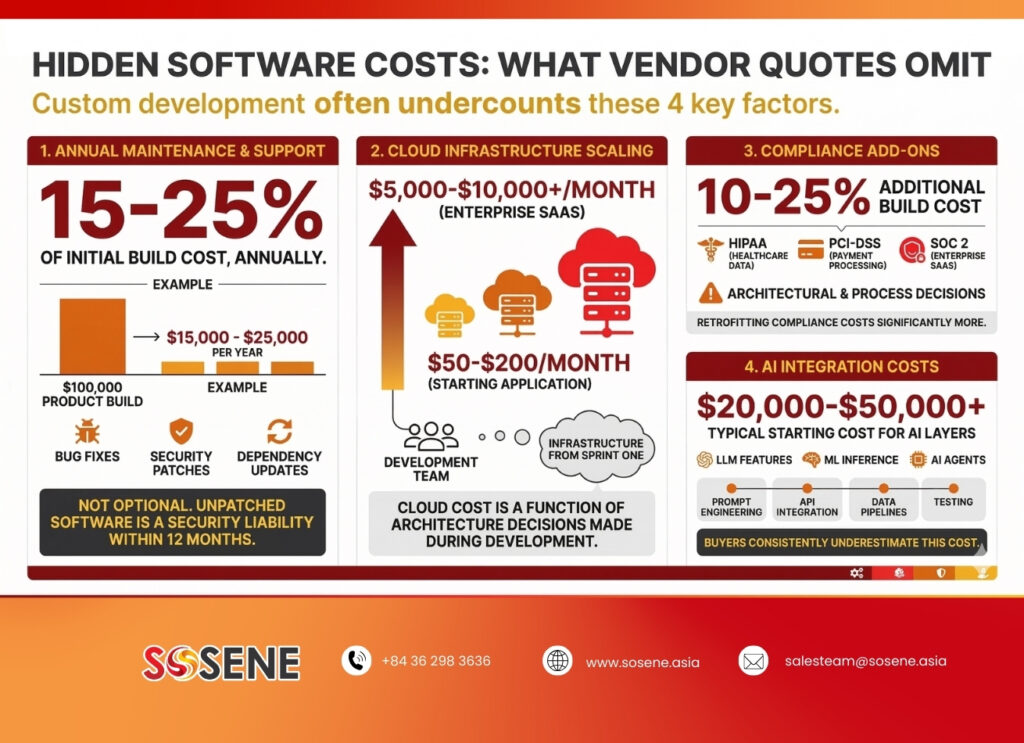
Maintenance and support runs 15–25% of the initial build cost annually. For a $100,000 product, budget $15,000–$25,000 per year for bug fixes, security patches, and dependency updates. This is not optional. Unpatched software is a security liability within 12 months on any modern stack.
Cloud infrastructure scales with usage. A small application on AWS or Azure starts at $50–$200/month. An enterprise SaaS platform handling significant transaction volume can reach $5,000–$10,000/month or higher. Cloud cost is a function of architecture decisions made during development — if your development team is not thinking about infrastructure from sprint one, you will inherit an expensive design.
Compliance requirements add 10–25% to build cost when present. HIPAA for healthcare data, PCI-DSS for payment processing, and SOC 2 for enterprise SaaS all require specific architectural and process decisions during development. Retrofitting compliance post-launch costs significantly more than building it in from the start.
AI integration has become a standard line item. Adding machine learning inference, LLM-based features, or an AI agent layer to a product typically adds $20,000–$50,000+ depending on complexity. This includes prompt engineering, API integration (OpenAI, Gemini, Anthropic), data pipeline setup, and testing. Buyers who treat AI as a “quick add-on” consistently underestimate this cost.
“On most medium-scale builds, the post-launch year costs clients 20–30% of the original build budget when maintenance, cloud, and incremental feature work are totalled. We build that into the initial roadmap so it is not a surprise at month thirteen.”
Sosene Team
What pricing model should you use for your project
The right pricing model for your build depends on how clearly defined your requirements are before you sign.
Fixed-price works when the scope is locked: feature list, acceptance criteria, and timeline are agreed before work starts. It gives you budget certainty but limits flexibility. Any scope change triggers a change order. This model suits well-defined internal tools, MVPs with a clear feature set, and phase-one builds where the goal is to validate a specific assumption.
Time and materials (T&M) is appropriate when the scope will evolve. You pay for actual hours worked and resources used, with agreed hourly rates per role. This model suits product companies building iteratively, or enterprise clients whose requirements surface progressively across discovery. The tradeoff: cost is less predictable upfront, but you are not locked into a scope that no longer reflects reality by month three.
Dedicated team means a fixed group of developers, a QA engineer, and typically a project manager, assigned exclusively to your project at a monthly rate. This model suits multi-month or multi-year builds where ongoing development, support, and feature velocity matter more than per-deliverable billing. It is the default model for SaaS companies and enterprises running continuous product development.
The mistake most first-time buyers make is choosing fixed-price for a project with unclear scope, then watching it collapse into change orders. The better question before selecting a model is: how much do you actually know about what you are building?
What do I need to know to estimate my custom software development cost accurately?
Accurate budgeting for custom software development requires clarity on four variables before you speak to a single vendor.
First, define your project scope at the feature level, not the concept level. “A platform for managing field technicians” is a concept. A list of 15 specific features with user roles, integrations, and data flows is a scope. Vendors can only give you a reliable number when they can see the latter.
Second, identify your compliance requirements upfront. If your product will handle health records, financial transactions, or personal data at scale, the regulatory layer is a cost driver that must be factored from the start. Discovering HIPAA or PCI-DSS requirements after the architecture is set will cost more to address than if they were specified in the brief.
Third, account for the full delivery team, not just developers. A project that quotes for “five developers” but omits a QA engineer, a designer, and a project manager is quoting for part of a delivery team. The rest of those roles will appear somewhere in the final bill.
Fourth, budget a contingency of 10–15% of total project cost. Discovery reveals complexity. Integrations are harder than documented. Third-party APIs change. Ten percent contingency is not pessimism — it is accurate planning based on how software projects actually run.
Buyers who work through these four points before vendor conversations find that quotes cluster more tightly and scope disputes become rare. The preparation shifts the negotiation from “what does this cost?” to “are we aligned on what we’re building?”
How Sosene approaches custom software development

Sosene’s software development engagements start with a scoping phase before a single line of code is written. For most new clients, this means a structured discovery process that produces a feature specification, a delivery timeline, and a budget breakdown across build, QA, and deployment. That document becomes the foundation for the contract.
The practical effect is that clients know exactly what they are getting before they commit. Scope surprises mid-project are the primary reason offshore engagements fail — not technical ability.
For clients who need AI integration in their product, we treat it as a first-class engineering workstream, not an afterthought. LLM integration, automation workflows, and AI agent development are handled by engineers who specialize in those layers, not general developers adapting as they go.
If you are scoping a custom software project and want a clear-eyed view of what it will cost given your requirements, the software development page outlines how we structure engagements and what information we need to give you an accurate number.
Conclusion
The most important decision you face before budgeting a custom software project is not which vendor to choose. It is whether your scope is defined clearly enough to get a quote that means anything.
Custom software development cost in 2026 ranges from $10,000 for a simple MVP to well over $1,000,000 for enterprise-grade systems but the figure that matters is the one that reflects your actual requirements, your compliance obligations, your ongoing infrastructure needs, and the full delivery team structure. Headline quotes that omit those variables are not useful for planning.
Start with scope clarity. Then evaluate vendors on their ability to hold that scope and deliver against it. If you want to see how Sosene structures a scoping process for your type of project, contact us!
FAQs
How much does custom software development cost in 2026?
Custom software development cost in 2026 ranges from approximately $10,000 for a small MVP to over $1,000,000 for a large enterprise system. The actual number depends on project complexity, team size, build duration, and developer location. A medium-complexity SaaS platform or CRM typically sits between $50,000 and $250,000 when all phases are included.
What is included in a custom software development cost estimate?
A complete estimate covers five phases: core development (40–60% of budget), QA and testing (15–25%), UI/UX design (10–15%), project management (10–15%), and deployment and DevOps (5–10%). Estimates that omit QA or DevOps are incomplete and will produce surprises after launch.
Why is Vietnam a cost-effective option for custom software development?
Vietnam-based developers charge $20–$50 per hour, compared to $80–$220 in North America, because of a large and growing engineering graduate output (over 50,000 per year) and lower operating costs. For multi-month builds, the savings on labor are substantial without a proportional difference in output quality on well-structured projects.
What hidden costs should I budget for beyond the initial build?
The most commonly underbudgeted items are annual maintenance and support (15–25% of the initial build cost per year), cloud infrastructure ($50/month to $10,000+/month depending on scale), compliance requirements such as HIPAA or PCI-DSS (10–25% additional development cost), and AI integration ($20,000–$50,000+ for LLM or machine learning features).
Which pricing model is right for my custom software project?
Fixed-price works when requirements are fully defined before work starts. Time and materials suits projects where scope will evolve iteratively. A dedicated team model is best for multi-month or ongoing builds where you need sustained engineering velocity. The right model depends on how clearly you can specify what you need before the first sprint begins.