Introduction
Education institutions and EdTech companies in Southeast Asia (SEA) are undergoing rapid digital transformation, from implementing e-learning platforms to harnessing AI-driven learning tools. The regional EdTech market is booming – valued at $10.7 billion in 2024 and expected to reach $41.5 billion by 2033 (at a 14.7% CAGR) (Imarcgroup Report). However, this growth comes with a pressing challenge: finding the right IT talent to execute these ambitious projects. Globally, organizations face an acute tech skills shortage – in fact, Gartner research shows that lack of IT talent is now the biggest barrier to adopting 64% of new technologies.
This talent crunch is prompting project managers, HR leaders, and executives to seek creative staffing solutions to keep education projects on track. IT staff augmentation has emerged as a strategic answer. It’s a flexible hiring model where you embed external IT professionals into your team on-demand to fill skill gaps, without the long-term commitments of traditional hiring. This approach is gaining traction worldwide – the IT staff augmentation market was worth ~$299 billion in 2023 and is projected to nearly triple to $857 billion by 2031. (VMResearch)
For education projects in SEA, staff augmentation offers a way to quickly acquire specialized tech talent (from LMS developers to AI experts) while remaining cost-effective and agile. In the following sections, we’ll explore key takeaways, benefits, and best practices of IT staff augmentation in the context of SEA’s education sector, and how partnering with the right provider can ensure project success.
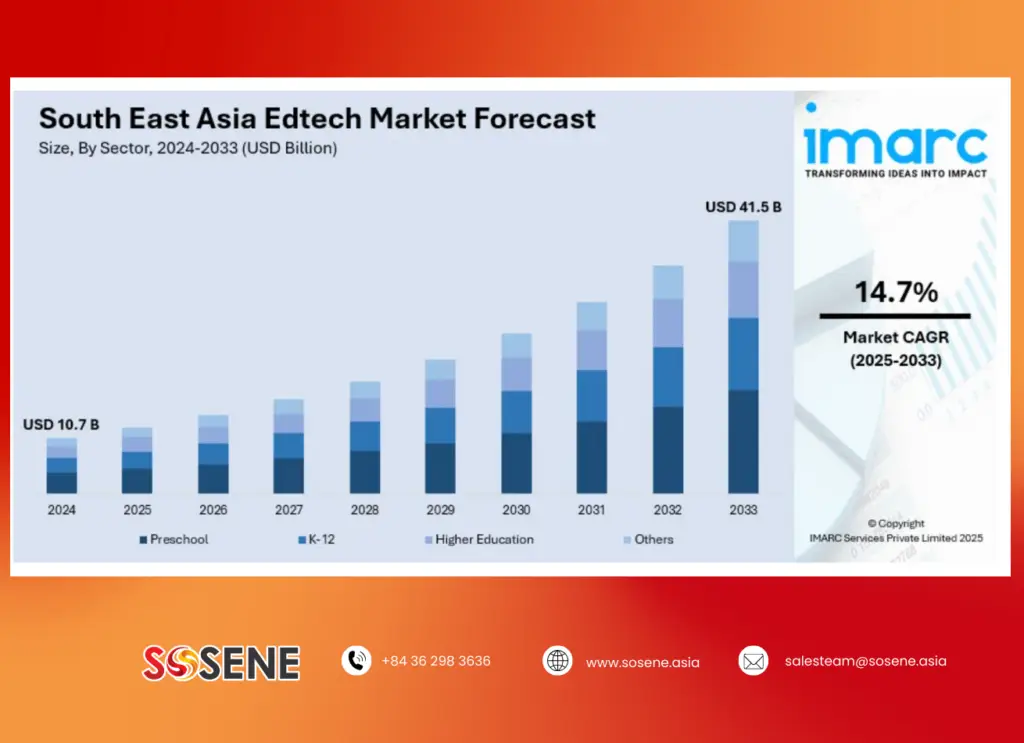
Table of Contents
Key Takeaways
Digital Education Boom & Talent Gaps: Southeast Asia’s education sector is rapidly digitizing, fueling demand for IT talent that often exceeds local supply. The EdTech market’s meteoric growth underscores the need for external expertise to deliver cutting-edge projects.
Staff Augmentation Fills Critical Skill Gaps: IT staff augmentation enables education projects to tap into specialized skills on demand, from AI and data analytics to cloud and mobile development. This model directly addresses talent shortages – Gartner notes skill scarcity is hindering adoption of new tech in the majority of organizations.
Cost-Effective & Scalable Resourcing: By leveraging talent in SEA, organizations can significantly reduce development costs (often by 50–70% vs. Western markets) without compromising quality. Augmentation is highly scalable – you can ramp teams up or down as project needs evolve, ensuring budget control and efficiency.
Faster Time-to-Market & Continuity: Augmentation accelerates project timelines by cutting lengthy recruitment cycles. (Hiring a software engineer can take over a month or more.) With ready-to-deploy experts, education projects can launch faster and avoid overburdening internal staff. It also provides business continuity – if an internal member leaves, augmented staff ensure work doesn’t stall.
Choosing the Right Partner is Key: Success hinges on partnering with an experienced, trusted provider. Look for vendors with industry expertise in education, a proven track record, and robust processes (from talent vetting to data security). In Vietnam and across SEA, firms like Sosene act as reliable partners, offering cost-effective, innovative solutions with the scalability to meet your needs.
Further Reading
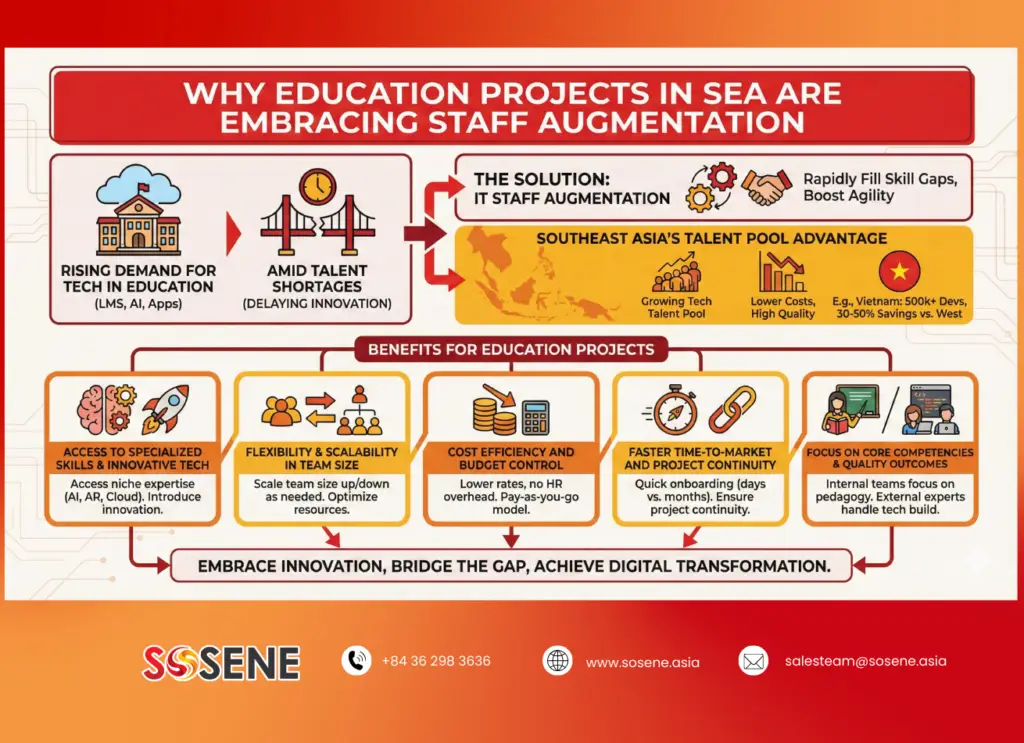
Why Education Projects in SEA Are Embracing Staff Augmentation
Rising Demand for Tech in Education, Amid Talent Shortages
Across SEA, educational institutions, EdTech startups, and corporate training programs are launching technology-driven initiatives – whether it’s a university deploying a new student information system or a startup building an online learning app. These projects require niche IT skills (e.g. cloud architecture for an LMS, AI for adaptive learning, mobile app development for e-learning) that are not always available in-house. Compounding this, the global tech talent crunch affects SEA as well. A recent Gartner survey revealed that IT talent scarcity is a top blocker for nearly two-thirds of emerging technologies’ adoption. In other words, many great digital education ideas risk delay not due to lack of vision or funding, but lack of skilled people.
IT staff augmentation directly tackles this issue by giving organizations a way to rapidly fill skill gaps. Instead of spending months recruiting (the median time to hire a software engineer is ~41 days, with some positions taking up to 82 days), you can onboard qualified developers or engineers in a matter of days through a staff augmentation partner. This agility is crucial in education projects where timing (e.g. launching a platform before a new semester) is critical. As one industry analysis notes, flexibility and speed are major reasons companies choose staff augmentation – it lets them meet project deadlines without the usual hiring bottlenecks. For education leaders under pressure to modernize, this approach provides a lifeline to keep innovation moving forward despite talent gaps.
Southeast Asia’s Talent Pool Advantage
SEA offers a particularly compelling case for IT staff augmentation due to its growing tech talent pool and cost advantages. Countries like Vietnam, Indonesia, and the Philippines have rapidly expanding IT workforces. Vietnam, for example, now boasts one of the largest developer talent pools in the region – over 500,000 software developers, aided by strong STEM education and English proficiency. Local IT salaries are markedly lower than Western levels, meaning outsourcing or augmenting through Vietnam-based teams can cut development costs by 50–70% compared to hiring in the US. This cost-effectiveness is a huge draw for education projects which often have tight budgets (public institutions and startups alike aim to maximize value).
Moreover, working with a SEA augmentation partner can align well with regional project needs. Proximity and time zone overlap within Asia can facilitate real-time collaboration for organizations based in APAC. Even for Western organizations, Vietnam and other SEA countries are attractive for their combination of skilled labor, political stability, and improving infrastructure, consistently ranking high on global outsourcing indices. In practice, this means a university in Singapore or an EdTech firm in Australia can extend their team with Vietnamese software engineers who integrate seamlessly and communicate effectively. The result is a best-of-both-worlds scenario – access to world-class technical expertise at a fraction of the usual cost, and with the cultural/linguistic compatibility needed for smooth teamwork.
Benefits of IT Staff Augmentation for Education Projects
1. Access to Specialized Skills & Innovative Technologies
Education projects today might require anything from AI developers for intelligent tutoring systems to cybersecurity experts for protecting student data. Through staff augmentation, you gain on-demand access to specialists in whatever field you need, without permanently hiring them. This is especially valuable for short-term needs or emerging tech skills. For instance, if you’re developing an augmented reality learning app, an augmentation partner can provide experienced AR/VR developers for the project’s duration. You’re effectively tapping a global talent pool to bring cutting-edge technology into your project. As one report notes, companies use staff augmentation to quickly onboard experts with the latest skills, ensuring they have the right talent for each project without long-term payroll burden. For education leaders striving to incorporate modern EdTech (AI, analytics, mobile, etc.), this model enables innovation by bridging the skills gap.
Furthermore, augmented IT staff often bring fresh perspectives and best practices from having worked on varied projects. They can introduce new ideas – say, a developer experienced with adaptive learning algorithms might suggest features to personalize an e-learning platform. This cross-pollination of expertise helps drive innovation in your project, positioning your institution or product as a thought leader in educational technology.
2. Flexibility and Scalability in Team Size
One key advantage of staff augmentation is the flexibility to scale your team up or down quickly. Education projects can have fluctuating workloads – imagine a college rolling out a new Learning Management System that requires extra developers during implementation, but far fewer once it’s in maintenance. With staff augmentation, you can add personnel when demand spikes and release them when work tapers off, without the complications of hiring or layoffs. This scalability ensures you always have the right-sized team for the project’s phase. In fact, flexibility and scalability are often cited as the top reasons to use IT staff augmentation.
For project managers, this means improved agility and cost control. If a new grant lets you expand an e-learning initiative, you can quickly augment your team to accelerate development. Conversely, after meeting a major deadline or deliverable, you can scale back to reduce costs. Traditional hiring can’t easily match this fluidity. By aligning resources to actual needs, you optimize productivity and budget use. Not only does this prevent burnout of internal staff (who aren’t stretched too thin), it also avoids paying for idle full-time employees when project activity is low. In short, staff augmentation provides elastic resourcing – an invaluable asset for dynamic project environments.
3. Cost Efficiency and Budget Control
Cost-effectiveness is a major benefit of IT staff augmentation, particularly important in the education sector where ROI is closely watched. With augmentation, you save on recruitment expenses, salaries, benefits, and training that come with full-time hires. Instead, you typically pay an all-inclusive hourly or monthly rate for the contracted talent. These rates are often very attractive when using offshore/nearshore talent. Most IT staff augmentation engagements fall in the range of $25–$49 per hour for high-quality engineers (Clutch), far less than equivalent local hires in North America or Europe. Clutch industry data also shows that many augmentation projects end up costing between $50k–$200k in total, but can be lower or higher depending on scope – a level that is often more palatable than funding a whole new internal department.
For SEA-based projects, leveraging regional talent amplifies savings. As mentioned, companies outsourcing to Vietnam have reduced development costs by 30–50% compared to Western markets while maintaining high quality. Those savings can be redirected to other strategic needs – for example, investing in better hardware for a computer lab or funding additional content development. Also, augmentation’s pay-as-you-go model means you only pay for what you use. If a project is delayed or scaled down, you’re not stuck with sunk HR costs – you can adjust contracts accordingly. This level of budget control and predictability is a CFO’s dream. It’s no surprise Deloitte’s Global Outsourcing Survey found that 78% of companies outsource (or augment) specifically to drive cost efficiency and innovation. Education leaders can similarly use staff augmentation services to do more with limited budgets, achieving digital transformation goals cost-effectively.
4. Faster Time-to-Market and Project Continuity
In the fast-evolving landscape of EdTech, speed matters. Whether it’s launching a new mobile learning app before competitors or rapidly implementing remote teaching tools due to an unexpected campus shutdown, time-to-market can be critical. IT staff augmentation helps accelerate project timelines by cutting down hiring lead times and providing ready-to-work talent. Instead of waiting months to fill a role, augmentation partners often can present candidates within days or weeks. This swift onboarding means development or implementation work proceeds without delay. Many organizations have recognized this benefit: by hiring an IT staff augmentation partner, companies reduce onboarding time and keep projects on schedule while easing overhead burdens. For an education project, this could be the difference between deploying a new student portal over the summer break versus missing that window and disrupting the academic calendar.
Additionally, staff augmentation contributes to operational continuity and risk mitigation. Projects don’t exist in a vacuum – people take leave, resign, or unforeseen issues arise. Augmented team members can backfill critical roles so that progress doesn’t stall when an internal employee is unavailable. For example, if your sole database administrator goes on maternity leave mid-project, an augmented DBA can step in to maintain momentum. Augmentation partners often guarantee resource replacement if someone leaves, ensuring you’re never left shorthanded. This continuity is crucial in education settings; you “can’t afford to slow down” on systems that support students and faculty. By sharing the load with external experts, your internal team can focus on their core duties without burning out, and the project stays on track even during staff transitions or peak workloads. In essence, staff augmentation de-risks your project timeline – a reassuring factor for any project manager or executive sponsor.
5. Focus on Core Competencies and Quality Outcomes
By augmenting IT staff, education organizations allow their internal teams to focus on what they do best. Teachers, curriculum designers, and academic administrators can concentrate on pedagogy and strategy, rather than being stretched thin trying to also manage technical development. Your existing IT department, too, can focus on core operations (network uptime, user support, etc.) while augmented developers handle the new software build or integration. This clear division of labor often leads to better quality outcomes. Each aspect of the project is handled by specialists fully devoted to that task – internal staff provide the educational context and requirements, and augmented IT experts deliver the technical solution. The collaboration can produce superior results, e.g. a learning platform that is both pedagogically effective (thanks to internal input) and technically robust (thanks to external engineering talent).
Moreover, reputable IT augmentation providers bring strong project management and best practices that can elevate your project’s quality. They are accustomed to working in diverse teams and can introduce methodologies (Agile/Scrum, QA processes, DevOps automation) to ensure efficient development and thorough testing. Many clients of staff augmentation firms praise the seamless integration and professionalism of augmented developers, noting their ability to align with the company’s processes and deliver on goals. For an education project, having such committed external team members means your end product – be it a campus app or an online course platform – is built to high standards. And because you retain oversight (unlike outsourcing entirely), your organization’s vision and quality expectations remain central. In short, staff augmentation lets you focus on your mission while leveraging technical experts, resulting in a high-quality solution that meets both educational and technical benchmarks.
Choosing the Right IT Staff Augmentation Partner in SEA
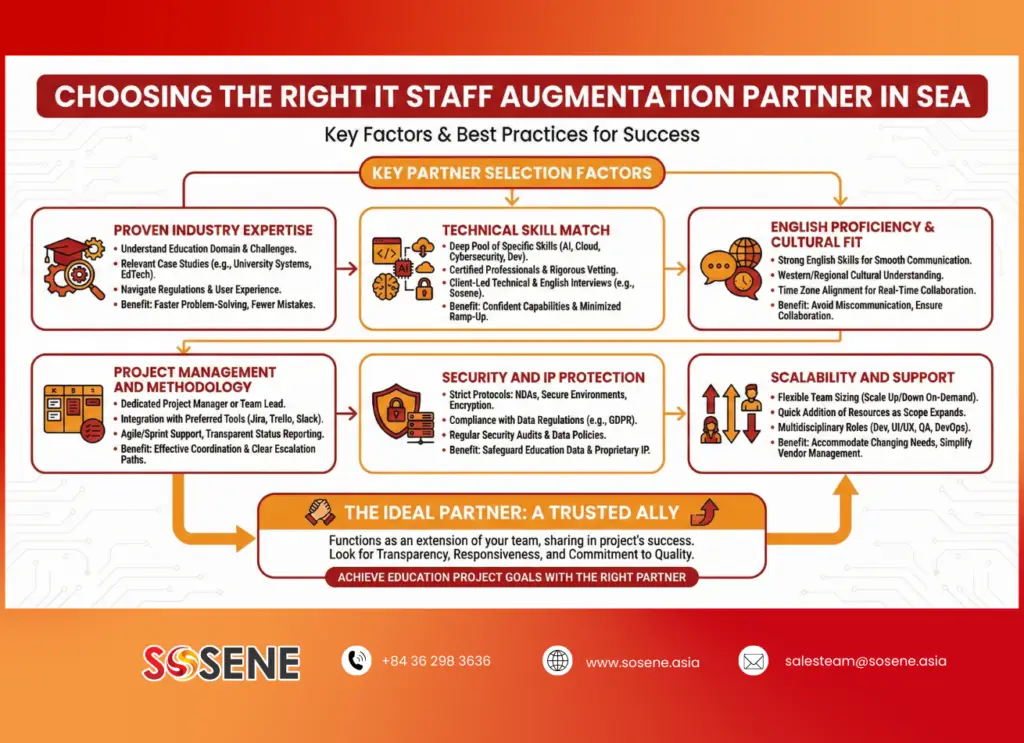
While IT staff augmentation offers many benefits, realizing them fully depends on selecting the right partner. Here are key factors and best practices for choosing an augmentation provider, especially in the context of SEA:
- Proven Industry Expertise: Look for vendors who understand the education domain and have relevant case studies. An industry-savvy partner can anticipate sector-specific challenges and align solutions to your objectives. For example, a firm that has supported university system implementations or EdTech product development will know how to navigate educational regulations, user experience for students/teachers, and integration with legacy campus systems. Their prior experience means faster problem-solving and fewer rookie mistakes on your project.
- Technical Skill Match: Ensure the provider has a deep pool of the specific skills you need – whether it’s frontend web developers, AI/machine learning engineers, cloud architects, or cybersecurity experts. Vet their talent pipeline: Do they have certified professionals? How do they conduct technical screenings? A strong partner will allow you to interview and approve each augmented team member, so you can be confident in their capabilities (Sosene, for instance, lets clients conduct technical and English fluency interviews to choose the right fit). The team should also be familiar with the tech stack you use to minimize ramp-up time.
- English Proficiency & Cultural Fit: Communication is vital when integrating external staff. Most leading firms in Vietnam and SEA have engineers with good English skills and experience working with Western or regional clients. This is important for avoiding miscommunication and ensuring smooth collaboration day-to-day. Consider time zone alignment as well – working with a team in a nearby time zone (or one willing to adjust hours) can facilitate real-time meetings. Many SEA providers highlight their Western cultural understanding and 24/7 availability to bridge any gaps. Don’t hesitate to ask for references or speak with past clients about the partner’s communication effectiveness.
- Project Management and Methodology: Evaluate how the augmentation partner handles project coordination. Will you get a dedicated project manager or team lead on their side? What tools do they use for tracking progress (e.g. Jira, Trello) and for communication (Slack, Teams)? Effective project management processes are key to a successful partnership. The provider should be able to integrate with your preferred workflow (Agile sprints, etc.) and keep transparency on tasks and issues. Clear escalation paths and status reporting will help you stay in control of the project.
- Security and IP Protection: When working with overseas teams on potentially sensitive education data or proprietary IP, confidentiality is paramount. Reputable augmentation partners follow strict security protocols – including NDAs with their staff, secure development environments, and compliance with data protection regulations. Standard practice now is to include NDAs, encryption standards, and regular security audits in contracts to safeguard data integrity. During due diligence, ask about the firm’s data protection policies and past track record (for example, compliance with GDPR or local privacy laws if student data is involved). A trustworthy partner will proactively address these concerns and ensure your intellectual property and information are safe.
- Scalability and Support: One reason you’re augmenting is scalability, so probe how the vendor can scale teams up or down on demand. How quickly can they add more developers if your project scope expands? Conversely, what’s the minimum commitment if you need to reduce team size? Flexible partners will accommodate changing needs with minimal hassle. Additionally, consider the breadth of support – can they provide multidisciplinary roles (developers, UI/UX designers, QA testers, DevOps engineers) if your project requires it? A one-stop partner that covers a range of IT services can simplify your vendor management. Finally, review the contract terms for exit options or conversion to full-time if you decide to hire an augmented staff permanently.
By taking these factors into account, you can select a partner that not only fills seats, but truly adds value as a trusted ally. The ideal augmentation provider will function as an extension of your team, sharing in your project’s success. In Vietnam, for instance, Sosene has built a reputation as a reliable partner for overseas clients by ensuring business continuity, fostering innovation, and delivering cost-effective results. Whichever partner you choose, ensure they demonstrate transparency, responsiveness, and a commitment to quality – those traits will make all the difference in achieving your education project’s goals.
Conclusion

IT staff augmentation for education is becoming a strategic advantage for organizations operating in Southeast Asia. It helps project managers and executives overcome talent shortages and budget constraints by providing flexible access to specialized IT skills exactly when needed. In a fast-growing EdTech landscape, this model enables institutions to accelerate digital transformation, deploy innovative learning platforms, and scale technology initiatives without overloading internal teams.
Success depends on choosing the right IT staff augmentation partner. Providers with education domain expertise, regional understanding, and scalable delivery models act as true collaborators rather than short-term vendors. When implemented effectively, IT staff augmentation services extend internal capabilities, improve delivery speed, and ensure long-term business continuity.
Partner with Sosene – A Trusted Partner for IT Staff Augmentation Services
Ready to strengthen your education technology initiatives? Sosene is a trusted Vietnam-based partner delivering cost-effective, scalable IT staff augmentation services. With innovative technology and deep industry expertise, Sosene helps education organizations build resilient teams and deliver impactful digital solutions. Contact Sosene to support your next education project.
FAQs
What is IT staff augmentation, and how is it different from traditional outsourcing?
IT staff augmentation allows you to add external IT professionals to your internal team on a temporary basis, working under your direct management. Unlike traditional outsourcing, where a vendor delivers an entire project independently, staff augmentation gives you full control over execution, priorities, and intellectual property while remaining flexible and scalable.
Why should education projects consider IT staff augmentation?
Education and EdTech projects often require specialized skills for limited timeframes, such as AI, mobile apps, or LMS development. Staff augmentation enables faster access to these skills without long-term hiring, helping institutions deliver projects on time while avoiding internal team overload.
Is IT staff augmentation cost-effective for educational organizations?
Yes. Staff augmentation reduces recruitment, onboarding, and long-term employment costs by allowing organizations to pay only for the talent they need. Leveraging SEA talent, especially in Vietnam, can significantly lower costs while maintaining high technical quality and ROI.
How do we manage and integrate augmented IT staff, especially remotely?
Augmented staff are onboarded like internal team members and managed using standard collaboration tools such as Jira, Slack, or Microsoft Teams. Clear workflows, regular check-ins, and time-zone overlap ensure smooth collaboration, even with fully remote teams.
How can we protect data and intellectual property when using staff augmentation services?
Data and IP protection are ensured through NDAs, clear ownership clauses in contracts, controlled system access, and secure development environments. Reputable providers also comply with data protection regulations and follow industry-standard security practices.