Artificial Intelligence has become a core driver of business competitiveness. It enables faster decision-making, automation at scale, and predictive insight that transforms data into strategy. For enterprise leaders, AI is not a trend—it is an operational necessity.
The question is no longer whether to integrate AI, but how to integrate it effectively into existing software systems without disrupting ongoing operations.
At Sosene, we help organizations adopt AI in a way that fits naturally into their current infrastructure. Our approach focuses on business alignment, data integrity, and measurable performance improvement ensuring AI becomes a growth multiplier, not an operational burden.
Table of Contents
Key Takeaways
- AI integration is now a business necessity for scale, speed, and efficiency.
- Success depends on clean data, API-first design, and strong governance.
- Start small, prove ROI, and expand through measurable outcomes.
- Choose an experienced AI partner with proven industry expertise.
- Sosene delivers end-to-end AI integration—from strategy to execution.
Further Reading
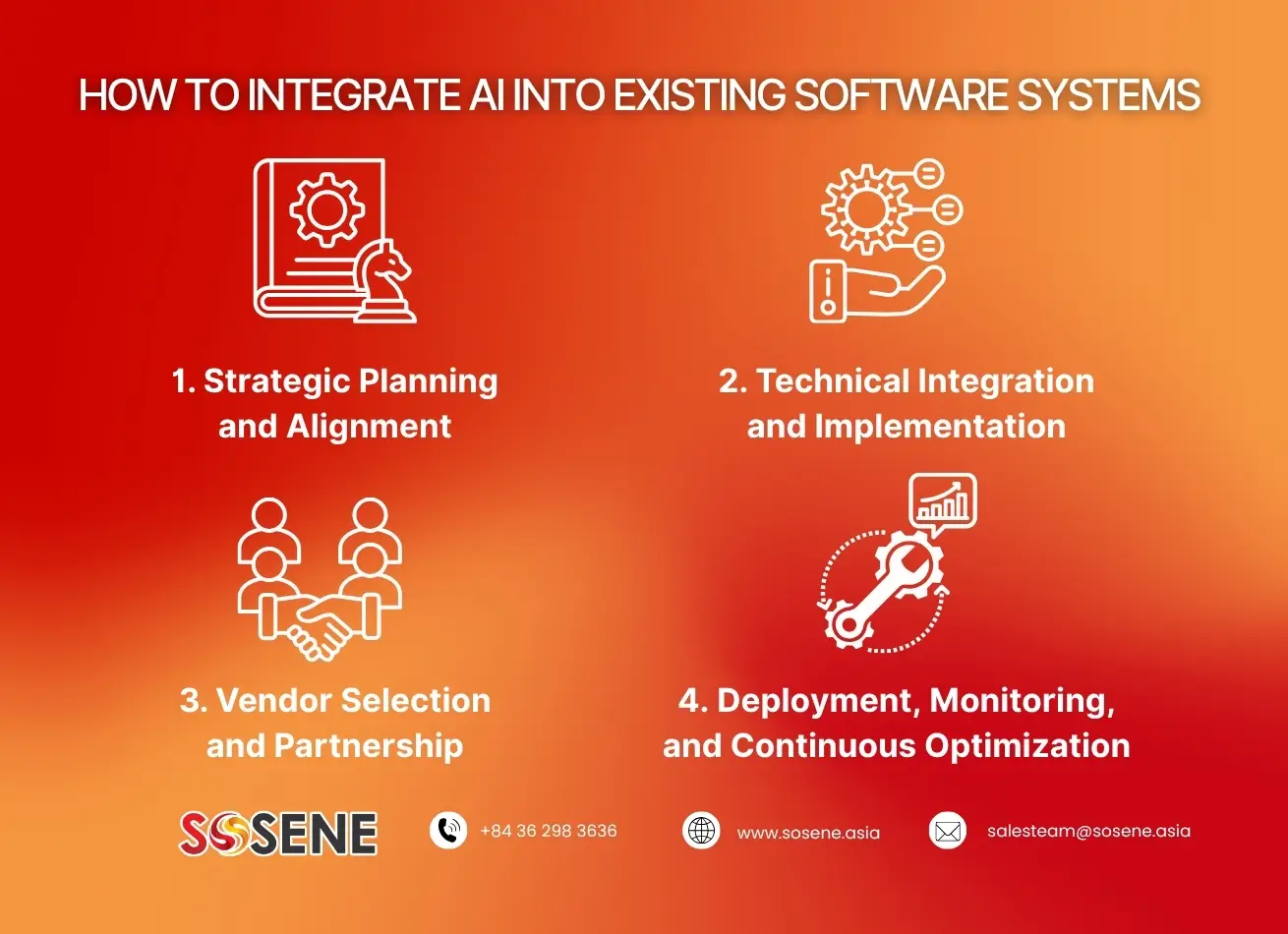
Phase 1: Strategic Planning and Alignment
The success of AI integration begins with clarity of purpose. Before selecting tools or models, business leaders must define why AI is being introduced and what impact it should deliver.

Identify High-Impact Use Cases
Start with business pain points where AI can create quantifiable value:
- Process automation and cost optimization.
- Predictive analytics for demand, inventory, or risk management.
- Enhanced customer experience through personalization or chat-based AI assistants.
Each use case should have clear KPIs for example, time saved, cost reduced, or customer retention improved.
Assess Organizational Readiness
AI requires more than technology; it requires culture.
Evaluate your current IT architecture, data maturity, and decision-making processes. Identify internal champions who can bridge technical and business teams to drive adoption.
Define the Scope and Budget
Commit to a start small, scale fast philosophy.
Define measurable milestones, realistic budgets, and governance processes that allow experimentation without operational disruption.
Tip: Projects that begin as focused pilots, then scale, achieve higher ROI than large, untested transformations.
Phase 2: Technical Integration and Implementation
This phase defines how to integrate AI within your existing systems—without rebuilding from scratch.

Data Is the Fuel
Data is the foundation of every successful AI system.
Before any model deployment, ensure you have clean, accessible, and well-structured data. Implement strong data governance policies to maintain quality and security.
Sosene helps clients assess data readiness and design strategies to consolidate scattered data silos into unified, AI-ready environments.
Adopt an API-First Architecture
An API-first approach allows AI models to be integrated as modular, external components connecting seamlessly to legacy systems without heavy reengineering.
This method provides flexibility, scalability, and long-term resilience.
It also minimizes risk by isolating AI components from mission-critical systems, ensuring continuous operations during deployment.
Leverage Cloud Platforms for AI Integration
Cloud-based AI services accelerate development and reduce infrastructure costs.
Platforms such as AWS AI, Azure Cognitive Services, and Google Vertex AI provide scalable environments for rapid model deployment.
Sosene leverages secure, multi-cloud architectures to balance performance, compliance, and cost efficiency across regions.
Phase 3: Vendor Selection and Partnership
Choosing the right partner determines whether your AI initiative scales or stalls.
C-level leaders should treat AI integration as a strategic alliance, not a transaction.

Define Partnership Criteria
Select a partner with industry-specific expertise, not just technical proficiency. The right AI integrator should understand your sector’s data, compliance, and customer landscape.
Evaluate Expertise and Track Record
Ask for case studies and client references relevant to your industry. A proven AI integration provider will demonstrate how they helped similar companies modernize operations while preserving business continuity.
Scrutinize Security and Data Ethics
AI runs on data, which makes trust non-negotiable. Ensure your partner maintains certifications such as ISO 27001 and GDPR compliance. Clarify data ownership rights and confirm transparent usage policies.
Assess Scalability and Long-Term Support
Integration is only the beginning. The ideal partner offers post-deployment support, performance tuning, and model retraining services to keep your systems adaptive.
Conduct a Proof of Concept (POC)
Every major AI initiative should begin with a pilot using your own data. A successful POC validates ROI assumptions, confirms technical feasibility, and builds stakeholder confidence before large-scale rollout.
Phase 4: Deployment, Monitoring, and Continuous Optimization
AI success depends on oversight, not just deployment. Sosene implements AI observability frameworks to monitor performance, accuracy, and bias in real time.
Our clients benefit from continuous model retraining, version control, and compliance tracking. We help you stay ahead of changing regulations and technological advances, ensuring long-term reliability and ethical operation.
Beyond technical support, Sosene helps build a culture of AI adoption across your organization—where teams view AI not as a replacement but as a partner that enhances human capability and decision-making.

Understanding the Cost of AI Integration
The cost to integrate AI depends on the project’s complexity, data maturity, and required customization. Most enterprise projects range between $15,000 and $150,000, covering data preparation, model training, integration, and continuous optimization.
Sosene uses a modular pricing model that allows businesses to scale intelligently. You can start with a single use case such as automating customer support or adding predictive analytics and expand as ROI becomes clear.
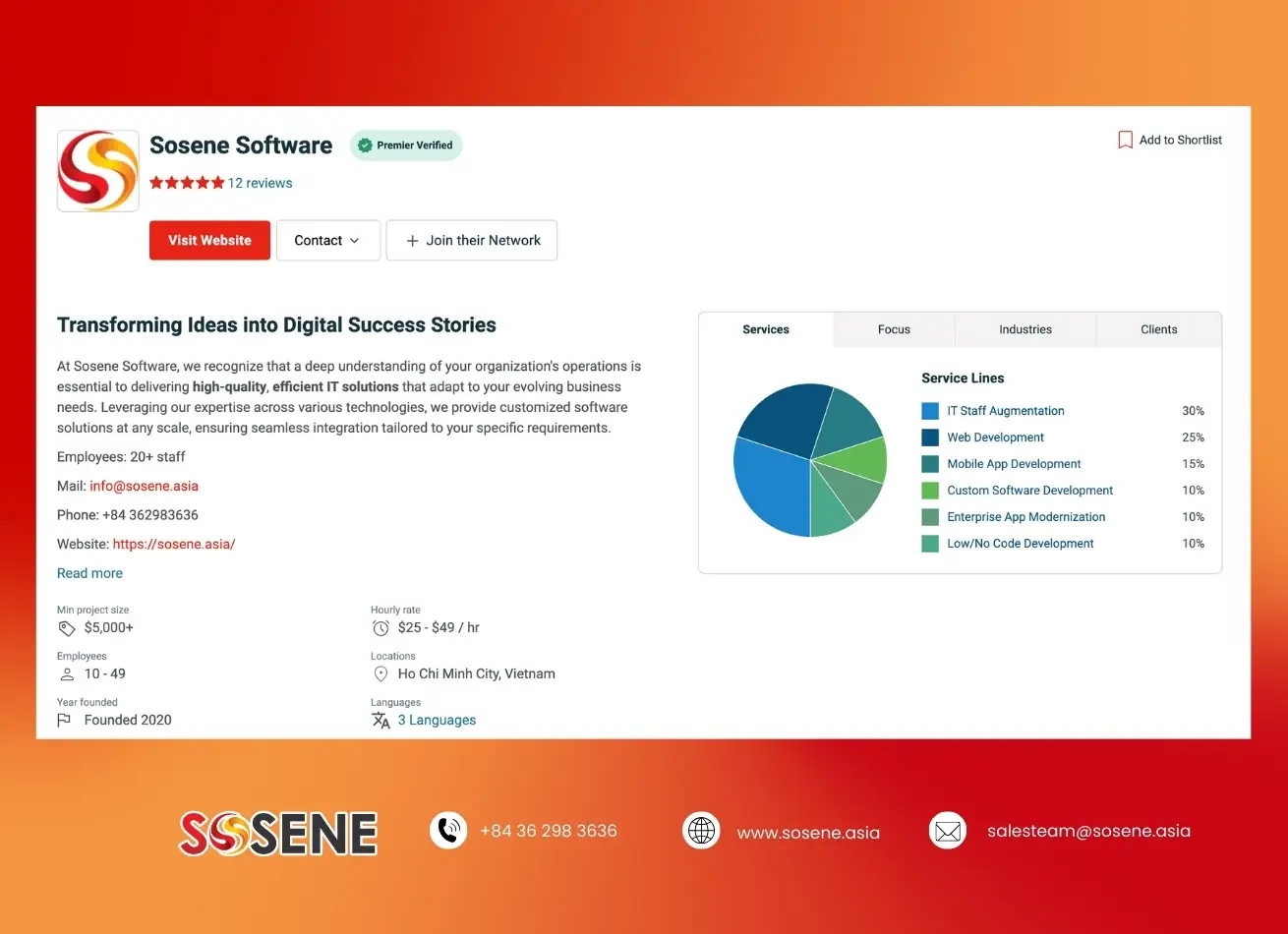
Partnering with Sosene: Regional Strength, Global Standards
Transform your business with tailored AI integration solutions. We help enhance productivity, boost customer engagement, and improve decision-making through smart, flexible technology.
Why Leaders Choose Sosene
-
Save money by accessing expert-level AI talent without hiring full-time staff
-
Streamline your processes, freeing up your team to focus on your main business goals.
-
Stay ahead with 24/7 monitoring and management of your digital systems, from infrastructure to servers.
-
Quickly adjust your AI setup as your business grows or shifts direction.
Unlock new potential by using Sosene’s smart AI and automation services. We connect your data, processes, and systems—removing manual steps and creating an intelligent, smooth workflow. Whether you’re improving customer service, optimizing operations, or scaling quickly, Sosene helps you build a future-ready business with less friction and more impact.
Conclusion
Integrating AI into existing systems is not a one-time upgrade it is an evolutionary shift toward intelligent operations. Enterprises that treat AI integration as a strategic capability will outpace competitors in innovation, agility, and decision-making.
At Sosene, we enable organizations to integrate AI seamlessly, securely, and at scale. Our methodology combines technical depth with business alignment, ensuring every project drives measurable ROI while preparing your systems for the next decade of digital transformation.
Partner with Sosene to integrate AI into your existing software systems with confidence. We help global enterprises deploy, manage, and scale AI capabilities that transform data into competitive advantage.
FAQs
What does it mean to integrate AI into existing software systems?
It means embedding AI models or services into current applications to enhance automation, decision-making, and customer experience without rebuilding core infrastructure.
How do I integrate AI into a website or web application?
Start with API-based AI services such as chatbots, recommendation engines, or predictive analytics that can connect to your website or web application through secure endpoints.
What are the benefits of AI integration?
AI improves efficiency, reduces manual errors, enables personalization, and generates actionable insights from data, helping businesses scale intelligently.
How much does it cost to integrate AI?
Costs vary by complexity but typically range between $15,000 and $150,000 depending on data readiness, system scope, and customization needs.
Why choose Sosene for AI integration?
Sosene delivers end-to-end expertise—from strategy and data readiness to deployment and governance—helping enterprises achieve real business outcomes through AI integration.